Electronic Arts sold for $55bn to Saudi-led group

Electronic Arts has been acquired for $55bn by a group of investors led by Saudi Arabia's Public Investment Fund, in a deal that takes the games giant private and saddles it with $20bn of borrowed money that the business will now need to repay.
The deal, which also includes Affinity Partners, the fund run by Jared Kushner, son-in-law of US President Donald Trump ranks as the largest leveraged buyout in history. EA, maker of EA FC, The Sims, and Mass Effect, will be removed from public stock exchanges entirely. The Public Investment Fund, or PIF, had already committed $36bn before turning to JPMorgan to bridge the remainder.
That debt structure has drawn the most scrutiny from industry observers. A leveraged buyout places repayment obligations directly on the acquired business, not the buyer. For EA, which generated $7.5bn in revenue last year, the question is whether the pressure to service $20bn in loans will reshape how it makes games.
Bloomberg analyst Jason Schreier suggested the consequences could include mass layoffs, a more aggressive approach to in-game monetisation, and broad cost-cutting across the business. EA employed thousands of staff across multiple studios before the deal closed and had already carried out layoffs in the months prior, including teams that worked on Battlefield 6, despite the game selling more than 7 million copies in its first three days after its October launch.
The PIF is a $514bn state-backed investment vehicle controlled by the Saudi government and Crown Prince Mohammed bin Salman. Its portfolio ranges from Premier League football club Newcastle United to four clubs in the Saudi Pro League. The EA deal adds a very different kind of asset: a games publisher with relationships spanning 20,000 professional footballers, 750 clubs, and 35 top leagues through EA FC alone.
George Osborn, journalist and author of Power Play: Video Games, Politics and the Battle for Global Influence, described EA's value to PIF as more than financial. He pointed to the long-term appeal of EA's live-service titles and their seemingly evergreen revenue, alongside the strategic benefit of owning a media asset with proven reach across billions of players globally.
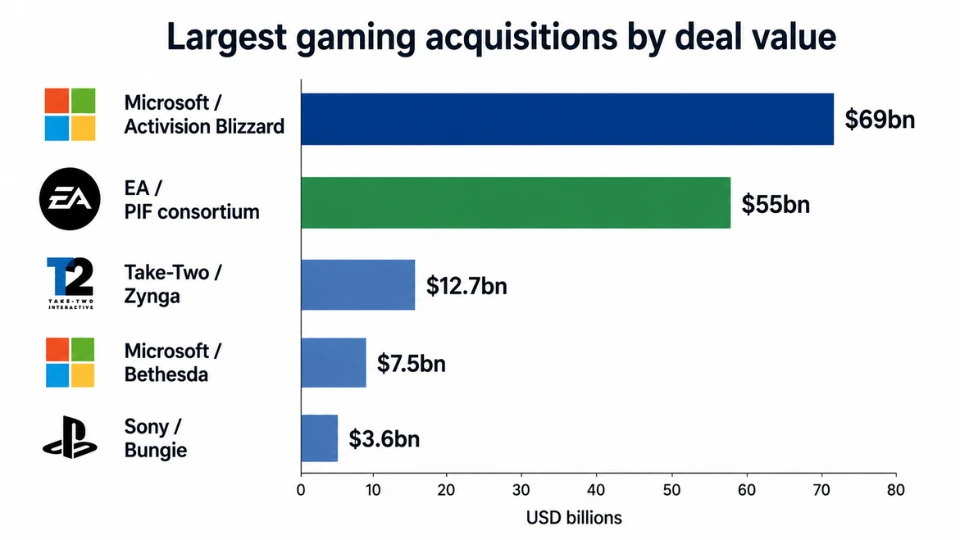
Saudi Arabia has invested heavily in sport and esports in recent years, hosting the Esports World Cup in 2025 and sponsoring a string of international events. Those investments have attracted accusations of sportswashing, using high-profile sponsorships to deflect attention from the country's human rights record. The EA deal extends that pattern into interactive entertainment, and on a scale that dwarfs previous gaming acquisitions. The second-largest deal in gaming history was Microsoft's $69bn purchase of Activision Blizzard, parent company of Call of Duty.
Shams Jorjani, chief executive of Arrowhead Game Studios — the independent developer behind Helldivers 2, told reporters he was concerned the new ownership would push EA toward safer commercial bets. "More sequels, more mega-franchises over breadth," he said, warning that a shift in that direction would represent a waste of "one of the best catalogues in the industry".
The cultural dimensions of the deal have generated significant protest. Several of EA's most prominent franchises, including The Sims, have built reputations on inclusive storytelling and LGBT+ representation. In Saudi Arabia, consensual same-sex conduct can be punishable by death or flogging under interpretations of Sharia law. The PIF is an instrument of the Saudi state.
The advocacy group Players Alliance HQ launched a campaign urging players to contact their elected representatives and speak out against the acquisition. Its campaign materials cited concern that themes including gender identity, free expression, and LGBT+ relationships could face censorship or removal across major franchises if PIF's ownership influenced creative decisions.
Christopher Dring, editor-in-chief of Game Business, said the structure of the buyout pointed toward hands-on management. Private equity-backed owners typically move quickly to cut costs and reshape operations. EA's chief executive Andrew Wilson, who will retain his position, described the deal at the time of its announcement in September 2025 as an opportunity to build "transformative experiences" language that has since been received with scepticism by developers and fans alike.
The acquisition now raises a tension that EA's new owners will face directly: the company's most beloved franchises derive their commercial value from the very audiences whose interests PIF's broader investment strategy has repeatedly put at odds. Players Alliance HQ and the studios within EA's portfolio are watching the same outcome, from opposite sides of it.
More AI & Tech News

.webp)

Subscribe to Stay in the loop
Get the latest AI and technology news, honest tool reviews, and practical guides delivered straight to your inbox.
Success! Check your Inbox!

Tezons Newsletter
The latest technology news, in-depth tool reviews, and practical guides - curated and delivered to your inbox.
Latest News
Have any questions?
Didn’t find what you were looking for? We’re just a message away.