EU forces Google and Apple to open AI on smartphones
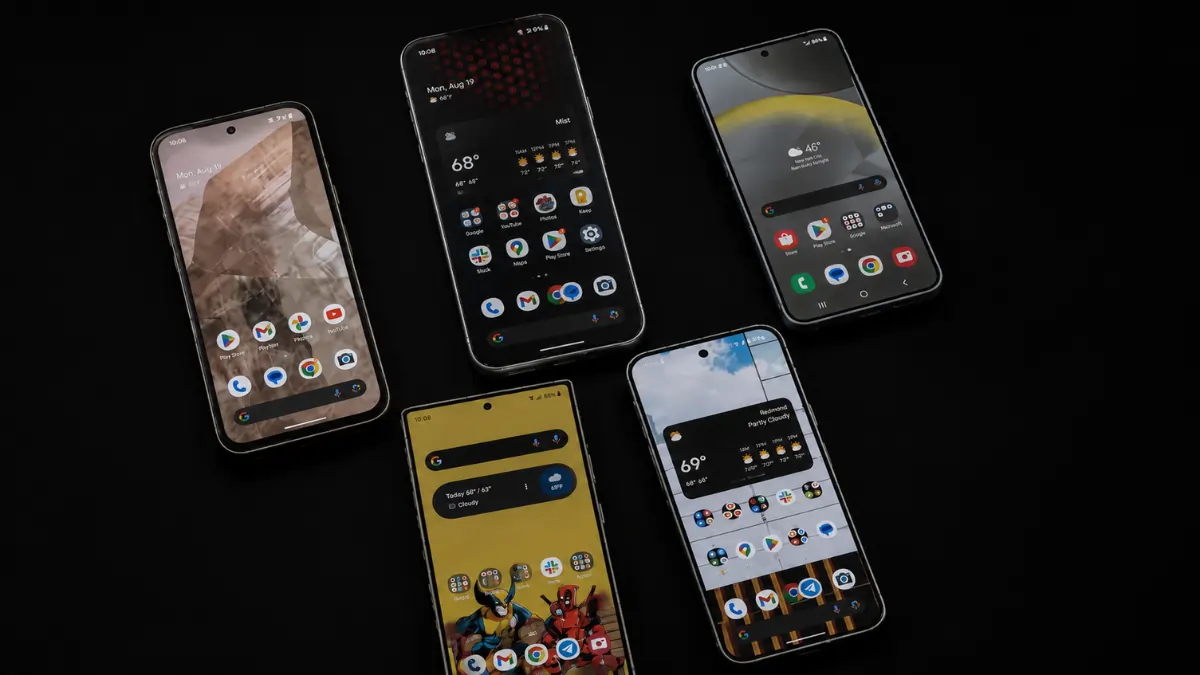

The European Commission has issued binding orders under the Digital Markets Act requiring Google to grant rival AI assistants full system-level access to Android by July 2027, while Apple has withheld its upgraded Siri entirely from EU iPhones, escalating a regulatory standoff over who controls AI on the world's smartphones.
The two decisions, adopted on 16 July 2026, target the structural advantage Google and Apple hold over AI assistant competition through their combined control of roughly 5 billion active smartphones worldwide. The orders are immediately enforceable and do not require further legislative steps from Brussels.
Google's binding decision, issued under Article 6(7) of the DMA, identifies four integration points that currently give Gemini capabilities no third-party assistant can match on Android. By July 2027, EU users must be able to wake a rival assistant by voice, have it operate apps on their behalf, and access the same contextual data hooks Gemini uses today. A separate order requires Google to begin sharing anonymised search data with competing search engines and AI chatbots by January 2027.
Tools such as ChatGPT, Claude, and Perplexity AI are among the services that could benefit from the ruling, with ChatGPT already installed on approximately 30% of EU smartphones according to analyst firm Omdia.
Google rejected the Commission's reasoning the same day the orders were published. Kent Walker, Google's president of global affairs, argued that granting external apps sensitive device-level permissions would create serious security risks. Sameer Samat, Google's Android president, added that the Commission was "on the wrong track" and pointed out that Android users already have the option to switch default assistants in their settings.
Critics of Google's position note that changing a default setting is not the same as receiving equal platform access. The current Android system gives Gemini capabilities that third-party assistants cannot replicate regardless of what a user sets as their default, including always-on voice activation from a locked screen and the ability to complete multi-step tasks across multiple apps.
Google is expected to appeal the ruling, though appealing does not suspend enforcement. The Commission has said it will allow technical safeguards, provided they are not used as a pretext to block competing services. Final certification terms are due by May 2027, at which point Google must begin accepting applications from rival assistants. Each application must be reviewed within four weeks of submission.
The ruling also creates an internal tension within EU regulation that neither Google nor the Commission has fully resolved: the DMA's interoperability mandate runs in direct conflict with the EU's own Cyber Resilience Act, which requires companies to minimise attack surfaces on connected devices.
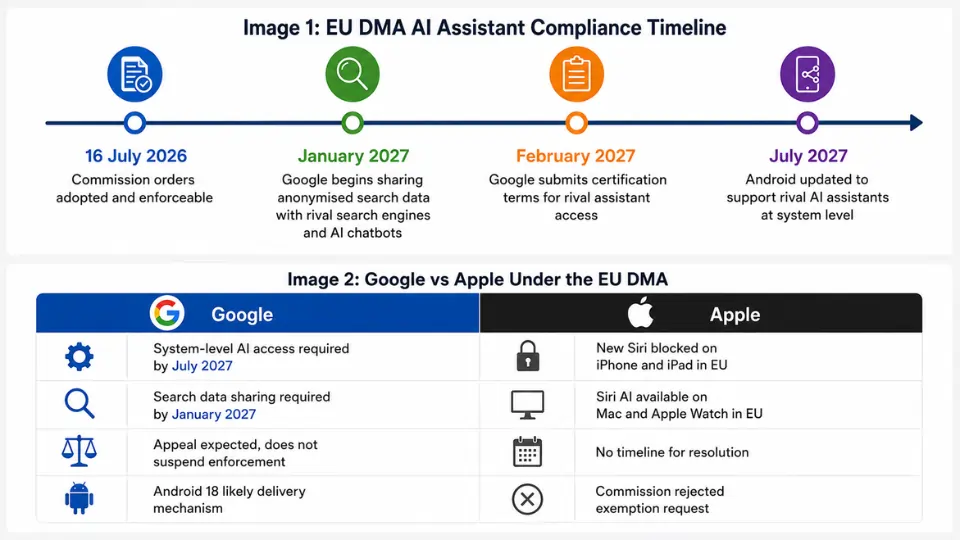
Apple's position is more binary. The company announced in June that its new Siri AI, unveiled at its Worldwide Developers Conference, will not launch on iPhones or iPads in the EU when iOS 27 and iPadOS 27 are released later this year. Craig Federighi, Apple's senior vice president of software engineering, said the company was "deeply disappointed" that EU users would not have access at launch.
Apple said it spent several months proposing solutions to regulators before announcing the delay. The European Commission rejected that framing. A Commission spokesperson stated that the DMA does not prevent Apple from launching new products and that Apple's decision was its own, not a regulatory requirement. The Commission said Apple had failed to develop interoperability solutions meeting EU privacy and security standards, and had instead sought an exemption Brussels refused to grant.
Regulators elsewhere are watching closely. The UK's Competition and Markets Authority has also proposed controls on Google's AI content practices, reflecting a broader pattern of competition regulators treating AI assistant integration as a structural market question, not just a product feature decision.
For EU consumers, the immediate consequence depends on the platform. Apple's new Siri remains available on Mac and Apple Watch in the EU, as those devices fall outside the DMA's gatekeeper scope for mobile. Android users will see no changes before mid-2027 at the earliest, with the most likely delivery mechanism being the Android 18 update. Whether Google certifies a broad or narrow set of rival assistants under the terms it drafts by February 2027 will determine the practical scope of the ruling for the 427 million EU smartphones the Commission says fall under its jurisdiction.
More AI & Tech News

.webp)

Subscribe to Stay in the loop
Get the latest AI and technology news, honest tool reviews, and practical guides delivered straight to your inbox.
Success! Check your Inbox!
Tezons Newsletter
The latest technology news, in-depth tool reviews, and practical guides - curated and delivered to your inbox.
Latest News




Have any questions?
Didn’t find what you were looking for? We’re just a message away.