Tesla posts record second-quarter deliveries as Europe demand rebounds

- Tesla delivered 480,126 vehicles in the second quarter of 2026, a record beating estimates by close to 80,000 units
- European sales growth outweighed continued softness in North America and modest gains in China
- Capital spending is set to nearly triple to more than $25bn this year as Tesla expands AI, battery and robotaxi operations
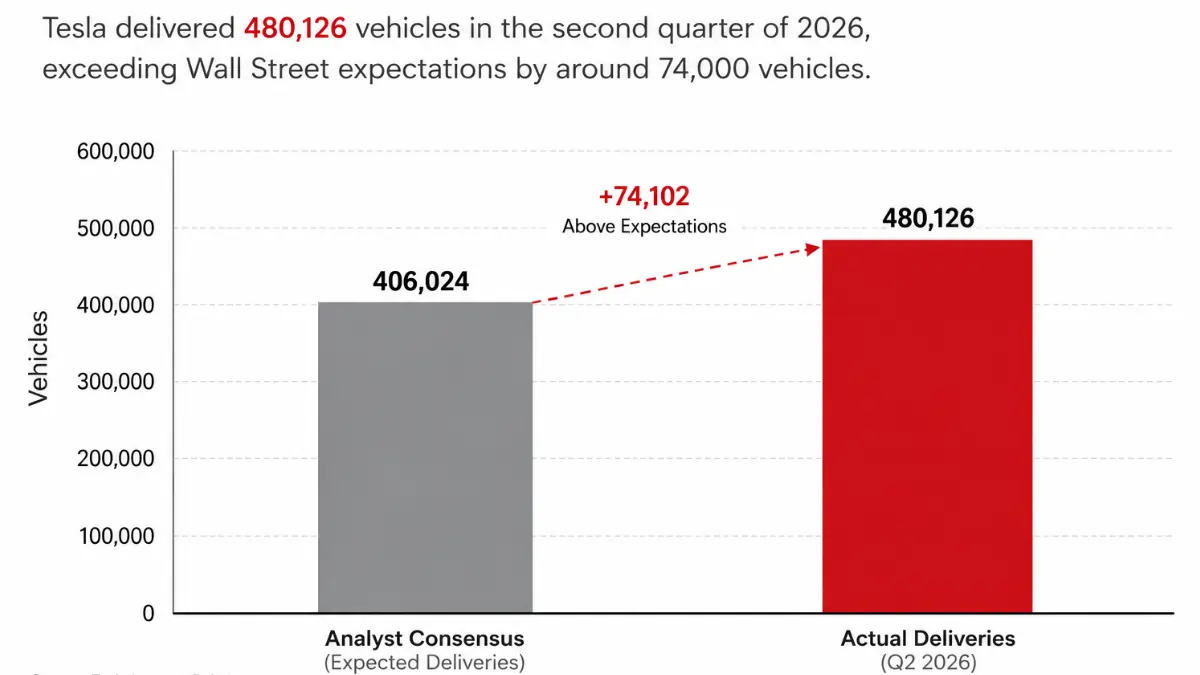
Tesla delivered 480,126 vehicles in the second quarter of 2026, a record for the period that beat Wall Street's average estimate of 402,776 by close to 80,000 units.
The result is Tesla's strongest quarterly delivery figure on record and points to a recovery in Europe that outweighed continued weakness in North America. Deliveries rose about 25% compared with the same quarter a year earlier. The figures suggest Tesla's core vehicle business is regaining momentum after two consecutive years of annual sales declines.
Tesla produced 451,758 vehicles during the quarter, according to the company's own figures. Deliveries exceeded production by more than 28,000 units, a gap that reflects a drawdown of inventory built up earlier in the year. Rivian, a smaller electric vehicle maker, also beat second-quarter delivery estimates on the same day and raised its full-year forecast, a sign that demand across the wider American EV market may be stabilising after a prolonged slump.
The contrast between Tesla's two largest markets is stark. North America remains the weakest region for the company, dragged down by reduced federal EV tax credits and a crowded field of domestic and Asian competitors. Europe has moved in the opposite direction, turning from a source of concern a year ago into the main engine behind the record quarter.
Seth Goldstein, senior equity analyst at Morningstar, said Europe's growth is the main driver for Tesla right now. US sales remain below last year's level, though the drop is smaller than the broader American EV market decline, he said, while sales in China are showing modest growth.
Several factors drove the European rebound:
- Government incentives for electric vehicle purchases across multiple EU markets
- Faster electrification of corporate and fleet vehicles
- Higher fuel prices pushing buyers toward electric models
- A cooling of the consumer backlash against chief executive Elon Musk's political activity last year
The scale of that European recovery carries a separate implication for legacy carmakers on the continent. Volkswagen and Stellantis have leaned on the same EV incentive schemes to shift their own electric ranges, and Tesla's record quarter suggests it is capturing a large share of that incentive-driven demand rather than only riding a wider market lift.
Tesla's China-made electric vehicle sales have also risen in 2026, helped by production of the refreshed Model Y, despite intense competition from BYD and other domestic manufacturers. The combined regional performance points to a business stabilising after a difficult stretch, even as the North American market remains a drag on overall volume.
BYD still outsells Tesla in China on volume, but the refreshed Model Y has narrowed the gap in the premium segment where Tesla competes most directly. That narrower gap matters for Tesla's pricing power in its second-largest market heading into the second half of the year.
The delivery beat gives Tesla extra financial headroom to fund its push into artificial intelligence and autonomous driving, the two pillars behind its roughly $1.6tn valuation. The company expects to spend more than $25bn on capital expenditure in 2026, nearly triple the $8.5bn it spent the previous year, covering AI infrastructure, battery production, Cybercab manufacturing and the Optimus robot programme.
Musk's ambitions extend well beyond Tesla's own balance sheet. He is separately backing a Texas chip manufacturing plant intended to expand AI chip production capacity, a project that mirrors the same capital intensity now defining Tesla's own AI and autonomy roadmap.
Not every analyst is convinced the spending will pay off on the timeline Musk has set out. Tesla has pushed back its own robotaxi and Optimus targets before, and the near tripling of capital expenditure this year adds to broader concerns about AI investment outpacing returns across the sector.
That tension between record vehicle demand and unproven AI returns is likely to shape how investors read Tesla's next two quarters. A stronger core auto business buys Musk more time, but it does not remove the question of when Cybercab, Optimus and the robotaxi fleet start contributing meaningfully to revenue rather than capital expenditure.
Tesla has continued rolling out its full self-driving advanced driver-assistance software in Europe, though availability remains limited to a handful of countries. Analysts expect broader rollout over the coming months to support demand further.
The company expanded its robotaxi operations after launching a limited commercial service in Austin in June. Musk has said Tesla intends to scale the service significantly through the rest of 2026. Production of the Cybercab, Tesla's purpose-built autonomous vehicle without a steering wheel or pedals, is expected to ramp up later this year.
Expansion beyond Austin will test whether Tesla can replicate the service in cities with denser traffic and stricter local regulation, conditions that have slowed rival robotaxi operators in the past. How quickly regulators in additional US states and European countries approve wider FSD and robotaxi access is likely to determine how much of Tesla's AI spending converts into revenue before the end of 2026.
The stakes extend beyond Tesla's own balance sheet. A large share of Musk's personal fortune, which recently passed $800bn, is tied directly to Tesla's share price and its bet that autonomous driving and robotics can scale profitably.
More AI & Tech News




.webp)


Subscribe to Stay in the loop
Get the latest AI and technology news, honest tool reviews, and practical guides delivered straight to your inbox.
Success! Check your Inbox!

Tezons Newsletter
The latest technology news, in-depth tool reviews, and practical guides - curated and delivered to your inbox.
Latest News




Have any questions?
Didn’t find what you were looking for? We’re just a message away.