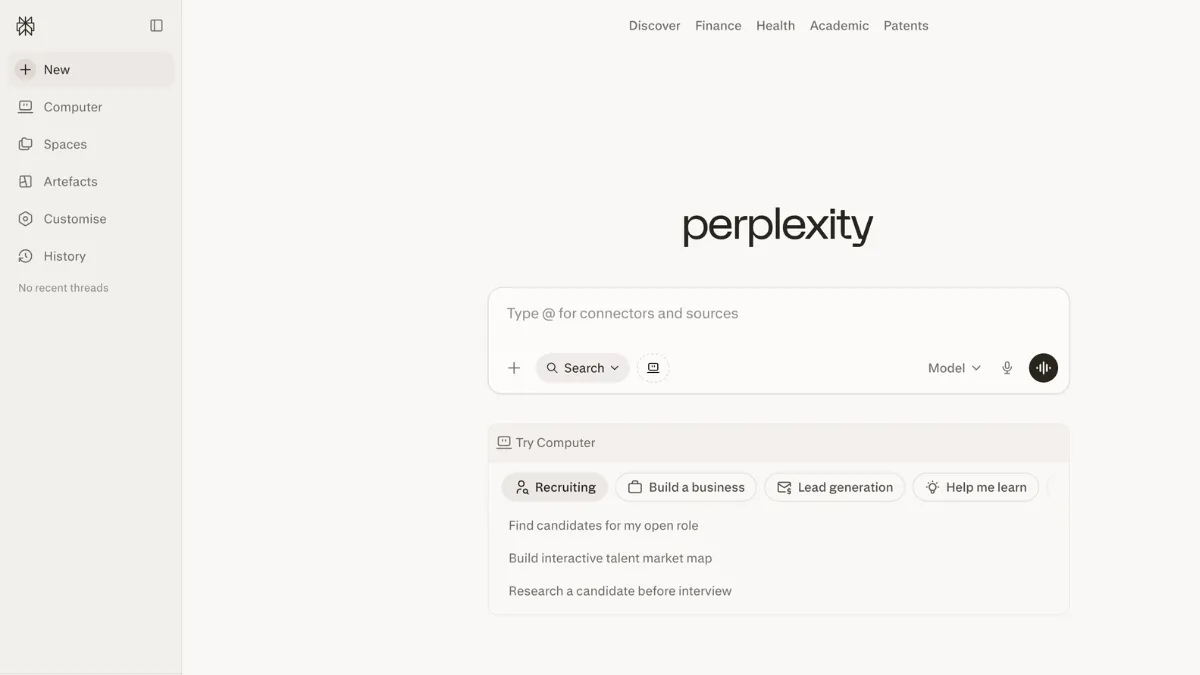
Perplexity AI does one thing that most AI tools avoid: it tells you exactly where its answers came from. Every response is built from live web retrieval, and every claim carries a numbered citation linked to the source document so you can verify the logic before you act on it. That mechanism makes Perplexity the clearest choice for research, fact-checking, and any professional task where an unsourced AI answer is not good enough.
The platform describes itself as an answer engine rather than a search engine, and the distinction holds. Instead of returning ten links for you to sort through, it interprets your question, retrieves relevant pages from the live web, and produces a direct prose answer with the sources attached. For researchers, journalists, legal professionals, and analysts who spend time hunting down current data, that is a different proposition from a chatbot that generates plausible text from memory.
By mid-2026, Perplexity had passed 45 million monthly active users and was processing over 1 billion queries per month, with annualised revenue exceeding $450 million. Those numbers reflect real adoption among knowledge workers, not general-audience curiosity. The growth also reflects a product that has moved well beyond basic web retrieval: the current platform includes multi-model switching across GPT-5, Claude Opus 4.6, and Gemini 2.5 Pro, document analysis, Deep Research reports that synthesise dozens of sources into structured outputs, and collaborative Spaces that turn individual queries into persistent research environments.
Why citation-first retrieval changes the research workflow
The mechanism behind Perplexity is retrieval-augmented generation, or RAG. Submitting a query triggers multiple searches against a combination of Bing and Google APIs alongside Perplexity's own web index. The retrieved documents are passed as context into a large language model, which generates an answer grounded in those documents rather than drawing from static training data. The practical effect is that hallucination, the chatbot tendency to state confident falsehoods, is significantly reduced because every claim is anchored to a document you can inspect.

Most AI chatbots produce answers that feel authoritative but are impossible to verify without running a separate search. Perplexity removes that step by default. The numbered citations are not decorative: each one links to the source URL, the page title, and the specific passage the model drew from. Following a citation takes seconds, and the habit of doing so is what separates reliable professional research from AI-assisted guesswork.
Deep Research mode extends this further. Available on Pro and above, it breaks a complex question into sub-queries, runs iterative searches across dozens of sources, cross-references findings, and produces a structured multi-page report. The process takes two to five minutes. For a task that would otherwise require an hour of manual research across multiple tabs, that represents a meaningful time saving. From early 2026, the mode also generates formatted spreadsheets and presentations directly within the interface, reducing the need to export findings into separate tools.
One limitation worth naming directly: the citations tell you where the model retrieved information, but they do not confirm the model interpreted that source correctly. Perplexity occasionally misattributes a claim to a source that contains related but not identical information. For high-stakes professional or academic work, follow every citation that underpins a conclusion before treating it as confirmed. The tool is a strong starting point for research, not a replacement for primary source verification.
Focus modes give you further control over the retrieval layer. Academic mode surfaces peer-reviewed content and is the right default for literature reviews and evidence-based writing. Web mode is broader and better suited to news, commercial topics, and general background research. Selecting the wrong focus for your query type is the most common reason users get incomplete or poorly sourced results, and it is the first setting worth adjusting when you set up the platform.
Where Perplexity outperforms, and where it does not
Perplexity's strongest ground is anything time-sensitive and fact-dependent. Recent earnings reports, policy announcements, breaking news, current pricing, regulatory updates: these are the query types where a chatbot relying on training data from months ago produces outdated answers, and where Perplexity's live retrieval gives it a clear advantage. For a market analyst tracking a fast-moving story, or a journalist fact-checking a claim published this morning, the speed and currency of results are the product.
The multi-model switching available on Pro is a less obvious but equally significant advantage. Pro subscribers can select from GPT-5, Claude Opus 4.6, Gemini 2.5 Pro, Grok, and Perplexity's own Sonar model per query, within the same session. No other platform at this price point offers this range. For research tasks where a second model's interpretation of the same sources matters, switching between models without changing platform saves time and avoids the context loss that comes from moving between different tools.
Spaces are the feature most users underuse. A Space is a persistent project environment where you store related searches, upload documents, and set standing instructions that apply to every query in that workspace. If you regularly research a specific market, topic, or client, configuring a Space with instructions like 'prioritise peer-reviewed sources' or 'focus on EMEA regulatory data' produces more consistent output across sessions than re-prompting from scratch each time.
Perplexity is clearly less suited to creative and generative tasks. Writing assistance, brainstorming, detailed code generation, and extended conversational tasks are areas where ChatGPT or Claude perform better. The platform's design prioritises sourced retrieval over creative generation, and trying to use it for tasks that do not require web retrieval produces answers that are competent but not differentiated. For content writing workflows, tools like Jasper are purpose-built in a way Perplexity is not. Perplexity also lacks the deep coding assistance features that make dedicated tools useful for development work.

The free tier is more restrictive than most users expect. Basic search with citations is unlimited. Pro Search queries, the deeper multi-step reasoning mode, are capped at approximately 5 per day on the free plan. For casual lookups, that ceiling is adequate. For anyone who depends on the research-grade mode as part of a daily workflow, it runs out fast.
What each pricing tier covers
- Free. Unlimited basic web search with citations. Approximately 5 Pro Search queries per day. Sonar model only, no access to frontier models, limited file uploads. Adequate for occasional lookups; restrictive for daily research work.
- Pro at $20 per month (or $200 per year). Unlimited Pro Search queries, 20 Deep Research reports per day, full model choice including GPT-5, Claude Opus 4.6, Gemini 2.5 Pro, and Sonar Large per query within the same session. Unlimited file and PDF uploads, Spaces and Pages access, image generation, Comet browser access on a regional rollout, and $5 monthly Sonar API credits. The right tier for most individual knowledge workers who use the platform daily.
- Max at $200 per month. Unlimited Deep Research, Model Council (your query dispatched simultaneously to three frontier models with a synthesised response surfacing where they agree and diverge), 10,000 monthly Perplexity Computer credits for agentic browser tasks, early access to new models, and priority support. For professionals whose workflows are intensive enough to exhaust Pro's 20 daily Deep Research cap.
- Enterprise Pro at $40 per seat per month. All Pro features plus SSO, SCIM provisioning, admin controls, audit logs, and contractual data protections. The enterprise data handling terms are meaningfully stronger than the consumer privacy policy for teams handling sensitive material.
- Enterprise Max at $325 per seat per month. Enterprise Pro plus unlimited Deep Research at scale, expanded file limits, enhanced video generation, and premium model access. For research-intensive organisations running the full platform at high volume.
The gap between Pro and Max is significant. For most individual knowledge workers, Pro at $20 per month covers the research workflow in full. Max becomes relevant if you regularly need more than 20 Deep Research reports per day, or if Model Council, running a query simultaneously across three frontier models, is core to your decision process. Education Pro at $10 per month offers the full Pro feature set with student or educator verification via SheerID.
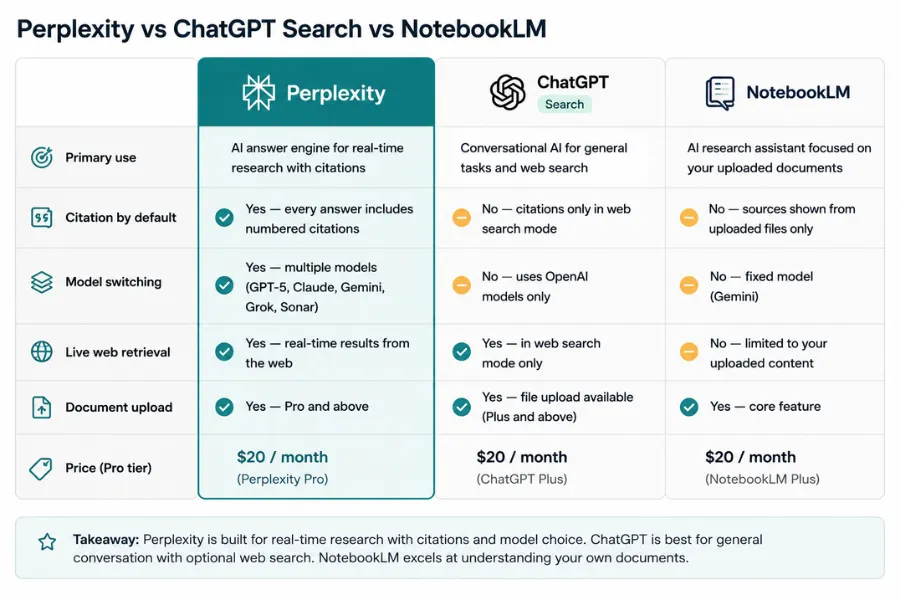
Perplexity vs ChatGPT Search and NotebookLM
The comparison that comes up most often is with ChatGPT, which now includes web search across its paid plans. Both sit at $20 per month at Pro level. ChatGPT is the stronger platform for creative output, code generation, voice interaction, and extended conversational tasks. Perplexity is stronger for citation discipline, current-web research, and the multi-model switching that lets you run the same query through different reasoning systems in one session. At identical price points, the decision comes down to your primary use: generative output favours ChatGPT; research and source verification favour Perplexity.
NotebookLM from Google is the closest structural alternative for document-centric research. NotebookLM excels when your sources are a defined set of uploaded documents: it reads them, cross-references them, and answers questions from within that corpus. Perplexity is stronger when your sources are the live web with no predefined set. For teams working from a fixed corpus of internal documents or reports, NotebookLM may fit better. For open-ended web research where currency matters, Perplexity is the clearer option. The two tools serve meaningfully different retrieval needs rather than competing for the same workflow.
For SEO and content research, Semrush and Ahrefs offer structured keyword data, backlink analysis, and competitive intelligence that Perplexity does not attempt to replicate. Perplexity is a useful complement for background topic research but does not replace purpose-built search intelligence platforms for visibility and keyword work.
Data privacy and what it means for different users
Perplexity holds a SOC 2 Type II certification. For consumer-tier accounts, its standard privacy policy governs how query data is collected and may be used for model improvement unless you opt out. For enterprise accounts, Enterprise Pro and Enterprise Max include contractual data protections and the option to keep uploaded documents out of training pipelines. The distinction matters in practice. For individual researchers using the platform for general professional work, the consumer terms are standard for the category. For organisations handling client data, regulated information, or confidential material, the enterprise tier is the appropriate entry point, and the data handling terms warrant review before deployment.
Security researchers identified weaknesses in earlier versions of Perplexity's Android application. The current platform has addressed those issues, but it is a reason for enterprise security teams to review the current documentation rather than assume the SOC 2 certification alone covers their specific requirements.
Perplexity scores 4.22/5 overall. Performance and speed lead the nine dimensions at 4.7: retrieval is fast, and citations render in under a second across both desktop and mobile. Ease of use scores 4.6, the interface requires no onboarding for anyone familiar with search. Data privacy and security at 3.8 reflects the manageable gap between consumer and enterprise data handling terms. For researchers, analysts, journalists, and students who need sourced, current answers as a regular part of their work, Pro at $20 per month is the tier where the platform earns its cost. Run five or more research tasks per day that require source-verified answers, and that cost recovers within a week of use.
How We Rated It:
More Tool Reviews



Subscribe to Stay in the loop
Get the latest AI and technology news, honest tool reviews, and practical guides delivered straight to your inbox.
Success! Check your Inbox!

Tezons Newsletter
The latest technology news, in-depth tool reviews, and practical guides - curated and delivered to your inbox.
Latest News




Have a question?
Have any questions?
Didn’t find what you were looking for? We’re just a message away.