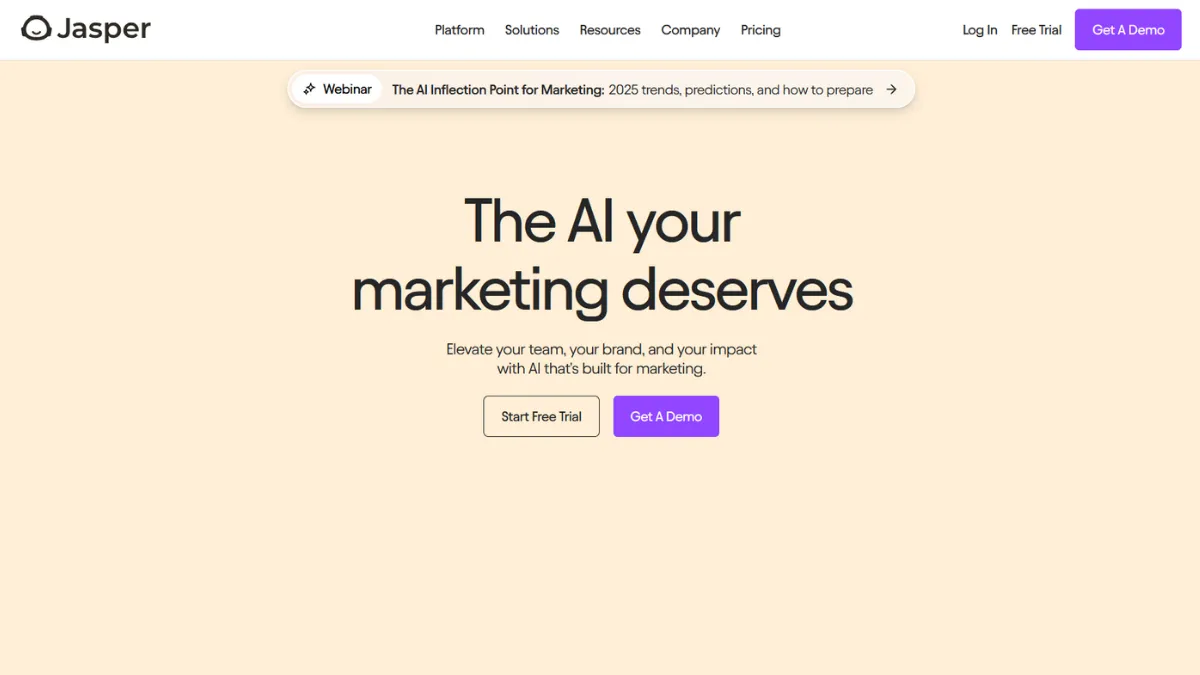
Scaling content output without losing brand voice is where most marketing teams hit a wall. Hire more writers and consistency drops. Rely on a generic AI and everything sounds the same shade of corporate beige. Jasper was built specifically for this problem, and after years of iteration it has developed into the most brand-aware AI writing platform available. It earns a strong overall score of 4.30 out of 5, and that number reflects a tool genuinely well-suited to marketing teams who need volume, consistency, and structure, not just raw generation speed.
The mechanism behind Jasper is its Brand IQ system, which lets you train the platform on your tone, style guide, forbidden words, and product catalogue. Once configured, every output reflects that training rather than generic AI defaults. This is what separates Jasper from reaching for ChatGPT and prompting from scratch each time. The platform routes prompts through multiple large language models dynamically, which gives it resilience against downtime and lets it select the best model for a given content type. Alongside Brand IQ sits a template library covering over 100 marketing formats, a collaborative Canvas workspace, and an agentic Studio layer for building custom content pipelines without code. Most teams underestimate how much setup the brand voice system requires: you need to upload existing content, define your style parameters, and test outputs before relying on it for live campaigns. Teams that skip this step get mediocre results and blame the tool.
A realistic expectation is that Jasper produces solid first drafts that still require a human editor for the final pass. Long-form blog posts come out structurally sound and on-brand once the system is trained, but technical content carries hallucination risk: the platform may generate plausible-sounding statistics that are not verifiable. Plan for a 20-minute edit cycle per major piece and you will save significant writing time overall. For short-form copy, ad variants, and email campaigns, the quality-to-speed ratio is especially strong. Agencies shipping dozens of client content pieces per week will see the clearest return.
Jasper is specifically well suited to content operations teams of two or more, in-house marketing leads at funded startups, and agencies managing multiple brand accounts. The multi-seat collaboration tools on the Pro plan are built for this context. Solo bloggers writing one post a week will find the pricing hard to justify against what they actually use.
The most significant limitation is output quality on technical or data-heavy content. Jasper is a drafter, not a researcher. Ask it to cite recent statistics or explain a niche regulatory topic and it will respond with confidence while potentially generating inaccurate details. Every output destined for publication needs fact-checking, particularly anything touching medical, legal, or financial subject matter.
The sections below cover how Jasper works mechanically, its key features, pricing tiers, and how it compares to the main alternatives in the AI writing category.
What Is Jasper?
Jasper is an AI-powered content platform built for marketing teams that need to produce high volumes of on-brand written content. It solves the problem of maintaining voice consistency at scale: as team size grows or content volume increases, keeping every piece sounding like it came from the same organisation becomes genuinely difficult. Where a general AI assistant treats each prompt as independent, Jasper stores your brand parameters and applies them across all outputs. Originally launched as Jarvis before rebranding, it has positioned itself at the enterprise and growth-team end of the market, with a feature set that prioritises brand governance, campaign workflows, and multi-seat collaboration over raw text generation speed. Its adoption across recognisable enterprise organisations signals that it has moved beyond early-adopter status into established marketing infrastructure. The key question is whether its content pipeline and agentic features translate into consistent quality gains, or whether the brand training investment exceeds what smaller teams can recover.
How Jasper Works
Setup begins with Brand IQ configuration. You upload existing content samples, define tone parameters, specify your style guide, and optionally add a knowledge base of product documentation, FAQs, and audience briefs. This training phase determines output quality more than any other factor. Teams that spend an afternoon on this setup produce noticeably better results than teams who skip directly to generation.
Once configured, content creation runs through the Canvas workspace or template library. Canvas is a collaborative document editor where you write alongside the AI: you prompt, it drafts, you edit, and the cycle repeats until the piece is complete. The template library provides structured starting points for specific formats, from Google Ads headlines to long-form blog posts, each with pre-built prompt logic that removes the need to engineer prompts from scratch.
The Studio layer handles more advanced use cases: building custom AI workflows, chaining tasks together, and connecting to external platforms. This is where Jasper moves from writing assistant into content operations infrastructure, allowing teams to automate repetitive brief-to-draft cycles.
The counterintuitive insight most new users miss is that Jasper's output quality is primarily a function of input quality, not model capability. Vague prompts return generic content regardless of how well the brand voice is trained. Specific briefs with clear audience, goal, and format instructions return content that requires minimal editing. The platform rewards structured thinking and detailed prompting. Teams who treat it as a one-click solution consistently underperform teams who treat it as a disciplined writing partner. This leads directly to the question of which specific features matter most for day-to-day use.
Jasper Key Features
The feature set is built around a core workflow assumption: marketing teams produce recurring content types at scale and need brand consistency across all of them.
Brand IQ and Voice Training. This is Jasper's most differentiating capability. You configure a brand voice by uploading sample content and defining style parameters, and the platform applies this configuration across all subsequent outputs. The system flags content that diverges from your defined voice and suggests corrections. For teams managing multiple clients or brand lines, the Pro plan allows multiple distinct brand voices, which the Creator plan does not. The practical value is reduced editing time on every piece because the first draft already reflects your house style rather than generic AI phrasing. Pair this with Surfer SEO for keyword-informed briefs and the combination covers both brand consistency and search optimisation in a single workflow.
Template Library. Over 100 pre-built templates cover every standard marketing format: blog post intros, product descriptions, ad copy variants, email subject lines, LinkedIn posts, and more. Each template structures the prompt automatically, so you supply the specific details and the AI handles the format logic. This removes a significant source of inconsistency in teams where multiple writers prompt differently and get varying outputs.
Canvas Workspace. Canvas is a collaborative document environment where content is drafted, edited, and refined in real time. Multiple team members can work in the same document, which eliminates the version-control friction of drafting in a separate editor and copying into a shared tool like Google Drive. The AI prompt interface sits directly within the document, so you can instruct it to rewrite a paragraph, adjust tone, or expand a section without leaving the editor.
Knowledge Base. The knowledge base lets you upload documents, URLs, and brand assets that Jasper references during content generation. This grounds outputs in your actual product details rather than general training data, which reduces hallucination risk on company-specific content considerably. The limit on knowledge assets varies by plan, so teams with extensive documentation should check the current tier specifications on Jasper's site.
Agentic Studio and Campaign Workflows. The Studio layer allows teams to build custom AI pipelines without code: connecting tasks, automating brief-to-draft sequences, and integrating with external platforms. Campaign workflow tools extend this into full content campaign management, from initial brief through to finished assets across multiple formats. These features sit primarily on higher tiers, and the value they deliver is proportional to the volume and regularity of your content output. Teams shipping fewer than ten pieces per month will rarely use this layer enough to justify the cost difference.
Jasper Pros and Cons
Jasper performs well across several dimensions and has clear gaps that matter depending on your use case.
- Best-in-class brand voice consistency. The Brand IQ system genuinely outperforms raw AI prompting for maintaining voice across a team. Once trained, it reduces per-piece editing time materially and scales to large content volumes without drift.
- Extensive template coverage. The library handles every standard marketing format without requiring users to engineer prompts from scratch. This is particularly valuable for teams onboarding non-technical writers to an AI workflow.
- Enterprise-grade security and compliance. SOC 2 compliance and GDPR alignment make Jasper viable for organisations that would otherwise be blocked by security review. This is an often-overlooked advantage over cheaper alternatives.
- Multi-seat collaboration tools. The Pro plan supports genuine team workflows with shared documents, review cycles, and multiple brand voice configurations. Most AI writing tools are still fundamentally single-user experiences.
- Knowledge base grounding. Uploading company-specific documentation reduces hallucination risk on proprietary content and produces more accurate first drafts than prompting without context.
The gaps are real and worth factoring into your decision.
- Hallucination risk on technical content. Like all large language model-based tools, Jasper can generate plausible but inaccurate facts, statistics, and citations. Every output needs human fact-checking before publication, particularly in regulated industries.
- Price point is high for solo users. The Creator plan is competitively priced for what it includes, but compared to using a general AI assistant, the monthly cost is significant for founders producing low content volumes. The tool earns its price at team scale, not solo scale.
- Setup investment is substantial. Brand voice training, knowledge base configuration, and workflow setup require a meaningful time commitment before outputs are useful. Teams expecting immediate results from day one will be disappointed.
- Creator plan restricts brand voices to one. Agencies or anyone managing multiple brands will need the Pro plan for multiple voice configurations, which increases cost considerably.
- Output is a starting point, not a finished product. Despite strong brand voice adherence, Jasper drafts require human editing for nuance, accuracy, and strategic positioning. Teams budgeting for AI that eliminates editing entirely will find the reality does not match the expectation.
How to Get the Most Out of Jasper
Before writing a single piece of content, invest a half-day in configuration. Upload your three to five best-performing pieces of existing content to train the brand voice system. Define your forbidden words, preferred formality level, and audience persona explicitly. Add your most important product documentation to the knowledge base. This setup phase determines whether your first draft is 60% publication-ready or 90% publication-ready, and that gap compounds significantly across hundreds of pieces.
In your first week, work through three to four different template types to understand how the system responds to your brand configuration. Test a blog post, an email campaign, and a short-form ad set. Identify where the brand voice training is working and where the outputs still sound generic, then refine your style parameters accordingly. Most teams find one or two areas where the initial training is weak and correct them early rather than editing around them indefinitely.
Building results over time means treating Jasper as infrastructure rather than a tool you open when inspiration runs low. Create a content calendar and use campaign workflow features to generate batches of related content: brief the campaign once, generate blog posts, social variants, and email copy from the same strategic input. This is where Jasper's approach to how to scale content marketing for a growing team becomes visible: the returns compound as the system learns more about your brand and your briefs become more structured.
The mistake most users make is writing vague prompts and blaming the tool for generic outputs. Prompt specificity is the single largest lever on output quality. Include the target audience, the desired emotional response, the key message, and the format in every instruction. Treat each prompt like a brief to a freelance writer, not a search query.
Measure success by tracking editing time per piece over your first month. If the average falls, the system is working. If it stays flat, your brand voice configuration or prompting discipline needs adjustment. Combine Jasper's output with Semrush keyword data at the brief stage to ensure every piece targets a viable search opportunity from the start, rather than optimising retroactively.
Who Should Use Jasper?
This is for you if you are leading content for a funded startup and need a consistent brand voice across blog, email, and paid channels without hiring a dedicated copywriter for each. The platform saves enough editing time at this volume to justify the cost, and Brand IQ means output quality does not fall when a junior team member is prompting instead of a senior writer. It is also a strong fit if you run a content agency managing multiple client accounts: the multi-voice Pro plan lets you maintain strict brand separation across clients while scaling output. The third persona is an in-house marketing team at a scale-up shipping more than ten content pieces per week, where the campaign workflow and collaboration tools reduce coordination overhead materially.
Jasper is not for you if you are a solo founder writing one blog post per month. The economics do not work: you are paying for team collaboration infrastructure you will never use, and the editing time savings do not offset the subscription cost at low volume. It is equally poor value for anyone who needs technically precise content in medical, legal, or scientific categories without a strong internal review process. The hallucination risk on fact-heavy content is real, and if your organisation cannot commit to rigorous editorial checking, the tool introduces more risk than it removes.
Jasper Pricing
Jasper operates on a tiered subscription model without a permanent free tier, though a trial period is typically available. Check Jasper's pricing page directly for the most current rates, as these change periodically. The Creator plan targets individual users and covers one brand voice, a capped number of knowledge assets, and access to the core template library and Canvas editor. The Pro plan adds multiple brand voice configurations, more knowledge assets, and multi-seat collaboration, making it the practical minimum for agency and team use. A Business plan with custom terms sits above both and targets enterprise organisations with advanced security requirements, custom integrations, and volume needs.
At the Creator tier, the monthly cost is meaningful for a solo user but reasonable for someone generating high content volumes. At the Pro tier, per-seat pricing means costs scale with team size, which some smaller agencies find stretches the budget at three or more seats. The value case is strongest when the tool is replacing freelance copy costs or reducing editorial bottlenecks at scale. For context, the alternatives reviewed below operate at different price points, and the cost differential matters when making your final decision.
Jasper vs Alternatives
The competitive field for AI writing tools has consolidated around a few genuine alternatives worth considering before committing to Jasper.
Copy.ai is the closest direct competitor in the marketing copy category. It covers similar template territory and has invested heavily in workflow automation. Copy.ai tends to be more affordable at the entry tier and suits teams whose primary need is short-form copy rather than long-form brand-consistent content. Jasper wins when brand voice training and knowledge base depth matter more than cost per seat.
Writesonic offers a broader feature set at a lower price point, with an integrated AI article writer that handles SEO optimisation natively. For teams on tighter budgets who want reasonable brand customisation without Jasper's price premium, Writesonic is worth evaluating. Jasper wins on output consistency and enterprise security compliance, which Writesonic does not match at equivalent tiers.
Jasper competes indirectly with Surfer SEO, particularly since the native integration between the two platforms was discontinued and Surfer developed its own AI writer. Teams whose primary goal is SEO-optimised content rather than brand voice consistency may find Surfer's integrated workflow more efficient. Jasper wins for organisations where brand governance across a team of writers is the primary constraint, not keyword density.
Jasper also competes with HubSpot's AI content tools for teams already embedded in that ecosystem. HubSpot's AI features are tied to its CRM and marketing platform, making them compelling if you are already paying for the suite. Jasper wins as a standalone content platform for teams not on HubSpot or wanting dedicated content infrastructure separate from their CRM.
Jasper Review: Final Verdict
Jasper earns an overall score of 4.30 out of 5, driven by a functionality rating of 4.6 and a customisation rating of 4.5 that reflect its genuine strength as brand-consistent content infrastructure for marketing teams. Its cost-efficiency score of 3.8 reflects the reality that the pricing tier makes sense at team scale but is harder to justify for solo users, and this is worth weighing directly against your actual content volume before subscribing.
The bottom line: if you lead content for a growing team and brand consistency across writers and channels is your biggest operational problem, Jasper is the most capable tool in its category. If you are a solo operator or your primary need is SEO optimisation rather than brand governance, the price-to-value ratio tilts against it.
How We Rated It:
More Tool Reviews





Subscribe to Stay in the loop
Get the latest AI and technology news, honest tool reviews, and practical guides delivered straight to your inbox.
Success! Check your Inbox!

Tezons Newsletter
The latest technology news, in-depth tool reviews, and practical guides - curated and delivered to your inbox.
Latest News




Have a question?
Have any questions?
Didn’t find what you were looking for? We’re just a message away.