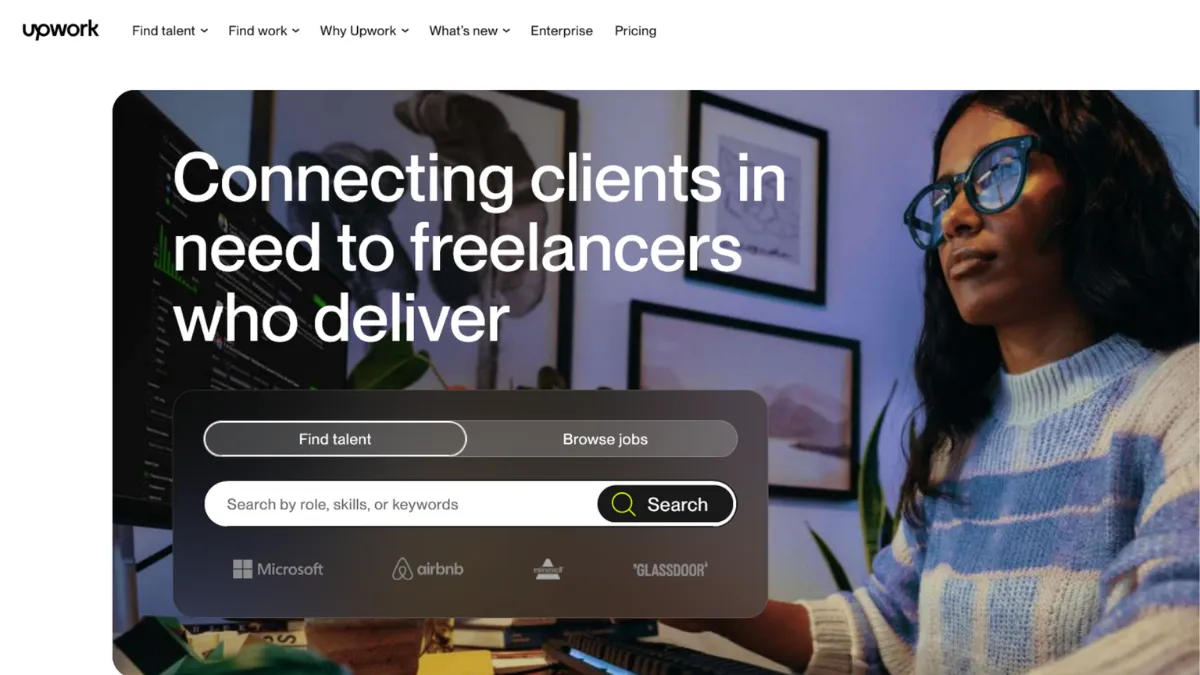
Upwork is a freelance marketplace where businesses post projects and hire independent professionals for scoped work, without committing to a full-time hire, managing payroll, or navigating international contractor paperwork. It is built for teams that need specialist skills on demand: a developer to ship a feature, a designer to take a product to launch, a finance specialist to own a channel for a quarter. The platform gives you a searchable pool of professionals across 125-plus categories, a badge system that surfaces track record, and an escrow-backed payment layer that removes the financial risk of working with people you have never met.
The problem Upwork exists to solve
Hiring a full-time specialist takes months and commits your business to ongoing payroll costs. Agencies charge a significant markup and you rarely work with the person you briefed. Generic job boards return unvetted candidates and no payment protection. Upwork sits between those options: a pool of credentialed professionals available for project work, with enough structure around payments and accountability to make the relationship viable from day one.
The platform runs on a combination of structured profiles, a reputation algorithm called the Job Success Score, and milestone-based escrow. A freelancer's Job Success Score reflects completed work, client feedback, and contract completion rates over time. Top Rated status, earned by the top 10% of freelancers, requires a Job Success Score above 90%, recent platform activity, and at least $1,000 in annual earnings. Top Rated Plus covers the top 3%. Expert-Vetted covers the top 1% and requires a 30-minute interview with an Upwork Talent Manager assessing both technical skills and professional conduct. That badge is only visible to Business Plus and Enterprise clients.
These signals exist because Upwork cannot screen every freelancer manually at scale. The badge system does the first pass for you. A freelancer with a Top Rated badge, 150 completed contracts, and a Job Success Score above 95% provides more pre-hire confidence than a portfolio on a personal website with no verifiable history.
How contracts actually work
Clients post a job with a description, budget range, and required skills. Freelancers spend Connects, a token currency costing $0.15 each, to submit proposals. The Connects system matters because submitting speculatively has a real cost. Experienced freelancers are selective about where they bid, which keeps proposal quality higher than open job boards. New Basic accounts receive 10 free Connects per month. Freelancer Plus subscribers get 100 for $19.99 per month.
Once you select a freelancer, you set the contract as hourly or fixed-price. Each model has distinct mechanics worth understanding before you commit.
- Hourly contracts use a built-in time tracker that captures screenshots and activity data at intervals, giving clients a verifiable record of hours worked. Upwork's payment protection covers verified hours if a client raises a dispute without valid grounds.
- Fixed-price contracts use milestone-based escrow: you fund each milestone before work begins, and funds release on your approval. Disputing a funded milestone is covered by Upwork's dispute resolution process, including mediation before escalating to arbitration.

Both models remove the ambiguity that makes informal freelance arrangements break down. The freelancer knows they will be paid for completed work. The client knows funds are held until they approve delivery. Neither side operates on trust alone.
For teams already using Notion, ClickUp, or Airtable for project tracking, Upwork sits alongside rather than replacing those tools. The platform handles contracts, payments, and communication but does not include task management or shared workspaces.
What you pay at each plan level
Client accounts are free to create and carry no monthly subscription. Fees apply when you make payments to freelancers and vary by plan and payment method. Always confirm current rates on Upwork's pricing page before hiring, as the fee structure has changed more than once.
- Basic (free to join). 5% marketplace fee on all payments to freelancers, reduced to 3% for eligible US clients paying by bank transfer (ACH). A one-time Contract Initiation Fee of $0.99 to $14.99 applies to each new contract, per contract not per project, so replacing a freelancer mid-project triggers it again. Best suited to occasional hiring or teams managing under $2,500 per month in freelancer payments.
- Business Plus (free to join, no monthly subscription). 10% marketplace fee on payments, reduced to 8% with ACH. No Contract Initiation Fee on contracts valued above $100. Unlocks the Expert-Vetted talent filter, Uma AI recruiter shortlists delivered within six hours, up to 60 invites per job post, and 24/7 priority support. Direct Contracts cost $49 per active contract per month under this plan.
- Enterprise (custom pricing). For organisations managing $50,000-plus annually in contractor spend. Includes compliance tools, global payroll integration, SSO, and bespoke onboarding. Fees are negotiated directly with Upwork and contract initiation fees are typically waived. Rebranded as Lifted, an Upwork Company, in August 2025.

For freelancers, the service fee runs from 0% to 15% per contract, disclosed before they accept work and fixed for the life of that contract. Many freelancers build this fee into their quoted rates, so clients absorb part of the cost through higher hourly or project prices.
The Business Plus upgrade only makes financial sense if you hire frequently enough for the waived initiation fees to offset the higher marketplace percentage, or if the Expert-Vetted filter has concrete value for the roles you are filling.
Where Upwork earns its score
- Talent depth across 125-plus categories. Software development, UI/UX design, content writing, financial modelling, video production, legal research, and dozens of specialist niches all have active candidate pools. Smaller platforms cannot match this breadth, particularly for technical or obscure categories.
- Structured payment protection. Escrow on fixed-price work and time-tracker-backed protection on hourly contracts reduce the financial risk of hiring people you have no prior relationship with. This separates Upwork from informal freelance arrangements and unstructured platforms.
- Badge system with verifiable signal. Job Success Score, Top Rated, Top Rated Plus, and Expert-Vetted tiers are built from real client feedback across real contracts. A Top Rated Plus freelancer with a 97% Job Success Score and 200 completed projects provides more pre-hire confidence than any self-reported portfolio.
- Uma AI recruiter (Business Plus). Upwork's AI hiring assistant reviews your job post and returns a curated shortlist within six hours. Match quality reflects the specificity of your brief. Vague scope produces a weaker shortlist regardless of the AI layer on top.
- Direct Contracts for external freelancers. You can bring freelancers sourced through referrals or your own network onto the platform's contract and payment infrastructure without requiring them to bid for the role. All payments, invoicing, and contract records sit in one place, and the freelancer builds a review history on their Upwork profile.
Where Upwork falls short
- Business Plus fee maths are not always in your favour. The plan carries no monthly subscription but charges 8% to 10% on payments versus 3% to 5% on Basic. Teams that hire infrequently will pay more per hire on Business Plus than they would have paid in initiation fees on Basic. Model your actual hiring volume before upgrading.
- AI-generated proposals have degraded quality in high-volume categories. Content writing, virtual assistance, and basic design are saturated with templated proposals that ignore your brief specifics. Screening now requires more effort per hire in these categories than it did two years ago.
- Contract Initiation Fees compound with turnover. At $0.99 to $14.99 per new contract on the Basic plan, teams that hire frequently or run multiple parallel projects with different freelancers face initiation costs that accumulate without appearing on any single invoice line.
- Off-platform hire triggers a conversion fee. Moving a freelancer off Upwork within 24 months of first contact on the platform incurs a fee of 13.5% of the freelancer's projected annual earnings. Teams planning a long-term hire who eventually want to bring someone in-house should factor this in early.
- New client accounts receive fewer proposals. Without a review history, early job posts attract lower proposal volume than established accounts. This compounds in niche categories where the active candidate pool is smaller.
How Upwork compares to Fiverr and Toptal
Fiverr operates on packaged services at fixed prices. Clients browse pre-built listings and receive a deliverable without a brief-negotiation phase. This suits tasks with clearly defined outputs: a logo, a short video script, a product photo edit. Upwork wins on custom scope, professional depth, and suitability for iterative work that cannot be fully defined upfront. Fiverr charges clients a 5.5% service fee on orders, making it cheaper than Upwork's Business Plus tier for simple one-off work but more expensive than Upwork Basic's 3% ACH rate.

Toptal vets developers, designers, and finance professionals through a multi-stage screening process that accepts roughly 3% of applicants. Senior developers on Toptal typically command $100 to $200-plus per hour. Toptal suits companies hiring at senior level where quality risk is the primary concern and budget is not the binding constraint. Upwork wins on volume, category breadth, and accessibility for teams that need strong professionals at competitive rates rather than an elite-only pool.
For teams wanting to automate notifications, update project records, or sync Upwork contract milestones into other systems, pairing it with Zapier or Make adds operational leverage the platform does not natively provide.
Who gets consistent results on Upwork
Three types of clients extract good value from the platform consistently. A seed-stage founder who needs a senior product designer for twelve weeks to take an MVP to a launch-ready interface. A marketing manager at a growing company who needs a paid search specialist to own a channel without the commitment of headcount. A solo operator who needs a developer to build a custom integration between two tools their business depends on. All three cases involve clear deliverables, defined timeframes, and skills that require professional track records rather than low-cost generalists.
Upwork is a poor fit for clients who want to post a brief and receive finished work without any screening or onboarding effort. The platform rewards clients who invest in a specific job description, review proposals critically, and treat the relationship as a professional engagement. Clients who filter on rate alone consistently report poor outcomes, and the platform's review history accurately reflects this pattern.
One practice that significantly improves first-hire outcomes: for projects valued above $500 or running longer than two weeks, commission a short fixed-price test task before committing to the full contract. Top-tier freelancers expect this approach on Upwork and treat it as a signal that you are a serious client. It narrows a shortlist faster than proposal review alone and produces a verifiable output before the main engagement begins.
Upwork's overall score of 4.13 out of 5 reflects a marketplace that delivers on its core promise for prepared clients while carrying real friction for casual ones. Ease of use scores 3.8, driven by the Connects system, variable fee structure, and the proposal volume new accounts must navigate before achieving consistent results. For businesses that invest in clear briefs, structured shortlisting, and ongoing freelancer relationships, no current marketplace matches Upwork's combination of talent depth and payment accountability. The test task is the single change most likely to improve your first hire.
How We Rated It:
More Tool Reviews




Subscribe to Stay in the loop
Get the latest AI and technology news, honest tool reviews, and practical guides delivered straight to your inbox.
Success! Check your Inbox!

Tezons Newsletter
The latest technology news, in-depth tool reviews, and practical guides - curated and delivered to your inbox.
Latest News



Have a question?
Have any questions?
Didn’t find what you were looking for? We’re just a message away.