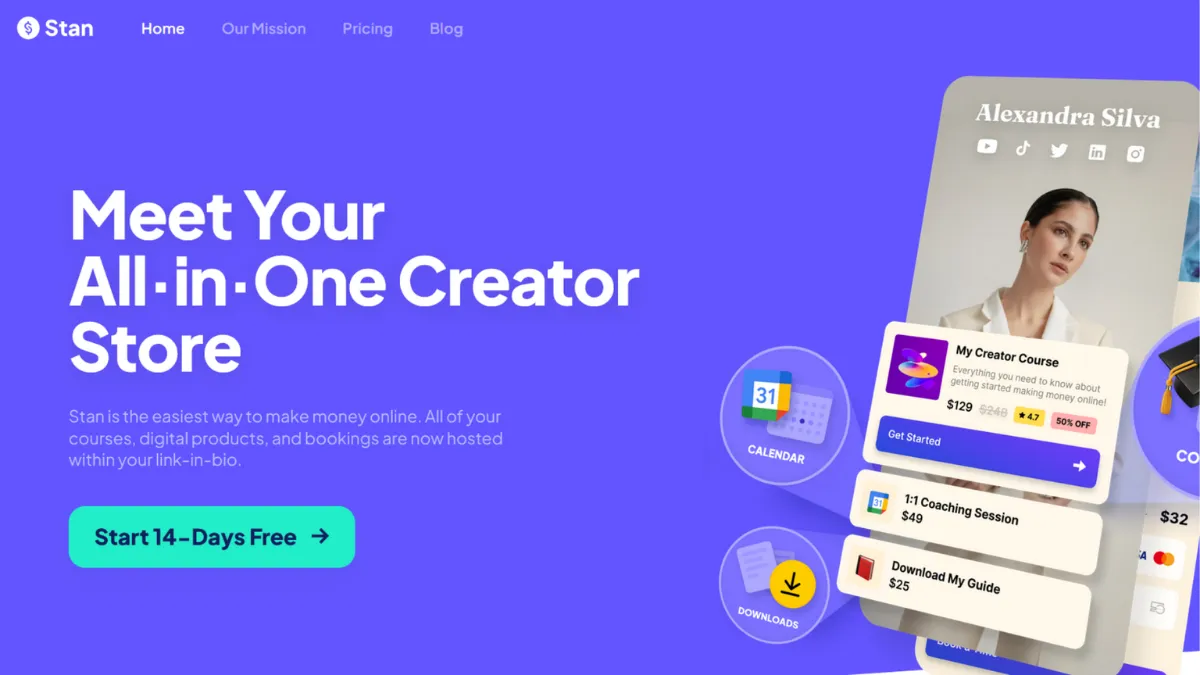
Social media creators spend years building audiences and then lose the sale at the link-in-bio stage, directing followers to a cluttered Linktree page that offers no checkout, no course delivery, and no way to capture an email. Stan Store was built to close that gap. It replaces the passive link list with a mobile-optimised storefront that handles digital product sales, course delivery, calendar bookings, and recurring memberships from a single URL. The verdict: for an Instagram or TikTok creator earning consistently from digital products, Stan Store is the most frictionless path from audience to revenue available at its price point. It is not a platform for complex course builders or businesses that need deep customisation, but for the creator whose storefront lives in a social media bio, it earns its subscription fee quickly.
The mechanism that makes Stan Store work is its unification of the checkout flow with the content delivery layer. On most competing platforms, you sell via one tool and deliver via another. Stan Store handles both, which means a buyer who purchases a course or ebook gets access immediately without you configuring a third-party integration. The drag-and-drop product builder lets you add digital files, video content, or booking availability in minutes. What most new users underestimate is how much the mobile-first design does for conversion: the storefront renders cleanly on a phone screen, and since the majority of social media traffic arrives via mobile, that detail compounds over time. Pairing Stan Store with a tool like Canva for product graphics is the fastest way to make your storefront look polished from day one.
Realistic expectations matter here. Stan Store does not replace a dedicated email marketing platform, a full learning management system, or an analytics suite. The base Creator plan at around $29 per month gives you unlimited digital products, course delivery, bookings, subscriptions, and community access. The Creator Pro plan, roughly $99 per month, unlocks email marketing, sales funnels, upsells, affiliate tools, discount codes, and pixel tracking. The jump between tiers is steep, and many creators find the base plan covers their needs for longer than they expect. Verify current pricing on Stan Store's own site before committing, as plan features can change.
Stan Store suits the creator who already has an engaged social audience and wants to monetise it without stitching together five separate tools. Content creators selling templates, presets, ebooks, mini-courses, or coaching calls will extract the most value. Founders building software products, physical goods businesses, or complex multi-module courses will hit its ceiling fast.
The most significant limitation is design flexibility. You can adjust colours, fonts, and banners, but the overall layout is constrained by the platform's templates. Creators who care deeply about brand differentiation will find the storefronts look similar to one another. There is no way to build a fully custom page structure, and the analytics provided are functional rather than detailed.
The sections below cover how the platform works mechanically, its key features, pricing breakdown, and how it stacks up against the most relevant alternatives.
What Is Stan Store?
Stan Store is an all-in-one creator commerce platform that replaces the standard link-in-bio tool with a functional storefront. Where a service like Linktree lists links, Stan Store hosts your products, processes payments via Stripe or PayPal, delivers digital files, schedules bookings, and manages recurring memberships. The core problem it solves is the handoff cost: every time a creator sends a follower off-platform to buy, some percentage drops out. Stan Store compresses the journey from social post to completed purchase into as few steps as possible. What separates it from a generic e-commerce builder is that it was designed from the ground up for the creator workflow, with a mobile-optimised storefront, social-native checkout experience, and no platform transaction fees on either plan. The platform has grown to serve tens of thousands of creators, reflecting genuine product-market fit in the social commerce category. The question worth examining is exactly how the product mechanics work and where the constraints sit.
How Stan Store Works
Setup begins with creating a store page at a Stan subdomain, though you can connect a custom domain. You add products through a drag-and-drop builder: upload a file, set a price, add a cover image, and your product is live. The storefront URL goes in your Instagram or TikTok bio, and from that point every sale routes through Stan's checkout, which accepts card payments via Stripe and PayPal. Buyers receive an automated delivery email with access to their purchase. No third-party delivery tool is required.
Course delivery works through a content library structure rather than a full learning management system. You can upload videos, PDFs, and other files organised into modules, but there are no quizzes, certificates, or student progress tracking. For demonstration-based content, that is sufficient. For academic or certification programmes, it is a real constraint. Bookings integrate with Google Calendar, so coaching sessions and calls can be sold and scheduled directly, with Zoom links generated automatically when the integration is active.
The AutoDM feature is where Stan Store does something meaningfully different from a standard storefront. You connect your Instagram account and configure keyword triggers: when a follower DMs you a specific word, Stan sends them an automated reply containing a link to your product or store. This converts comment-driven engagement into direct sales conversations without manual effort. The counterintuitive insight most users miss: AutoDM only supports one-off keyword replies. It does not support branching flows, re-engagement sequences, or multi-step automations. Creators expecting ManyChat-level logic will need to pair it with a dedicated tool or accept the simplified approach. The practical question that follows is which of Stan Store's broader features deliver the most consistent return on the subscription cost.
Stan Store Key Features
Mobile-optimised storefront. Stan Store's storefront is built specifically for mobile traffic, which is where the majority of social media audiences arrive. The layout renders cleanly on small screens, the checkout flow is minimal, and the page loads quickly. This is not a cosmetic distinction: a checkout optimised for mobile converts at a meaningfully higher rate than a desktop-first layout viewed on a phone. The trade-off is that you cannot significantly restructure the page layout. You work within the template.
Unlimited digital products and course delivery. Both pricing tiers allow unlimited products, which means you can build out a full catalogue of ebooks, templates, presets, video courses, and audio files without hitting a product cap. Course content is organised into modules and hosted within the platform, so buyers access their purchases through their Stan account rather than a separate delivery email with a download link. This is adequate for most creator-led content; it is not an interactive LMS and does not support quizzes or certificates.
Calendar bookings and subscription memberships. Coaching calls and recurring memberships are included in the base plan. The booking tool integrates with Google Calendar and can generate Zoom links automatically. Recurring subscriptions let you charge a monthly fee for access to a community, a content library, or ongoing product access. Stan allows one community per store, which is a genuine constraint for creators running multiple cohorts or programme types.
AutoDM for Instagram. Keyword-triggered automated direct messages send your product link to followers who DM you a specified word. This is included on both plans and is most effective for creators running campaigns where a social post directs followers to DM a keyword. The feature is limited to Instagram and supports only single-step replies, not branching conversation flows. Creators already using a dedicated automation tool will need to disable it to avoid conflicts.
Creator Pro: funnels, email marketing, and affiliate tools. The upper tier adds sales funnels with order bumps and upsells, a broadcast and automated email marketing suite, discount codes, affiliate programme management, and ad pixel tracking for Meta and Google. These features represent a significant capability jump and require consistent revenue to justify the monthly cost. Connecting Stan Store's email tool to a platform like Zapier for cross-tool automation is possible, though Stan does not offer a deep native integration library. Always verify which integrations are currently supported directly on the platform.
The feature set is coherent for its target user, but the gap between tiers and the lack of deep third-party integrations will push some users toward combining Stan Store with dedicated tools, which partly undermines the all-in-one positioning.
Stan Store Pros and Cons
Where Stan Store earns its subscription:
- Zero platform transaction fees. Neither plan charges a percentage of your sales beyond standard Stripe or PayPal processing fees. For creators generating consistent revenue, this matters more than the monthly subscription cost and compares favourably to percentage-based competitors.
- All-in-one delivery from a single link. Products, courses, bookings, and memberships are all accessible from one storefront URL. This removes the operational overhead of maintaining separate tools for checkout, delivery, and scheduling.
- Mobile-first checkout that matches where your audience is. The platform was designed for social media traffic, not SEO-driven web traffic. That focus shows in the mobile experience, which is consistently smoother than general-purpose e-commerce builders.
- AutoDM converts social engagement directly. The keyword-triggered DM automation is the most underused feature on the platform. Creators who build posts explicitly around AutoDM triggers report meaningfully higher conversion rates than passive bio link traffic alone.
- Fast setup with no technical knowledge required. A creator can have a live store with a product and payment processing configured in under an hour. This is not a trivial advantage when the alternative is stitching together a website builder, payment processor, and delivery tool.
Where Stan Store falls short:
- No free plan after the trial period. The 14-day trial is generous, but from day 15 you pay. Creators who have not yet validated their audience or revenue model take on real financial risk before they have proof the tool will pay for itself.
- Limited design customisation. Colour and font adjustments are available, but the storefront layout is template-constrained. Multiple Stan stores look similar, which creates a brand differentiation problem for creators investing in a distinct visual identity.
- Creator Pro's price jump is steep. Moving from $29 to $99 per month for email marketing and funnels is a significant commitment. Many creators find they need those features to scale but hesitate at the cost. Verify current pricing before upgrading.
- AutoDM is Instagram-only and single-step. The feature does not support TikTok DMs, story triggers, branching flows, or re-engagement sequences. Creators running multi-platform strategies will find it narrow.
- Basic analytics. The reporting available on both plans covers sales and traffic at a surface level. Creators making data-driven decisions about their funnel performance will likely need to supplement with Google Analytics or a dedicated analytics tool.
How to Get the Most Out of Stan Store
Before your first product goes live, connect your custom domain if you have one. The default Stan subdomain works, but a custom domain builds brand credibility with buyers who might otherwise hesitate at an unfamiliar URL. Set up Stripe before launch day as verification can take time on Stripe's side, and a delayed payout setup is a common reason early revenue gets stuck.
In your first week, prioritise one product rather than building a full catalogue. A single, clearly priced digital product with a strong cover image performs better than a crowded storefront with six half-finished options. Use the booking feature to add a paid consultation or audit call alongside your digital product: the combination of a low-ticket passive product and a higher-ticket live offer gives buyers two entry points at different price levels.
The mistake most Stan Store users make is treating the bio link as passive. The AutoDM feature changes the dynamic entirely. Learning how to use Stan Store's AutoDM effectively means building your social content around prompts that direct followers to DM a keyword, then ensuring the automated reply sends them to the right product. Creators who actively run AutoDM campaigns report significantly higher conversion rates than those relying on followers to click the bio link unprompted.
To measure success, track your storefront conversion rate (visitors divided by sales) rather than revenue alone in the early weeks. If traffic is arriving but not converting, the issue is usually the product page copy or the price point, not the platform. Stan's built-in analytics give you enough to diagnose this. Once you are converting reliably, the Creator Pro email tools become worth evaluating: email sequences that follow up on purchases and promote related products compound the lifetime value of each buyer over time. Pair Stan Store's product catalogue with a newsletter tool like Beehiiv if you want more control over your email list than the base plan provides.
Who Should Use Stan Store?
Stan Store is well suited to three specific creator profiles. The social media educator with an engaged Instagram or TikTok following who sells ebooks, templates, or mini-courses is the clearest fit: the mobile storefront, AutoDM feature, and zero transaction fees all serve this use case directly. The service-based creator who sells coaching calls, audits, or strategy sessions alongside digital products benefits from having bookings and product sales under one link without a separate scheduling tool subscription. The membership creator building a community around recurring monthly content can use Stan Store's subscription feature to manage access and billing, provided they only need one community space per store.
Stan Store is not the right choice if you need a full learning management system with student assessments, certificates, or progress tracking. Course creators building structured academic programmes will find the content library approach limiting. It is also a poor fit for creators who have not yet validated their audience: paying a monthly subscription before you have consistent sales volume is a financial risk that free-tier competitors remove. If your audience is primarily on platforms other than Instagram, the AutoDM feature, which is one of the most compelling reasons to choose Stan over alternatives, offers you little advantage.
Stan Store Pricing
Stan Store has no free plan. After a 14-day trial, you choose between the Creator plan and the Creator Pro plan. The Creator plan covers the core storefront: unlimited digital products, courses, calendar bookings, subscriptions, community, and AutoDM. The Creator Pro plan adds email marketing with broadcasts and automated flows, sales funnels, upsells, order bumps, discount codes, affiliate programme management, and ad pixel tracking for Meta and Google campaigns. Neither plan charges a platform transaction fee beyond standard Stripe or PayPal processing costs. Annual billing reduces the monthly equivalent on both plans. Check stan.store directly for current rates, as pricing has evolved and may change.
The Creator plan is enough for most creators in their first one to two years of monetisation. The Pro plan earns its cost once you are running structured email sequences and funnels, but the jump in monthly spend is substantial. Relative to alternatives in the category, Stan Store's pricing sits at a middle point: cheaper than platforms like Kajabi or Thinkific with their broader feature sets, and more expensive than percentage-based options like Gumroad for creators with low monthly volume.
Stan Store vs Alternatives
The alternatives worth comparing depend on what Stan Store's constraints cost you specifically. Gumroad operates on a no-subscription, per-sale commission model: you pay nothing monthly but a percentage on every sale. For creators with low or irregular volume, Gumroad is cheaper. For creators with consistent monthly sales above a few hundred dollars, Stan Store's flat fee becomes more cost-efficient. Gumroad also does not offer a link-in-bio storefront or AutoDM, making it less natural for social-first creators.
Beehiiv is not a direct competitor but fills a gap Stan Store leaves: if your email list is the primary asset and newsletter monetisation is your model, Beehiiv's tools go significantly deeper than Stan's Creator Pro email suite. Many creators use both in combination, which is a reasonable approach if the combined subscription cost is justified by revenue.
Kajabi is the most feature-complete comparison: it offers advanced LMS tools, full website building, robust email automation, and a community platform. It also costs substantially more per month and has a steeper learning curve. Choose Kajabi when your business model is built around structured course programmes and you need certificates, quizzes, and student tracking. Choose Stan Store when speed of setup, social-native checkout, and simplicity are the priority.
Beacons offers a free tier with more design flexibility, but its transaction fee on the free plan erodes margins quickly for anyone generating meaningful revenue. For a creator who wants to test before committing, Beacons removes the upfront cost. For a creator already earning, Stan Store's zero transaction fee structure is the more financially sound choice.
Stan Store Review: Final Verdict
Stan Store earns an overall score of 4.10 out of 5, reflecting a platform that executes its core promise well: turning a social media bio link into a functioning commerce operation without requiring technical setup or multiple tool subscriptions. Its ease of use at 4.7 is the standout dimension, and that score is deserved. The design customisation constraints and basic analytics, which hold the customisation and integrations scores to 3.7 and 3.6 respectively, are the most significant reasons to evaluate alternatives if those dimensions matter to your business.
The bottom line: if you have an engaged social audience and want to sell digital products, coaching, or memberships without stitching together five separate tools, Stan Store is the fastest path from zero to revenue. If you need a fully branded storefront, deep analytics, or multi-step automation beyond what Instagram AutoDM provides, plan to supplement it or consider a more flexible platform from the start.
How We Rated It:
More Tool Reviews



Subscribe to Stay in the loop
Get the latest AI and technology news, honest tool reviews, and practical guides delivered straight to your inbox.
Success! Check your Inbox!

Tezons Newsletter
The latest technology news, in-depth tool reviews, and practical guides - curated and delivered to your inbox.
Latest News




Have a question?
Have any questions?
Didn’t find what you were looking for? We’re just a message away.