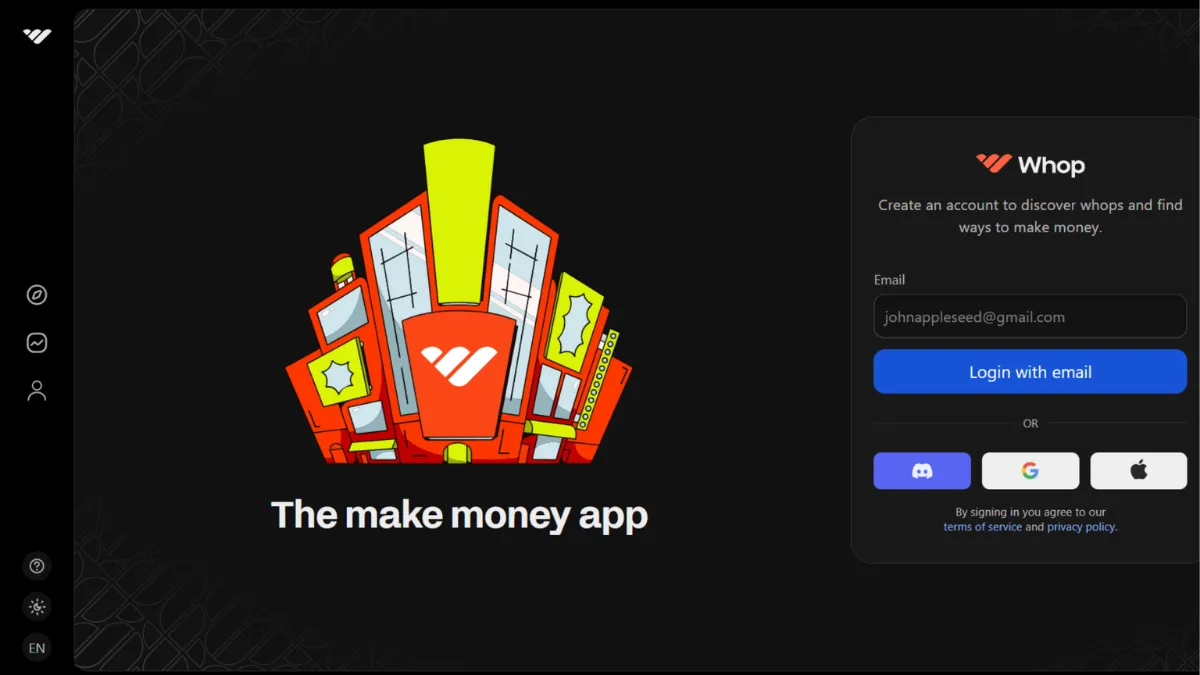
Selling digital products without a built-in audience means spending most of your energy on distribution rather than the product itself. Whop flips that equation by combining a creator storefront with a live marketplace where buyers already browse. You get a functional shop, community tools, payment processing, and organic discovery in a single backend, with no monthly subscription standing between you and your first sale. That combination is genuinely rare at this price point, and it is the reason Whop has become one of the most popular platforms for founders selling memberships, software access, courses, and digital communities.
The mechanism driving Whop is its modular app architecture. When you create a product, you are not just uploading a file and generating a checkout link. You are building a hub called a Whop, which can contain chat forums, course players, livestreams, Discord role assignments, coaching bookings, and more, each added as an individual app from a library of options. Payments flow through Whop's own processor, supporting card, PayPal, crypto, and buy-now-pay-later. Whop can also act as merchant of record for tax compliance, which removes a meaningful administrative burden for solo operators. Most new users underestimate how much of the setup is already done for them, and spend time looking for integrations that the platform already handles natively.
Realistic expectations matter here. The marketplace discovery feature gives your product organic exposure through Whop's Discover feed, but the quality of inbound traffic varies considerably by category. Finance and trading communities perform well on the platform. Education-focused products in less financially-oriented niches tend to see lower organic volume. You can absolutely build a profitable business on Whop using only your own traffic, with the marketplace as a bonus, but you should not launch expecting the platform to replace your own audience-building effort.
Whop is best suited to operators running subscription-based or community-driven digital businesses: think paid Discord servers, trading signals, SaaS access gates, cohort programmes, and knowledge communities. The platform was built around recurring revenue, and that use case is where its feature depth is strongest. Creators who primarily want a simple one-time-purchase storefront for static files will find it more powerful than they need, while those building complex multi-product subscription businesses will find it a strong operational fit.
The clearest limitation is customisation. Storefront design options are functional rather than flexible. You can set colours, upload a logo, and arrange your product layout, but you cannot build a fully branded web experience the way you would with Webflow or a dedicated landing page tool. If your brand presentation is a primary differentiator, Whop's aesthetic constraints will frustrate you.
The sections below cover how Whop works mechanically, where it genuinely adds value, what it costs in practice, and which alternatives are worth considering depending on your specific situation.
What Is Whop?
Whop is a digital commerce platform that lets creators and operators sell memberships, communities, software access, courses, downloads, and coaching from a single storefront. The problem it solves is fragmentation: most digital businesses at the early stage run on a patchwork of tools for payments, community, content delivery, and access management. Whop consolidates those layers into one backend, removing the integration overhead. What makes it different from a generic e-commerce platform like Shopify is its focus on digital-first, recurring-revenue products rather than physical goods, and its built-in marketplace where buyers discover products without any effort from the seller. The platform charges no monthly fee, taking only a transaction percentage when a sale is made, which keeps the barrier to entry low for operators who are not yet generating consistent revenue. Understanding how that fee structure actually works in practice, once automations are involved, reveals the detail most founders miss before committing.
How Whop Works
Setup starts with creating your Whop, which functions as both your storefront and your product hub. You configure your product, choose pricing (one-time, recurring, or lifetime), and add apps to define what buyers actually receive access to after purchase. Those apps include native chat, a course builder, a community forum, file delivery, video calls, and a Discord integration that automatically assigns server roles when a subscription is active or revokes them when it lapses.
Payments are processed through Whop's own gateway. Domestic card sales incur a 2.7% plus $0.30 base processing fee. If your product uses automations such as Discord or Telegram gating, a 3% platform fee applies on top, bringing your effective base rate to around 5.7% plus $0.30 before payout fees. International cards add a further 1.5%, and currency conversion adds another 1%. Payout fees vary by method. The headline pricing looks simpler than the actual cost structure, so you should run the numbers for your specific product type and audience geography before choosing Whop over a fixed monthly-fee alternative.
The counterintuitive insight most users miss: Whop's marketplace does not equally reward all product categories. The platform's organic discovery performs best for products with broad financial or entrepreneurial appeal. Niche educational content, creative tools, and B2B-adjacent services tend to generate less inbound traffic from the Discover feed. This does not make Whop a poor choice for those categories, but it does mean you should weight the marketplace feature less heavily in your decision if your product serves a specialised audience. Where Whop consistently wins is in the post-purchase experience: automated access, community hosting, and subscription management all work reliably without requiring Zapier automation or custom code to stitch together.
Whop Key Features
Modular product builder. Each Whop product is assembled from a library of apps rather than pre-set templates. You add a chat forum, a course player, a file library, or a livestream room depending on what your product actually needs. This architecture means a single product can serve as a community hub, a course platform, and a software delivery mechanism simultaneously, without requiring separate tools for each function. The practical value is that you ship a cohesive buyer experience from day one rather than patching together services.
Discord and Telegram gating. Whop's integrations with Discord and Telegram are deeper than a simple webhook. When a member subscribes, Whop assigns the relevant server role automatically. When they cancel or their payment fails, access is revoked without any manual intervention. For operators running paid Discord communities, this removes the most time-consuming administrative task entirely. The caveat is that this automation is what triggers the additional platform fee, so it raises your effective transaction cost.
Flexible payment and billing options. Buyers can pay via card, PayPal, cryptocurrency, and buy-now-pay-later. Sellers can offer one-time purchases, monthly or annual subscriptions, lifetime access, free trials, and promo codes, all within a single product. This billing flexibility lets you test pricing models without rebuilding your product infrastructure. Pair this with Stripe or PayPal as underlying processors and most standard billing requirements are covered.
Built-in marketplace with Discover. Your product is automatically listed on Whop's Discover feed, giving it organic exposure to buyers already on the platform. This is genuinely useful for new operators who lack an established audience. Traffic quality and volume depend on your category, but the feature costs nothing extra and requires no separate listing effort.
Affiliate and referral management. Whop includes native affiliate tracking, allowing you to set commission rates and give partners unique referral links. For operators who want to scale distribution through other creators or community members, this removes the need for a separate affiliate platform. The tooling is functional rather than sophisticated, which means high-volume affiliate programmes may eventually need a dedicated solution, but for early-stage operators it handles the basics well. Customisation depth across all these features is more limited than purpose-built alternatives, which is the trade-off S5 addresses directly.
Whop Pros and Cons
Where Whop earns its reputation:
- No monthly fee to start. You pay only when you sell. This makes Whop one of the lowest-risk platforms to launch on, particularly for operators who are validating a product before committing to fixed software costs.
- All-in-one digital delivery. Community, course, file delivery, access gating, and payments coexist in one backend. The reduction in tool sprawl is real and saves meaningful setup time for solo operators.
- Discord integration that actually works. Automated role assignment and revocation is reliable and well-executed. Comparable third-party bots require more configuration and break more often.
- Marketplace discoverability at no extra cost. Being listed on Whop's Discover feed gives every product some organic exposure without a separate content or advertising spend.
- Transaction fees compare favourably at scale. Against Patreon's 10% platform fee or Gumroad's comparable rates, Whop's structure is more competitive for high-volume sellers once you account for what each platform includes.
Where Whop falls short:
- Fee transparency requires careful reading. The headline 2.7% processing rate does not reflect your true cost if you use automations. Once the 3% platform fee and payout charges are included, effective rates run considerably higher than the marketing suggests.
- Storefront customisation is limited. You cannot build a fully branded web experience. Design options cover the basics but will not satisfy operators for whom visual identity is central to their product.
- Course tools lack depth for serious educators. The native course builder handles straightforward content delivery, but it does not offer quizzes, certificates, or structured learning paths at the level of a dedicated platform like Thinkific.
- Marketplace quality is uneven. Because Whop is free to start, the Discover feed includes a significant volume of low-quality and get-rich-quick adjacent products. This affects the brand perception of being listed alongside them.
- No native email marketing. Whop does not include an email tool. If you want to run campaigns to your member list, you need to connect a separate platform, which adds cost and integration effort.
How to Get the Most Out of Whop
Before you publish anything, spend time in the app library rather than going straight to your product page. Most new users add the minimum number of apps, go live, and then retrospectively bolt on community features after launch. The better approach is to design the post-purchase experience first: decide what a member will do in the first 48 hours, what keeps them engaged in month two, and which touchpoints signal renewal intent. Build those apps in before your first sale and your retention numbers will be materially better.
In your first week, prioritise your checkout page copy over your Discover listing. The Discover feed drives some organic traffic, but conversion happens on your product page, and most sellers underinvest in that copy. Write a clear outcome statement, show what is inside, and add one or two credibility signals. Do not rely on the platform to sell on your behalf.
For ongoing growth, treat your affiliate programme as a distribution channel rather than an afterthought. Set a meaningful commission rate before launch, not after you have already sold to your warmest contacts. Recruiting three to five affiliates who already have an audience in your category will consistently outperform the Discover feed for targeted inbound traffic.
The mistake most Whop operators make is treating the community feature as optional. A live, active community inside your Whop drives retention more effectively than any content drip sequence. Even a weekly discussion prompt or a pinned resource thread gives members a reason to return. Measure success by tracking monthly active members alongside revenue, not just subscriber count.
If you want to know how to sell digital products effectively on Whop, the answer comes down to specificity: a tightly defined product with a clear buyer outcome converts better than a broad membership with dozens of loosely related resources. Start narrow, validate the core offer, then expand the product hub once members tell you what else they want. Use Google Analytics connected to your checkout to track where converting traffic actually originates, which is often not where you expect it to be.
Who Should Use Whop?
This is for you if you are building a subscription-based digital business and want to avoid stitching together five separate tools to make it work. Three specific profiles fit well: a community operator running a paid Discord or Telegram group who needs reliable access gating and automated role management without custom bot setup; an early-stage creator validating a membership product who cannot justify a fixed monthly software fee before revenue is proven; and a solo developer or agency offering SaaS access or recurring software licences who wants payment processing, access management, and a storefront without building custom infrastructure.
Whop is not for you if your primary product is a structured online course with assessments, completion tracking, and certificates. The native course tooling does not meet that standard. It is also not a strong fit if design control is non-negotiable for your brand: operators who have invested in a visual identity and need pixel-level storefront control will find Whop's customisation options frustrating. And if you are running a high-volume affiliate programme that needs granular reporting, multi-tier commissions, or compliance features, you will outgrow Whop's affiliate tools quickly.
Whop Pricing
Whop has no monthly subscription fee. You pay a percentage of each sale, which makes it genuinely free to start. The base processing fee for domestic card transactions is 2.7% plus $0.30 per sale. If your product uses automations, specifically Discord, Telegram, or TradingView gating, an additional 3% platform fee applies, bringing the effective base rate to approximately 5.7% plus $0.30. International cards attract a further 1.5% surcharge, and currency conversion adds another 1%. Payout fees apply depending on withdrawal method and speed. The total cost for a typical international subscription sale, once all layers are counted, often sits between 6% and 8% of the transaction value before payout costs.
At low monthly revenue, the percentage model works strongly in your favour compared to platforms that charge a fixed subscription. As your monthly volume grows beyond a few thousand pounds, a fixed-fee platform may become cheaper in total cost. The free-to-start model rewards validation; operators at scale should run a cost comparison against platforms charging a monthly fee with lower or zero transaction rates. Always verify current fee details on Whop's pricing page, as specific rates are subject to change. Relative to the alternatives in S9, Whop's cost structure is competitive at entry level but warrants re-evaluation as revenue grows.
Whop vs Alternatives
Gumroad is the most common comparison point. Gumroad is faster to set up for a single file download and has a more mature API for custom integrations, but it lacks native community tools and charges a higher flat transaction rate. Choose Gumroad if you are selling a standalone digital file to your own audience and want the simplest possible checkout. Choose Whop when your product includes community access, recurring billing complexity, or Discord gating.
Stan Store targets social media creators who want a link-in-bio storefront with flat monthly pricing. It is more opinionated in its design and workflow, which suits creators who want a guided setup rather than a modular system. Stan Store charges a fixed monthly fee rather than transaction percentages, which can be cheaper for high-volume sellers. Whop wins on product flexibility and community depth; Stan Store wins on simplicity and predictable cost.
Thinkific is the right choice when your core product is a structured course with learning paths, quizzes, and completion certificates. It is purpose-built for education and goes considerably deeper than Whop's course app. Whop wins when community is as important as content delivery. Thinkific wins when the learning experience itself is the product.
Skool competes directly on the community-plus-course model. Skool charges a flat monthly fee and offers a more polished, gamified community experience with points and leaderboards built in. It lacks the product type flexibility Whop offers, specifically software licensing, file delivery, and crypto payments. Choose Skool for a course-plus-community product where engagement mechanics matter. Choose Whop for broader product variety and lower entry cost.
Whop Review: Final Verdict
Whop earns a 4.19 out of 5 overall. That score reflects a platform that genuinely solves the fragmentation problem for digital operators, delivering community, payments, access management, and marketplace exposure in one place without a monthly fee. Its highest dimension is functionality at 4.5, justified by the breadth of product types and the modular app architecture. Cost efficiency scores 3.8, reflecting the gap between the headline pricing and the real effective rate once automations and payout fees are included: a limitation that deserves honest consideration before you commit.
The bottom line: if you are launching or validating a subscription-based digital product and want to move fast without stitching together multiple tools, Whop is one of the strongest options available at this price point. Verify current fees on Whop's pricing page before building your margin assumptions.
How We Rated It:
More Tool Reviews



Subscribe to Stay in the loop
Get the latest AI and technology news, honest tool reviews, and practical guides delivered straight to your inbox.
Success! Check your Inbox!

Tezons Newsletter
The latest technology news, in-depth tool reviews, and practical guides - curated and delivered to your inbox.
Latest News




Have a question?
Have any questions?
Didn’t find what you were looking for? We’re just a message away.