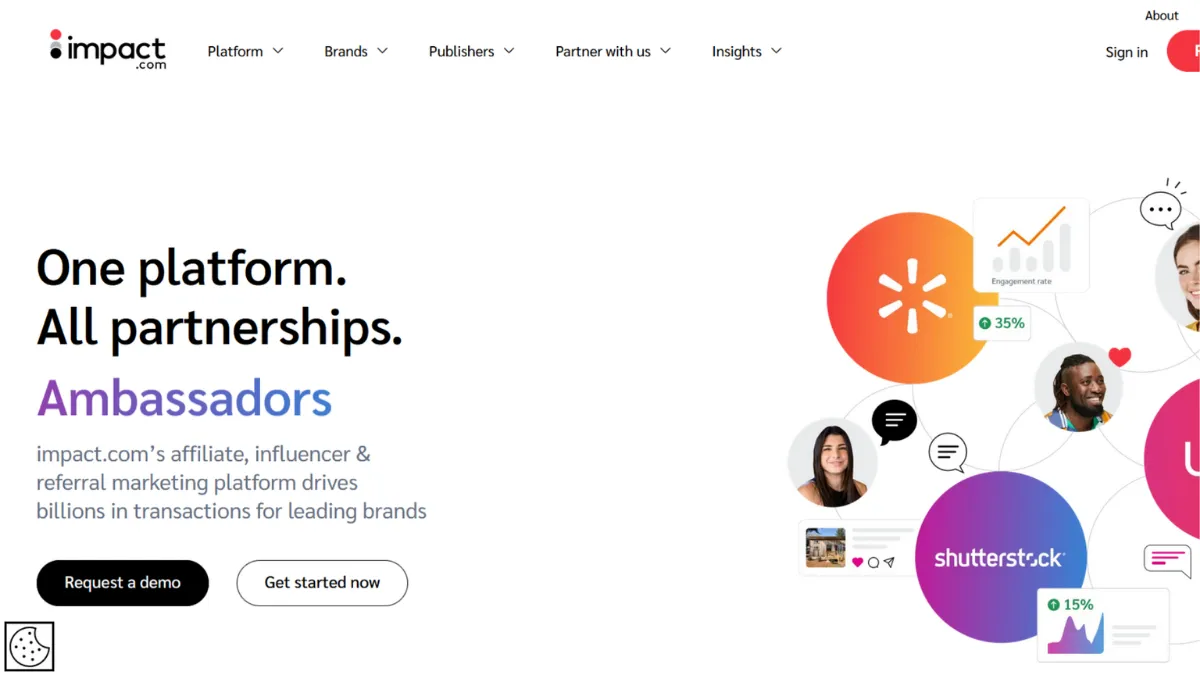
Partnership programmes fail not because brands lack affiliates, but because they lack the infrastructure to manage them properly. Most affiliate platforms were built for a simpler era: post a link, track a click, send a cheque. Impact.com was built for something more ambitious. It treats every partner relationship, whether that is a content creator, a loyalty site, a B2B reseller, or a brand ambassador, as a managed commercial relationship with a contract, a performance record, and automated payment logic behind it. The result is one of the most capable partnership management platforms available, provided your programme is large enough to justify the complexity and cost.
The mechanism that separates impact.com from a standard affiliate network is its full-lifecycle approach. You are not simply joining a marketplace and hoping partners apply. Instead, you recruit partners through the platform's discovery tools, negotiate and sign contracts inside the platform, track performance across every touchpoint using cross-device attribution, and trigger automated payouts based on the rules you set. Each stage feeds the next. The brands that get the most from impact.com tend to be the ones that treat it as a system to build around rather than a tool to log into when they want to check a report. Most users who underperform on the platform do so because they configure it once and expect it to run itself.
Realistically, you should expect three to six months before a programme built on impact.com starts generating meaningful, predictable revenue. The first month is largely onboarding and integration work. The second involves recruiting a core set of partners and testing commission structures. Results compound as you identify which partner types convert well and optimise terms accordingly. Brands with existing affiliate programmes migrating to the platform often see the strongest early traction, because they bring a partner list with them. Starting entirely from scratch takes longer, even with the platform's AI-powered partner recommendations.
Impact.com is built for brands running programmes at scale, typically those managing more than a handful of active partners across multiple channels. It suits mid-market and enterprise e-commerce businesses, subscription products with strong average order values, and any brand that wants to manage influencer relationships and affiliate relationships inside a single system rather than juggling separate tools.
The platform is not a straightforward starting point. Onboarding involves technical integration work, a one-time setup fee, and a learning curve that most solo founders or very early-stage teams will find steep. The depth that makes it powerful for a seasoned programme manager is the same depth that makes it slow to get off the ground for someone new to partnership marketing. The interface has improved, but new users consistently report confusion during the initial configuration phase.
The sections below cover how the platform works mechanically, which features matter most, and how it stacks up against the alternatives you are likely to be weighing against it.
What Is Impact.com?
Impact.com is a partnership management platform that enables brands to recruit, contract, track, pay, and optimise relationships with affiliates, influencers, content publishers, strategic partners, and mobile apps from a single interface. The problem it solves is the operational chaos that grows when a brand's partner programme scales beyond what spreadsheets and email threads can manage. Where a traditional affiliate network acts as a marketplace that connects you to a pool of publishers, impact.com gives you the infrastructure to run your own programme with full control over partner terms, attribution logic, and payment rules. The company was founded in 2008 as Impact Radius, acquired complementary fraud detection and attribution products over the following decade, and rebranded to impact.com in 2018. It now counts thousands of brands across retail, financial services, travel, and software among its client base, and has been ranked the top affiliate network by the Blue Book performance marketing survey. The relevant question for any brand evaluating it is not whether it is powerful, but how it actually translates that power into partner results at the programme level.
How Impact.com Works
Setting up impact.com as a brand starts with a technical integration: connecting your e-commerce platform or website so that the tracking pixel or server-to-server integration can pass conversion data back to the platform. Impact.com supports direct integration with Shopify, WooCommerce, and other major platforms, as well as API-level connections for custom builds. This step is non-negotiable and is where most onboarding timelines slip. Get it wrong and your attribution data is unreliable from day one.
Once tracking is live, you set up your programme terms: commission rates, cookie windows, attribution models, and any tiered bonuses for high-performing partners. The platform then lets you build a branded partner portal that prospective affiliates and influencers apply through. You can either approve applicants manually or set automated approval rules based on criteria such as audience size or content category. After a partner is approved, their unique tracking links go live and every conversion they drive flows into your reporting dashboard.
The attribution engine is one of the more sophisticated elements. Rather than defaulting to last-click attribution, which overpays whichever partner was last in the funnel, impact.com allows you to build multi-touch models that credit partners based on their actual role in the customer journey. This changes the economics of the programme significantly. Partners who drive early awareness, such as content publishers or review sites, get credited for their contribution rather than being systematically undervalued. The counterintuitive thing most brands assume wrong about the platform is that better attribution will reduce total costs. It often does the opposite initially: accurate attribution reveals how many touchpoints were genuinely involved in a sale, and commission obligations rise accordingly until you rebalance your rates. Understanding that dynamic before you go live shapes how you structure your programme from the outset, and that structure is what the features section covers in detail.
Impact.com Key Features
Impact.com covers a wide surface area of partnership management, and five features in particular define how it performs in practice.
Partner Discovery and Recruitment. The platform includes a marketplace of publishers, creators, and affiliates that brands can search and filter by category, audience, and performance data. An AI-powered recommendation engine surfaces potential partners relevant to your programme based on your category and existing partner set. This is meaningfully different from simply browsing a directory, because the system weighs match quality rather than just listing available publishers. The practical implication is that brands can move from a cold start to an active shortlist of partner candidates without relying entirely on outbound outreach, though high-value partners still require direct relationship-building.
Automated Contract and Payment Management. Rather than managing commission agreements through email and external documents, impact.com handles contract creation, signing, and payment execution inside the platform. You set the commission logic once, whether flat fee, percentage of sale, tiered by volume, or event-based, and the system calculates and disburses payments automatically on your schedule. This removes a significant manual overhead for programmes with dozens or hundreds of active partners and reduces the risk of payment disputes caused by calculation errors.
Cross-Device and Multi-Touch Attribution. Impact.com's tracking goes beyond single-session cookie attribution. It follows a user's journey across devices and attributes partial credit to multiple partners based on the model you configure. For brands running programmes that include both upper-funnel content partners and lower-funnel coupon or cashback sites, this distinction is commercially significant. It allows you to make rational decisions about which partner types to invest in rather than defaulting to paying whoever happened to drop the last cookie.
Fraud Detection. The platform employs machine learning to flag suspicious traffic patterns, invalid clicks, and attribution manipulation. This matters because affiliate fraud, including cookie stuffing and fake conversions, is a real and ongoing problem in performance marketing. Having fraud protection built into the platform rather than bolted on as a third-party tool means the data feeding your decision-making is cleaner from the start.
Reporting and Analytics Dashboards. Impact.com's reporting layer gives programme managers granular visibility into partner performance, conversion path data, revenue contribution, and trend analysis. Custom dashboards are available on higher tiers. The depth of the data is a genuine strength. The limitation is that extracting meaningful insights requires familiarity with the platform's reporting structure, which is not immediately intuitive for new users. That usability gap is exactly what the pros and cons section addresses.
Impact.com Pros and Cons
Impact.com earns its reputation in areas that matter for scaling programmes, but it carries real trade-offs worth weighing before committing.
- Enterprise-grade attribution. The multi-touch attribution engine is one of the most configurable in the category. You can build models that reflect how your customers actually buy rather than accepting the oversimplified last-click default. This translates to more rational commission spend and a more defensible programme economics over time.
- Unified partner management. Managing affiliates, influencers, brand-to-brand partners, and app-based partnerships inside a single platform removes the operational cost of running parallel tools. Teams using HubSpot or Salesforce for CRM alongside a separate affiliate tool will appreciate having partner relationship data centralised.
- Payment automation at scale. Automated commission calculation and disbursement across a large partner set is a meaningful operational saving. The platform handles currency conversion and supports a range of payment methods, which is relevant for brands running international programmes.
- Fraud protection built in. Having machine learning fraud detection as part of the core platform, rather than an add-on, means it operates across all tracking data continuously rather than in periodic audits.
- Strong partner marketplace. Access to a large pool of publishers and creators with verifiable performance data gives brands a head start on recruitment that purely self-hosted affiliate software cannot match.
The cons are significant enough to determine whether impact.com is the right choice at your current stage.
- Steep onboarding curve. New users consistently report that the initial configuration is complex and time-consuming. The platform's depth works against you during setup, and the one-time onboarding fee adds cost before you have seen any programme results.
- Pricing opacity and cost at scale. Pricing is not transparently published beyond the entry Starter tier, and enterprise-level plans require a sales conversation before you know what you will pay. The effective cost once you factor in programme fees, payment volume charges, and platform subscription can be substantially higher than initial estimates.
- Not suited to very small programmes. Brands with fewer than a small number of active partners will find the platform's complexity out of proportion to their needs. Simpler tools will give faster results with less overhead.
- Publisher access is curated, not open. Unlike some networks that allow any publisher to join, impact.com's approach means that smaller affiliates may find fewer accessible programmes. For brands wanting a large volume of smaller affiliates, this selectivity can limit the bottom of the recruitment funnel.
- Support is tier-dependent. Access to responsive, dedicated support is weighted toward higher-paying clients. Starter-tier users report a meaningful gap between the support experience and what higher-tier customers receive.
How to Get the Most Out of Impact.com
Before you go live, invest time in getting the technical integration right. Server-to-server tracking is more reliable than pixel-based tracking, particularly for mobile users and browsers with aggressive cookie restrictions. If you skip this step or implement it partially, your attribution data will be incomplete from day one and every decision you make downstream will rest on unreliable numbers.
In the first week after launch, resist the temptation to approve every partner who applies. Set clear approval criteria and review each applicant against them. A smaller group of well-matched partners will consistently outperform a large group of misaligned ones, and a bloated partner list creates reporting noise that obscures which relationships are actually driving value.
Building results over time on impact.com is largely a process of iteration: identify which partner types convert at the best margin, adjust commission structures to incentivise those partners, and use the reporting layer to catch fraud patterns early before they distort your data. Set up automated alerts for unusual traffic spikes from individual partners rather than relying on manual periodic reviews.
The mistake most brands make is treating impact.com as a set-and-forget system. The platform is powerful when a programme manager is actively working it: negotiating improved terms with top performers, running recruitment outreach to specific partner categories, and reviewing attribution path data to spot gaps. If you want to understand how to build and scale an affiliate programme using impact.com's full toolset, the platform's own certification and resource library is worth working through before you begin, since it teaches the mental models the product is built around.
Measure success by revenue per active partner rather than total partner count. A rising headcount with flat revenue is a warning sign, not a growth signal. Complement impact.com's data with whatever analytics tool you use for your wider marketing, such as Google Analytics, to validate that partnership traffic is contributing to actual business outcomes rather than isolated conversion events.
Who Should Use Impact.com?
This is for you if you are running a programme that has grown beyond what simpler tools can manage. Three specific profiles get clear value from the platform.
You are a mid-market e-commerce brand with an established affiliate programme and a team member whose role includes managing partner relationships. You need contract management, automated payouts, and attribution data that goes beyond last-click. You have the technical resource to implement server-to-server tracking and the programme volume to justify the cost.
You are a subscription business managing a mix of content publishers, influencer partners, and loyalty sites, and you want to bring all of those relationships into one system rather than running separate tools for each. The unified management layer and multi-touch attribution are the specific features that solve your problem.
You are a larger brand with an international programme. Impact.com's support for multi-currency payouts, cross-device tracking, and a marketplace of global publishers makes it a realistic choice for programmes that operate across regions with meaningfully different partner mixes.
Impact.com is not the right fit if you are a solo founder or early-stage team launching your first affiliate programme with no existing partner base. The onboarding complexity, upfront costs, and learning curve will slow you down rather than accelerate you. A simpler tool with lower friction will get you to your first ten active partners faster. Equally, pure SaaS businesses focused on B2B recurring revenue will find PartnerStack better aligned to their programme structure and partner type.
Impact.com Pricing
Impact.com does not publish a full pricing schedule on its website. Entry-level access through the Starter tier is publicly documented at around $30 per month, though the platform applies a revenue-based fee structure in addition to the monthly subscription, meaning that actual cost rises with programme volume. Mid-tier and enterprise plans are quoted through a sales process, and user reports indicate that brands running active programmes at scale typically pay substantially more once all fees are accounted for. There is also a one-time onboarding fee that varies by the technical complexity of your setup. Publishers and affiliates join the network for free, though they must apply and be accepted.
The Starter tier is adequate for testing the platform's mechanics but lacks the automation and reporting depth that makes impact.com genuinely useful. Most brands that commit to it for serious programme management will end up on a higher tier. Always confirm current rates directly on impact.com's pricing page before budgeting, as the fee structure has historically been adjusted. Relative to alternatives, impact.com sits at the premium end of the category, which is a reasonable position given its feature depth, but it makes the cost-benefit calculation unfavourable for smaller programmes. That pricing context shapes how the platform compares against its direct competitors.
Impact.com vs Alternatives
The four most common alternatives that brands evaluate alongside impact.com each serve a meaningfully different use case.
PartnerStack is purpose-built for SaaS and B2B software companies. If your programme centres on recurring subscription commissions and reseller relationships rather than e-commerce transactions, PartnerStack's architecture fits that model more naturally than impact.com's. Choose PartnerStack when your partners are primarily other software businesses or agencies. Impact.com wins when you need to manage physical product affiliates, influencers, and content publishers in the same programme.
CJ Affiliate (Commission Junction) has a larger open publisher network and lower barriers to entry for both brands and affiliates. If you want access to a high volume of smaller publishers quickly and do not need impact.com's contract management or attribution sophistication, CJ is a credible alternative. Impact.com wins on data quality and programme control; CJ wins on network breadth and accessibility.
Awin is particularly strong for European brands and programmes that need a large established publisher base in UK and EU markets. It operates a more traditional network model, which suits brands that want a simpler operational structure. Impact.com wins when you need automation and attribution depth; Awin wins when European reach and publisher volume are the priority.
ClickBank operates in a different segment entirely, primarily digital products and information offers with high commission rates. If your product fits that category and you want access to a marketplace of performance-focused publishers, ClickBank is worth evaluating. Impact.com wins on brand control and programme sophistication for most mainstream product categories.
Impact.com Review: Final Verdict
Impact.com earns a 4.21 overall score, reflecting a platform that is genuinely best-in-class for partnership attribution and automation but carries real costs in pricing transparency and onboarding complexity. Its ratingAccuracy of 4.6 reflects consistently reliable tracking and fraud protection, while its ratingCostEfficiency of 3.7 reflects the reality that the platform's price point and fee structure make it a difficult value proposition for anything below mid-market programme volumes.
The bottom line: if you are running a partnership programme that has outgrown simpler tools and you have the budget, technical resource, and team focus to operate it properly, impact.com is the strongest platform in the category. If you are not yet there, start somewhere simpler and migrate when the complexity is worth it.
How We Rated It:
More Tool Reviews





Subscribe to Stay in the loop
Get the latest AI and technology news, honest tool reviews, and practical guides delivered straight to your inbox.
Success! Check your Inbox!

Tezons Newsletter
The latest technology news, in-depth tool reviews, and practical guides - curated and delivered to your inbox.
Latest News




Have a question?
Have any questions?
Didn’t find what you were looking for? We’re just a message away.