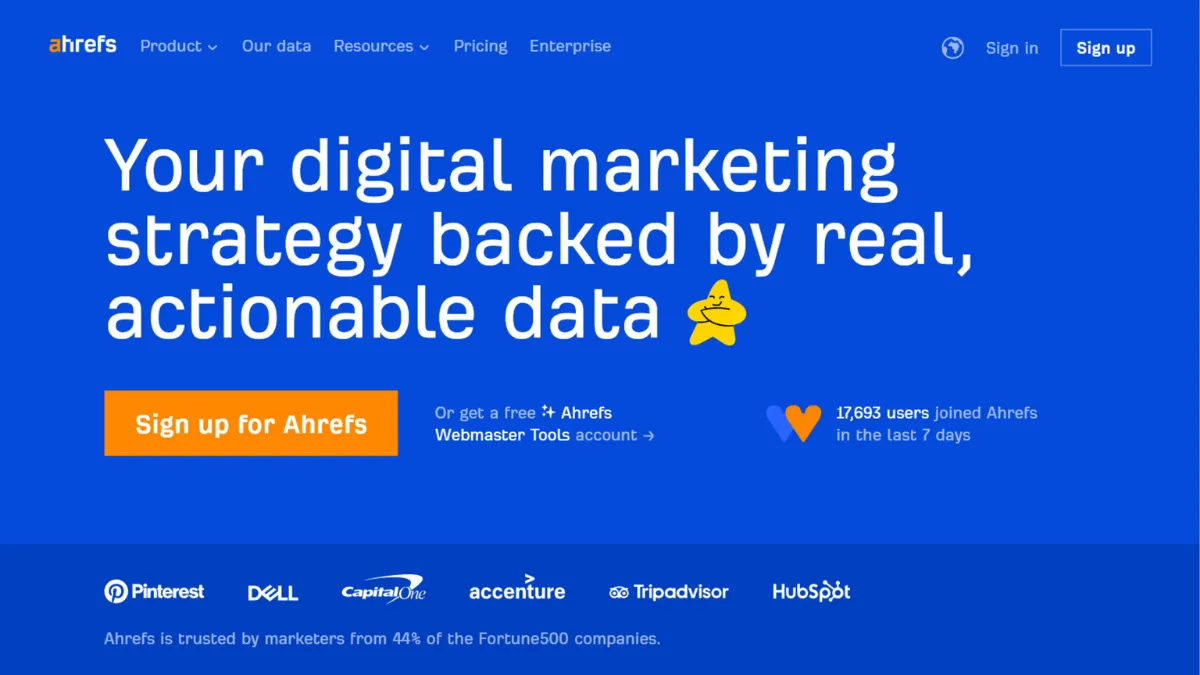
Serious SEO work does not tolerate guesswork, and Ahrefs has built its reputation on giving you data that is accurate enough to act on. This is not a tool for dipping a toe into search optimisation. It is a professional platform built around one of the largest backlink indices on the web, a keyword database spanning over 110 billion terms, and a crawler infrastructure that operates at a scale most competitors cannot match. If you are running content strategy, link building, or competitive analysis at anything beyond a hobby level, Ahrefs is the benchmark you are measuring against, not the tool you are graduating away from.
The platform works by continuously crawling the web and refreshing its indices so that the data you pull reflects current reality rather than a historical snapshot. Its core loop is built on three interconnected tools: Site Explorer surfaces the full backlink and organic traffic picture for any domain you point it at, Keywords Explorer maps the keyword opportunity space with difficulty scores and traffic potential estimates, and Content Explorer scans a database of nearly 17 billion pages to surface link prospects and content ideas. Each tool feeds the others. You research a competitor in Site Explorer, identify the pages earning their best links, reverse-engineer the topic in Keywords Explorer, then use Content Explorer to find who is already linking to similar content. Done well, this process turns competitive intelligence into a concrete outreach and content calendar. Most users underuse Site Explorer by treating it as a backlink checker rather than a full competitive research station, which means they miss the organic traffic data that reveals which pages are actually driving results for rivals.
Realistic expectations matter here. Ahrefs gives you the data; it does not build the strategy for you. A well-run site audit using the Site Audit tool will surface technical issues you can fix, but resolving those issues and improving rankings still requires editorial judgement and execution. Similarly, a keyword difficulty score of 25 does not guarantee you rank within three months. It means ranking is achievable, not that it is automatic. Budget for two to six months of consistent content and link-building effort before organic results compound meaningfully.
Ahrefs suits SEO professionals, content strategists at growth-stage startups, and digital marketing agencies managing multiple client accounts. It is specifically strong for anyone whose primary growth channel is organic search, who is running an active link-building programme, or who needs to audit a site with hundreds or thousands of pages. The depth of the toolset rewards structured, systematic use.
The genuine limitation is cost. Entry-level access starts at a price point that prices out solopreneurs and early-stage founders who are not yet generating meaningful organic traffic. The credit-based usage quota on lower-tier plans adds friction during intensive research sprints, and premium add-ons for features like Brand Radar and Content Kit push the total spend well beyond the base subscription for teams that need the full platform.
The sections below cover how Ahrefs works mechanically, what each core feature delivers, who gets the most value at which tier, and how it stacks up against the main alternatives.
What Is Ahrefs?
Ahrefs is an SEO and marketing intelligence platform built around proprietary web crawling infrastructure. The problem it solves is one of visibility: without reliable data on which keywords to target, which pages are earning links, and how competitors are performing in search, most content and SEO efforts are informed by intuition rather than evidence. Ahrefs replaces that intuition with a structured data layer covering backlinks, organic keywords, paid keywords, traffic estimates, and site health across virtually any domain on the internet. What separates it from a generic SEO tool is scale and freshness. Its backlink index is one of the largest available to commercial users, and the crawler refreshes data frequently enough that the competitive picture you are looking at is not weeks out of date. Ahrefs has expanded significantly beyond its backlink-analysis origins to cover rank tracking, site auditing, content discovery, local SEO, social media scheduling, and AI-assisted content creation, making it closer to a full marketing stack than a single-purpose research tool. The natural question, given that breadth, is how well each tool works in practice and whether the platform earns its premium price at each tier.
How Ahrefs Works
Ahrefs runs its own web crawler, AhrefsBot, which is one of the most active on the internet. The crawler continuously visits pages, follows links, and indexes data into databases that power every tool in the platform. When you run a Site Explorer report on a competitor's domain, you are querying a live index rather than waiting for a fresh crawl to complete. That architecture means the data is available immediately but also means you are working with Ahrefs' interpretation of the web rather than raw crawl data you control.
Setup is straightforward. You verify ownership of your site through Google Search Console integration or an HTML tag, connect your GSC data, and your own site's organic performance flows directly into the dashboard. From there, a Site Audit crawl runs on a schedule you set, returning a health score and a prioritised list of technical issues. Rank Tracker pulls in your target keywords and plots position history over time, with competitor Share of Voice visible in the same view.
Output quality depends on how you configure your projects and how systematically you build your keyword lists. Ahrefs' keyword difficulty score uses a model based on the backlink profiles of current top-ranking pages. A low-difficulty keyword does not mean low competition in an absolute sense; it means the pages currently ranking for it have relatively weak backlink profiles. This distinction trips up many new users, who conflate difficulty with overall competition and either over-target hard keywords or under-invest in moderately competitive terms where they could win quickly. The counterintuitive insight is that a keyword with modest search volume and a difficulty of 15 frequently delivers more traffic than a high-volume keyword at difficulty 60, because you can rank for the first and realistically cannot rank for the second without a years-long link-building effort. Understanding that volume and achievability are separate dimensions is what separates Ahrefs users who get results from those who build content calendars they cannot execute. The practical implication is that your keyword strategy should be filtered by both traffic potential and your current domain's backlink profile strength, which Site Explorer quantifies as Domain Rating.
Ahrefs Key Features
Site Explorer. Site Explorer is the heart of the platform and its most powerful tool for competitive research. Point it at any URL or domain and it returns the full backlink profile, organic keyword rankings, estimated traffic, and paid search data. The most productive use is not checking your own site but dissecting competitors: find the pages earning their best links, understand what search intent those pages satisfy, and identify the gap between their position and yours. Filtered link reports let you surface newly acquired links, broken links pointing at competitors, and anchor text distributions that reveal how a site has built authority over time. Pairing Site Explorer with Google Analytics data from your own site gives you a complete picture of where organic traffic is coming from and where competitors are winning ground you have not yet targeted.
Keywords Explorer. With over 110 billion keywords indexed across 170 countries, Keywords Explorer is built for scale. Each keyword entry returns difficulty scores, search volume, traffic potential, click distribution between organic and paid results, and a SERP overview showing current top-ranking pages with their backlink counts. The parent topic clustering feature groups related terms so you can plan content that targets multiple keywords within a single page rather than building a fragmented architecture that splits authority across thin posts. Traffic potential, which estimates the total traffic the top-ranking page earns from all related keywords, is consistently more useful than raw search volume when sizing an opportunity.
Site Audit. Site Audit crawls your domain on a schedule you define and returns a prioritised health score alongside specific technical issues, grouped by severity. It surfaces crawl errors, duplicate content, slow pages, missing metadata, broken internal links, and orphaned pages that are not receiving any internal link equity. The structured issue list makes it actionable for both technical SEO specialists and developers who need a concrete task list rather than a narrative report. Teams running Notion or similar project management tools often pipe audit outputs directly into their sprint backlog.
Content Explorer. Content Explorer searches a database of nearly 17 billion pages, filtering by metrics like Domain Rating, organic traffic, and number of referring domains. Its primary use cases are link prospecting and content ideation. You search a topic, filter for pages with meaningful traffic but modest Domain Rating, and surface sites that are already linking to content in your niche and are likely receptive to outreach. The broken link building workflow within Content Explorer, where you find content in your space that has gone offline but still attracts links, is one of the highest-conversion link acquisition methods available in any platform.
Rank Tracker. Rank Tracker monitors your keyword positions on both desktop and mobile across 190 countries, with competitor Share of Voice overlaid on the same chart. The GSC integration surfaces anonymous queries that Google does not expose in raw Search Console data, which frequently reveals keyword clusters driving impressions that your current content is not fully capturing. The practical limit on lower-tier plans is the number of tracked keywords, which forces prioritisation and can frustrate teams with large, multi-market keyword sets. This restriction is worth understanding before committing to a plan tier.
Ahrefs Pros and Cons
Ahrefs earns its position as a category leader on several dimensions, but it carries real trade-offs that should factor into your decision.
- Backlink data depth. The backlink index is one of the largest commercially available. For any serious link-building programme, the breadth of referring domain data and the freshness of index updates make Ahrefs the most reliable source for prospecting and profile monitoring.
- Keyword research precision. Traffic potential as a metric is a genuine differentiator. It shifts the frame from ranking for one keyword to capturing the full topical cluster, which is how modern search actually distributes clicks across a results page.
- All-in-one architecture. Having Site Explorer, Keywords Explorer, Site Audit, Rank Tracker, and Content Explorer under one login eliminates the workflow friction of stitching multiple tools together. Teams that previously used separate tools for auditing and research save meaningful time in a consolidated setup.
- API quality. The Ahrefs API covers over 100 endpoints across all core tools, with RESTful design and solid documentation. Agencies and in-house teams building custom dashboards or automated reporting pipelines have a reliable foundation to build on.
The platform also carries weaknesses that are worth naming directly.
- Pricing is steep and has risen sharply. The entry-level Lite plan is significantly more expensive than it was before the most recent pricing revision, and the credit-based quota system on lower tiers limits how aggressively you can research during intensive sprints without incurring additional costs.
- No free trial. Committing a meaningful monthly spend without the ability to test workflows in advance is a genuine barrier, particularly for teams new to professional SEO tooling who cannot self-evaluate from a demo alone.
- Add-on costs compound quickly. Brand Radar, the Content Kit, and Project Boost add-ons each carry their own monthly fees. Teams that need the full feature surface will pay substantially more than the base plan price suggests.
- Lower-tier plans restrict team access. User seat limits on entry plans make Ahrefs awkward for small teams where multiple people need simultaneous access. Adding seats costs extra, and this is easy to underestimate when budgeting.
How to Get the Most Out of Ahrefs
Before you run a single report, connect your Google Search Console account and complete a full Site Audit crawl. This baseline gives you a health score to improve and surfaces technical issues that suppress ranking potential regardless of how strong your content or link profile becomes. Technical debt resolved before a content push compounds the returns from everything you publish subsequently.
In your first week, prioritise three reports: a Site Explorer analysis of your two or three closest competitors, a Keywords Explorer pass on your core topic cluster filtered by difficulty and traffic potential, and a Content Explorer search for link prospects in your niche. These three inputs should produce a content brief, a keyword priority list, and an outreach target list within a few days of getting started.
Building results over time requires consistent use of Rank Tracker to measure Share of Voice movement, not just individual keyword positions. Share of Voice gives a cleaner signal about whether your overall organic presence is growing, because it accounts for position across all tracked keywords rather than treating each ranking in isolation. Reviewing this monthly alongside the Site Audit health score creates a feedback loop between technical health, content output, and ranking momentum.
The mistake most Ahrefs users make is running ad hoc reports without a systematic process behind them. The platform rewards documented workflows: a repeatable competitor audit cadence, a monthly keyword gap analysis against the same set of rivals, and a Content Explorer prospecting session tied directly to outreach. Without that structure, Ahrefs becomes an expensive source of interesting data that does not compound into ranking results.
For anyone asking how to do keyword research with Ahrefs effectively, the answer is to start with your competitors rather than a blank keyword list. Site Explorer reveals which keywords are already driving their traffic. Filter for keywords where they rank in positions four through twenty, because those are the gaps where a well-constructed page with targeted links can realistically move the needle within a planning horizon you can commit to.
Measure success by three metrics: Domain Rating trajectory (are you earning links consistently?), Share of Voice change over rolling 90-day periods, and organic traffic growth attributed to pages you have actively optimised or built. If all three are moving in the right direction, your Ahrefs workflow is working.
Who Should Use Ahrefs?
This is for you if you are running an active SEO programme with a clear content and link-building strategy. Three profiles get the most value: a content marketing lead at a growth-stage SaaS company who needs to map keyword opportunity against competitors and build a 12-month editorial calendar grounded in data rather than assumptions; an SEO agency managing multiple client accounts who needs a single platform for audits, rank tracking, and link prospecting across different domains; and an in-house SEO specialist at an established e-commerce or media brand who needs to monitor technical health at scale and track Share of Voice against a defined competitor set. In all three cases, the depth of the data and the tool interconnection justify the cost.
Ahrefs is not for you if you are a solopreneur or early-stage founder who has not yet built content as a primary growth channel. At that stage, you cannot execute at a pace that amortises the cost, and a lighter tool will serve your actual needs better. It is also a poor fit if your primary acquisition channel is paid social or direct outreach rather than organic search, because you will be paying for infrastructure you use sporadically rather than systematically.
Ahrefs Pricing
Ahrefs does not offer a free trial. There is a free Ahrefs Webmaster Tools account that gives limited Site Explorer and Site Audit access for domains you own, which is worth activating if you want to test the interface before committing, but it does not give you access to competitor research or Keywords Explorer at any useful depth.
Paid plans start at the Lite level and move through Standard, Advanced, and Enterprise tiers. Entry-level monthly pricing is in the range of $129, with Standard around $249, Advanced around $449, and Enterprise starting from $1,499, though these figures change and you should verify current rates directly on the Ahrefs pricing page. Annual billing reduces the effective monthly cost. The Lite plan suits individual consultants running research for a single site or small client roster. Standard is the practical choice for most solo SEO professionals or small teams who need more historical data and fewer credit restrictions. Advanced unlocks additional user seats and features relevant to larger teams. The credit-based quota on lower plans is the detail most buyers miss: intensive research days can exhaust monthly credits faster than expected, and the overage cost structure matters when you are evaluating true total cost.
Relative to Semrush, the pricing is broadly comparable at the mid tier, though the feature mix differs and the right choice depends on where your workflow concentrates. Both represent a meaningful investment, and the next section covers that comparison directly.
Ahrefs vs Alternatives
The four tools most directly comparable to Ahrefs are Semrush, Moz Pro, Majestic, and Surfer SEO, and each suits a different situation.
Semrush is the closest equivalent in terms of breadth. It covers SEO, PPC, content marketing, and social monitoring within a single platform. Semrush tends to have a slight edge in paid search data and advertising intelligence, while Ahrefs is generally regarded as superior for backlink data depth and keyword research precision. Choose Semrush if paid search is a significant part of your programme; Ahrefs wins for pure organic SEO and link building.
Moz Pro targets a more accessible price point and is friendlier for teams new to professional SEO tooling. Its Domain Authority metric remains widely referenced, but the backlink index is smaller and less frequently refreshed than Ahrefs'. Choose Moz Pro if budget is a hard constraint and the team is earlier in its SEO maturity. Ahrefs wins on data quality as soon as the use case requires precision.
Surfer SEO occupies a different position: it focuses on on-page content optimisation rather than backlink analysis or technical auditing. It is a complement to Ahrefs for teams that use Ahrefs for research and Surfer for content grading, not a replacement. If your primary bottleneck is writing optimised content rather than finding the right keywords or building links, Surfer addresses that gap more directly.
Majestic specialises narrowly in backlink analysis and offers a large index at a lower price point. For teams whose only need is link data and who do not require keyword research or rank tracking, Majestic is worth considering. Ahrefs wins the moment the workflow extends beyond link analysis into keyword research, auditing, or content discovery.
Ahrefs Review: Final Verdict
Ahrefs earns an overall score of 4.38 out of 5, reflecting its standing as the strongest all-round SEO platform available to professional users. Its accuracy and reliability score of 4.8 reflects a backlink and keyword dataset that practitioners consistently trust for strategic decisions. The cost-efficiency score of 3.7 is the honest counterweight: the pricing revisions have made entry-level access less accessible, and the credit quota system on lower plans adds friction that more generously structured competitors do not impose. If you are running SEO seriously, the data quality justifies the cost. If you are not yet at a stage where organic search is a primary channel, start elsewhere and return when you are ready to use it systematically.
How We Rated It:
More Tool Reviews




Subscribe to Stay in the loop
Get the latest AI and technology news, honest tool reviews, and practical guides delivered straight to your inbox.
Success! Check your Inbox!

Tezons Newsletter
The latest technology news, in-depth tool reviews, and practical guides - curated and delivered to your inbox.
Latest News




Have a question?
Have any questions?
Didn’t find what you were looking for? We’re just a message away.