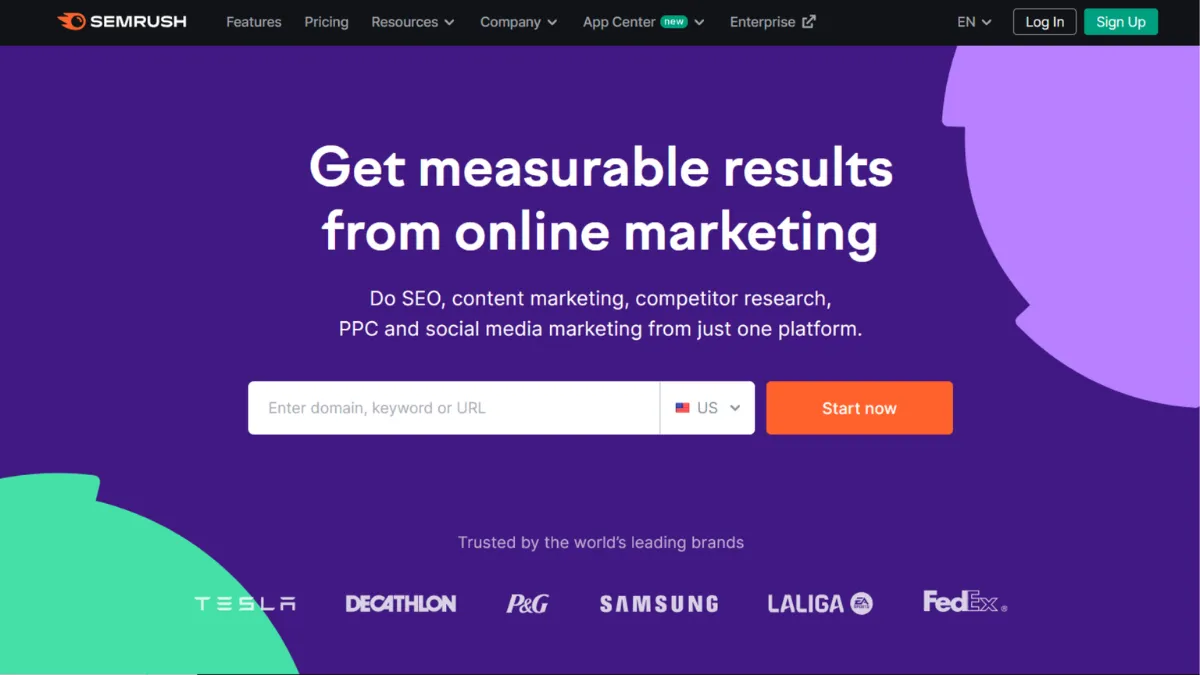
Organic search is one of the few acquisition channels that compounds over time, and Semrush is the platform most serious teams use to build and protect that asset. With over 55 tools covering keyword research, competitive intelligence, technical auditing, link building, and content optimisation, it occupies the top tier of the SEO software market. The platform scores 4.40 overall in this review, a number that reflects genuine breadth and data quality at a price point that demands you use it properly. Founders who treat it as a keyword lookup tool will feel they are overpaying. Teams who embed it across their entire search workflow will wonder how they managed without it.
Semrush works by aggregating data across a database of over 27 billion keywords and 43 trillion backlinks, then surfacing that data through interconnected tools that cover every stage of an SEO campaign. The Keyword Magic Tool generates keyword clusters from a single seed term, showing search volume, keyword difficulty, intent signals, and SERP feature opportunities. Site Audit crawls up to 100,000 pages per project, flagging over 140 technical issues by severity so you can triage what matters. Position Tracking delivers daily ranking updates per keyword, per location, and per device. The most common mistake is treating each tool in isolation. Semrush's compounding value comes from using Keyword Gap alongside Organic Research, then feeding those findings into your content calendar and measuring progress in Position Tracking. Teams that work that loop consistently outperform those who dip in and out.
Realistic expectations matter here. Semrush will not improve your rankings in week one. The platform gives you data and diagnosis. Acting on that data takes time, content production, and link acquisition, and organic results typically follow weeks to months after the work is done. What Semrush does accelerate is the decision-making process. You spend less time guessing which pages to fix, which keywords to target, and which competitors to watch. Most teams see measurable ranking improvements within three to six months of consistent use, though competitive niches take longer. Treat any tool that promises faster results with scepticism.
Semrush is specifically built for marketing teams, in-house SEOs, and digital agencies that manage multiple sites. The Pro plan suits individual consultants or early-stage startups running one or two domains. Guru and Business tiers serve agencies with client portfolios, larger content operations, and teams that need historical data and white-label reporting. If you are a solo founder with one product and a limited content budget, the platform's breadth can feel like paying for a flight simulator when you need a road map.
The single most significant limitation is pricing. Entry-level access starts above $100 per month, and additional user seats cost extra on top. The free tier allows only ten searches per day across keyword tools, which is not enough to evaluate the platform meaningfully before committing. For bootstrapped founders or small teams watching monthly burn, that barrier is real. The data quality and feature depth are best-in-class, but value depends entirely on whether you have the volume and consistency of SEO work to justify the cost.
The sections below cover how Semrush works mechanically, its key features, where it wins and where it falls short, and how to get the most from it from day one. Pricing and alternatives are addressed directly, including who should look elsewhere.
What Is Semrush?
Semrush is an all-in-one digital marketing platform built around search intelligence. It solves the core problem that teams face when trying to grow organic traffic: too many variables, too little data, and no clear prioritisation framework. Unlike lighter SEO tools that handle keyword research alone, Semrush connects keyword discovery to competitor analysis, technical health, link acquisition, and rank tracking inside a single platform. Used by over ten million marketing professionals and integrated into the workflows of a significant share of Fortune 500 marketing teams, it has become the reference standard for full-cycle SEO. The platform's keyword and backlink databases are the largest available to non-enterprise buyers, which is what gives its data an edge over cheaper alternatives. What that scale does not guarantee is ease. New users often find the volume of tools disorienting, and the question of how to string them together into an effective workflow is one the platform's onboarding only partially answers. Understanding that mechanical question is what separates teams who get results from those who churn.
How Semrush Works
Setup begins with creating a Project, which is Semrush's way of organising all activity around a single domain. Inside a Project, you connect Site Audit, Position Tracking, and the On-Page SEO Checker. That connection is important: it means ranking data, technical health scores, and content recommendations update in relation to each other rather than sitting in separate dashboards. Configuring your Project correctly at the start, including setting the right target location, device split, and crawl schedule, determines the quality of the data you work with for months.
The Keyword Magic Tool is the most-used entry point. You enter a seed term and the tool returns clustered keyword groups with volume, difficulty, intent labels, and SERP feature data. The intent labels (informational, navigational, commercial, transactional) are generated by Semrush's classification model rather than pulled from Google, which means occasional mislabelling in niche verticals. Cross-reference intent signals against the actual SERP before building content briefs. The Organic Research tool works differently: you enter a competitor's domain and retrieve their ranking keywords, top pages, and traffic estimates. This is how you find content gaps without guessing.
The counterintuitive truth about Semrush is that its traffic estimates are directional, not precise. Many users treat Semrush traffic numbers as ground truth and then feel misled when Google Analytics tells a different story. Semrush models traffic from its own keyword data and click-through assumptions. Use the numbers to understand relative size and trend, not to report absolute figures to stakeholders. Pair Semrush data with Google Analytics to ground your conclusions in actual behaviour. The practical question that naturally follows is which features deserve your attention first, and that is where a structured understanding of the toolset matters most.
Semrush Key Features
Keyword Magic Tool. The Keyword Magic Tool generates keyword ideas from a seed term across a database of over 27 billion keywords. Filters let you narrow by search volume, keyword difficulty, intent, and whether the keyword triggers SERP features like featured snippets or People Also Ask boxes. The most valuable output is the cluster view, which groups semantically related terms so you can plan topic coverage rather than targeting individual keywords in isolation. Use the Personal Keyword Difficulty filter rather than the overall difficulty score alone; it accounts for your own domain's authority, which makes prioritisation far more accurate for smaller sites.
Site Audit. Site Audit crawls your domain and categorises technical SEO issues across more than 140 checks, including Core Web Vitals, crawlability, internal linking, structured data, and duplicate content. Each issue is labelled as an error, warning, or notice, with a severity score that helps you prioritise fixes rather than working through an undifferentiated list. Schedule recurring audits weekly or monthly so regressions surface quickly. The tool does not tell you how to fix issues in code, so you will need a developer for implementation on complex technical problems.
Backlink Analytics and Link Building. The backlink toolset covers gap analysis, profile auditing, and outreach pipeline management. Backlink Gap compares your referring domain profile against up to four competitors simultaneously and highlights domains linking to them but not to you. These are warm prospects for outreach because they have already demonstrated willingness to link to content in your category. The Link Building Tool manages outreach status inside Semrush, though most teams layer it with a dedicated outreach platform for scale. Pairing Semrush's backlink data with a task management tool like Notion or Airtable keeps outreach pipelines organised without depending entirely on the built-in CRM.
Position Tracking. Position Tracking monitors daily keyword rankings across target locations and devices. You can segment tracked keywords by tag, compare ranking distributions over time, and receive alerts when positions change materially. The tool now includes AI Overview monitoring, so you can see whether your content appears inside Google's AI-generated answers, not just in the standard blue-link results. This matters because AI Overviews are reshaping click distribution at the top of the SERP.
Competitive Intelligence. Organic Research, Traffic Analytics, and the Advertising Research tools give you a clear picture of what competitors are doing and where they are winning. Traffic Analytics provides directional visit estimates, engagement metrics, and traffic source breakdowns for any domain. Organic Research shows which keywords a competitor ranks for, which pages drive the most traffic, and how their rankings have moved over time. These two tools together make competitor strategy visible in a way that manual SERP checks cannot replicate. The limitation to acknowledge here is that all traffic estimates are modelled, not reported, which means precision drops for smaller domains with lower search volumes.
Semrush Pros and Cons
Semrush consistently earns its position at the top of SEO platform comparisons, but not without trade-offs worth knowing before you commit.
- Market-leading data depth. The keyword and backlink databases are the largest available outside enterprise contracts. More data means more reliable difficulty scores, more accurate gap analysis, and fewer blind spots in competitive research.
- Genuinely integrated workflow. Project-based organisation connects Site Audit, Position Tracking, and keyword research so changes in one area surface implications in another. This is structurally different from using three separate tools.
- AI Overview and AI visibility tracking. Semrush One's inclusion of AI visibility monitoring across platforms like ChatGPT and Google's AI Mode is an underrated feature as zero-click search grows. Few tools at this price point offer it.
- Generous usage limits relative to competitors. Compared with Ahrefs, Semrush's plan limits on reports and tracked keywords offer better volume for the price, and you are not automatically billed for overage.
- Content marketing toolset on Guru and above. The SEO Writing Assistant, Topic Research, and Content Audit tools turn Semrush from an analysis platform into one that connects insight directly to production.
No platform at this complexity avoids real weaknesses.
- Pricing is prohibitive for small teams. Entry-level access costs over $100 per month with a single user seat included. Additional seats cost extra. For bootstrapped founders or early-stage teams, that is a significant fixed cost before you see results.
- Google-only search data. Semrush's keyword and ranking data covers Google exclusively. If your audience skews toward Bing, YouTube organic, or other engines, you will need supplementary tools.
- Steep learning curve. The volume of tools and dashboards is genuinely disorienting for new users. Onboarding materials exist but do not substitute for hands-on time, and the complexity can lead to underuse on lower-tier plans.
- Free plan is too limited to evaluate properly. Ten keyword searches per day is not sufficient to test whether Semrush fits your workflow before committing to a paid plan.
- AI coverage gaps in Semrush One. The AI visibility toolkit does not yet cover all major platforms. At the time of writing, Claude, Meta AI, and Perplexity are not included, which matters if those platforms are driving discovery in your category.
How to Get the Most Out of Semrush
Before you run a single search, configure your Project correctly. Enter your domain, set your target country and city if you run a local business, and connect Google Analytics and Google Search Console. That integration unlocks the ability to see your actual ranking keywords alongside Semrush's competitive data in one place, which closes the gap between modelled and real performance.
In your first week, run Site Audit and fix the errors flagged as critical before doing anything else. Technical issues act as a ceiling on everything else you do. A site with crawlability problems, broken internal links, or slow Core Web Vitals will not rank well regardless of content quality or backlink volume. Address the foundations first.
Once technical health is stable, build a keyword universe using the Keyword Magic Tool. Start with three to five seed terms that describe your product or service, then cluster the output by topic. Assign priority based on Personal Keyword Difficulty and commercial intent rather than volume alone. High-volume keywords with high difficulty will not generate traffic for a new domain in any reasonable timeframe. Medium-volume, low-difficulty terms with clear commercial intent are where most founders should start.
If you want to know how to rank faster using Semrush, the answer is competitor leverage. Use Backlink Gap to identify domains linking to two or three competitors but not to you. These are your first outreach targets. Use Organic Research on your closest competitor to find the keywords that drive most of their traffic, then assess whether you can produce a more useful version of those pages. Building a content calendar around identified gaps, and tracking progress weekly in Position Tracking, creates a feedback loop that compounds over time.
Measure success by ranking movement on target keywords, not by Semrush's traffic estimates. Report to stakeholders using the My Reports feature to pull ranking data and site health trends into a single document. Review your Backlink Gap quarterly, your Site Audit monthly, and your keyword clusters whenever you launch a new product line or service. Consistency in that routine matters more than any individual tactic.
Who Should Use Semrush?
Semrush fits a specific kind of user well, and being clear about that saves money and frustration.
This is for you if you are a growth-stage startup with a marketing hire or agency partner who will work the platform consistently. Semrush's value is proportional to usage frequency, not subscription tier. If you are an agency managing five or more client SEO accounts, the Guru or Business plan pays for itself through time saved on reporting and competitive analysis alone. If you are a content-led business, a media publisher, or an e-commerce brand relying on organic search as a primary acquisition channel, Semrush gives you the operational intelligence to protect and grow that channel. These three user types get the most from it: the in-house SEO manager at a Series A company trying to systematise organic growth, the boutique SEO agency handling ten to twenty clients who needs a single reporting and analysis environment, and the e-commerce operator on Shopify or similar platforms who wants to understand why competitors are outranking their product pages.
Not for you if: you are a solo founder at the idea or early validation stage with no dedicated time to run SEO campaigns. Semrush does not replace the need to produce content, build links, and fix technical issues; it surfaces the opportunities and measures the results. If you do not have capacity to act on its output, you are paying for data you cannot use.
Semrush Pricing
Semrush does not offer a meaningful free tier. The free account restricts keyword tool usage to ten searches per day, which is sufficient to explore the interface but not to evaluate the platform against a real campaign. A seven-day free trial of the Pro plan is available, though credit card details are required and billing starts automatically at the end of the trial unless you cancel.
The Pro plan covers five projects and 500 tracked keywords. It includes keyword research, site audit, position tracking, and backlink analytics, but excludes the content marketing toolkit and historical data, both of which sit behind the Guru tier. Guru adds content tools, historical data access, and up to 15 projects. The Business plan opens API access, higher limits across every tool, and is aimed at large agencies and enterprise teams. Semrush One, launched in late 2025, packages classic SEO tools with AI visibility tracking and is available across plan tiers. Current pricing should be confirmed directly on Semrush's pricing page, as rates and plan structures change. Annual billing reduces the monthly cost materially compared with month-to-month plans.
For most growing teams, the Guru plan is where the platform becomes genuinely useful as a full SEO workflow tool. Pro is a reasonable starting point for solo practitioners, but the absence of content tools limits its utility for content-heavy strategies. Compared with alternatives at a similar price point, Semrush's usage limits are generous, which softens the cost-per-insight ratio in practice.
Semrush vs Alternatives
Choosing between Semrush and its nearest rivals comes down to workflow priorities, team size, and budget.
Ahrefs is the most direct competitor and is widely regarded as stronger for backlink analysis and interface clarity. Its link database is exceptionally well maintained and its Site Explorer is faster to navigate for link prospecting. Semrush wins on keyword database breadth, the integrated content marketing toolkit, and more generous plan limits without automatic overage billing. Choose Ahrefs if link analysis is your primary use case and you value a cleaner interface. Choose Semrush if you need an end-to-end workflow platform covering content, technical SEO, and competitive intelligence in one place.
Moz sits below both in feature depth but has a lower entry price and a gentler learning curve. It suits teams new to SEO who want to build habits before committing to a more powerful platform. It does not match Semrush on data volume or toolset breadth, so growing out of it is common.
SE Ranking enters at a significantly lower price point, with plans starting well below Semrush's entry level. It covers core SEO functions and suits small businesses or freelancers who cannot justify Semrush pricing. The data depth and competitive intelligence features are thinner, and it does not yet offer the AI visibility tracking that Semrush One introduced.
Surfer SEO is not a direct alternative but a complement. It focuses on on-page content optimisation and SERP analysis rather than full-cycle SEO management. Teams that use Semrush for research and rank tracking sometimes add Surfer for content scoring and optimisation briefs.
Semrush Review: Final Verdict
Semrush earns a 4.40 overall score, which reflects a platform that leads its category on data quality and feature breadth but asks a lot of its users in terms of both cost and learning investment. Its functionality score of 4.8 is the standout dimension: no comparable tool at this price point covers as much of the SEO workflow in a single environment. The cost efficiency score of 3.9 is the honest counterweight, acknowledging that the pricing model excludes a meaningful portion of solo founders and early-stage teams who could otherwise benefit.
The bottom line: if you are running SEO as a serious growth channel and have a team member or agency partner with capacity to work the platform consistently, Semrush is the most capable tool available at its price point. If you are not there yet, start with a lighter tool and return when you are ready to use what Semrush actually offers.
How We Rated It:
More Tool Reviews



Subscribe to Stay in the loop
Get the latest AI and technology news, honest tool reviews, and practical guides delivered straight to your inbox.
Success! Check your Inbox!
Tezons Newsletter
The latest technology news, in-depth tool reviews, and practical guides - curated and delivered to your inbox.
Latest News




Have a question?
Have any questions?
Didn’t find what you were looking for? We’re just a message away.