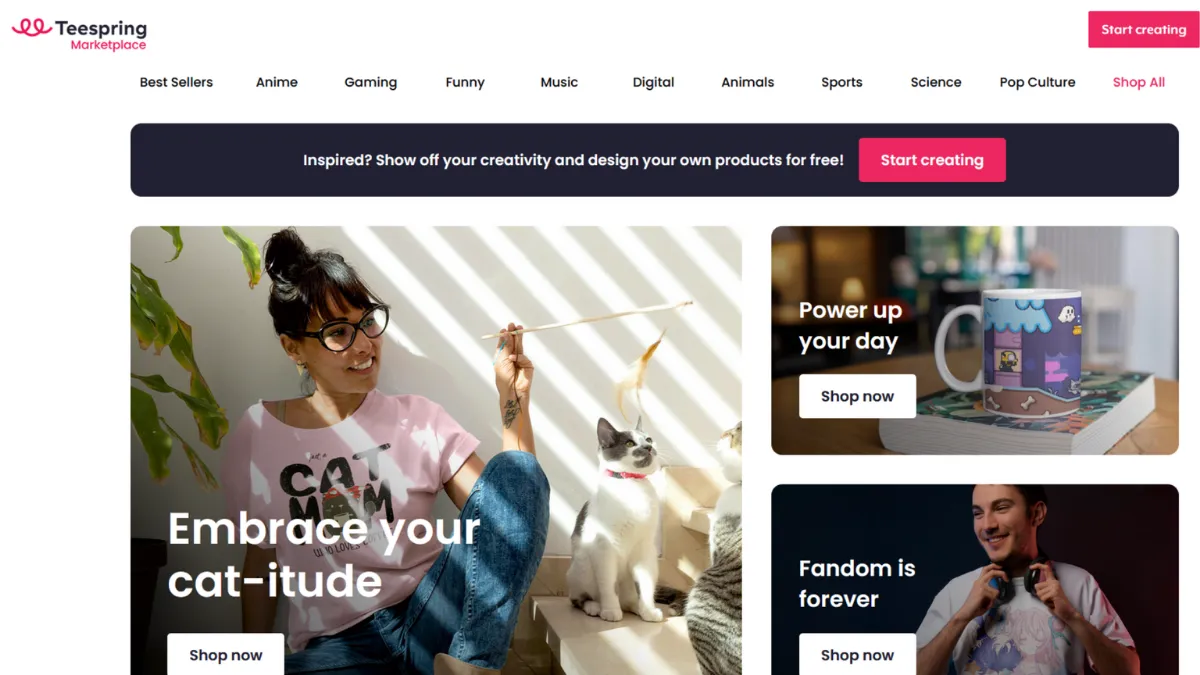
Selling custom merchandise without touching inventory is one of the cleanest monetisation models available to creators, and Teespring (now operating as Spring) has built the most creator-native version of it. The platform sits at a specific intersection: print-on-demand fulfilment combined with social commerce integrations that push your products directly into YouTube shelves, Twitch streams, and Streamlabs alerts. If you have an audience and want to sell branded products within the week, no comparable tool closes that gap as quickly.
The mechanism is straightforward. You upload a design, apply it to a product from the catalogue, set a retail price above the base cost, and Teespring handles printing, shipping, and customer service. Your profit is the margin between what you charge and what the platform charges you per unit. What most new sellers misunderstand is that the platform does not generate an audience for you. The Boosted Network, which distributes your listings across marketplaces including Amazon, eBay, and Walmart, helps with discovery, but organic traffic to a fresh storefront is minimal without an existing following or paid promotion. The sellers who extract consistent income from the platform are those who come with audiences already warmed up, not those hoping the marketplace does the heavy lifting.
Realistic expectations matter here. Margins on individual products can be tight, particularly on popular items like t-shirts, where your take after the base cost may be narrower than you expect at moderate price points. Sellers who report strong results either price confidently above the base cost or work at volume across multiple niches with a consistent social media presence driving traffic. Neither outcome happens overnight. A creator with tens of thousands of engaged followers can generate meaningful early revenue; a creator with a small, passive audience will find growth slow without external promotion.
Teespring is built for content creators who already have an audience on YouTube, Twitch, or social media and want to add a merchandise channel without technical overhead. It is also a practical first step for designers testing product-market fit before committing to a more infrastructure-heavy platform like Shopify with a dedicated fulfilment integration.
The platform's core limitation is control. You cannot customise the checkout experience, you have constrained analytics, and the storefront branding options fall short of what a dedicated ecommerce build gives you. Sellers who outgrow the basics will feel the ceiling.
The sections below cover how the platform works mechanically, where it performs well, where it falls short, and how it compares to the alternatives worth considering.
What Is Teespring?
Teespring is a print-on-demand platform that lets you create and sell custom products, from apparel and accessories to home goods and wall art, without holding inventory or managing fulfilment. It operates on a made-to-order model: nothing is produced until a customer places an order, which eliminates upfront manufacturing costs entirely. The company began as a crowdfunded t-shirt platform and evolved into a social commerce tool with a specific emphasis on creator monetisation. What separates it from a generic print-on-demand service is its direct integration layer with major content platforms, turning a merchandise store into an extension of a creator's existing content channels rather than a standalone ecommerce operation. The platform has grown to serve millions of sellers and buyers, making it one of the more established names in the creator merchandise space. Understanding how that integration layer works mechanically is what separates sellers who get quick traction from those who stall at setup.
How Teespring Works
Setup takes less time than most comparable platforms. You create an account, upload your artwork, apply it to products in the catalogue using the built-in design tool, set your storefront live, and configure your payout method via PayPal or Payoneer. The seller dashboard organises everything into tabs: products, storefronts, promotions, integrations, analytics, and payouts. New sellers frequently underestimate the payout configuration step and are surprised when earnings sit uncollected simply because the payment details were never connected.
The design tool is functional rather than sophisticated. It handles placement, scaling, and basic mockup generation, but you will get better results uploading finalised artwork rather than building designs within the platform itself. High-contrast, bold visuals work consistently better in the mockups than detailed or text-heavy work, which can lose legibility at smaller sizes on product images viewed on mobile screens.
The Boosted Network is the platform's most misunderstood feature. Opting in submits your listings for placement across third-party marketplaces, but eligibility requires verified payouts and prior sales history, so brand-new accounts cannot access it immediately. Sellers treat it as a passive income layer once active, but it should not be the primary traffic strategy for anyone starting out.
The counterintuitive insight most sellers miss: Teespring's social integrations have eligibility requirements that are not always obvious before you sign up. The YouTube merch shelf integration, for example, requires that you are part of the YouTube Partner Programme with a minimum subscriber threshold. Creators who assume the integration is immediate regardless of channel size are often disappointed. Knowing your eligibility status before building a launch plan around the integration saves significant frustration. This practical constraint matters most when deciding which features to build your sales strategy around from day one.
Teespring Key Features
Teespring organises its feature set around reducing operational work for creators. The core tools cover product creation, social selling, marketplace distribution, and promotional mechanics.
Built-in Design and Product Creator. The platform's design tool lets you upload artwork and apply it to over 50 product types, from hoodies and mugs to phone cases and canvas prints. You see a mockup immediately, set your price, and publish without leaving the dashboard. The tool is not a substitute for software like Canva or a dedicated illustration application, but it removes the need to use separate mockup generators for most standard products. Where it earns its value is speed: a creator with ready artwork can have a product live in under ten minutes.
Storefront and Multi-Storefront Management. You can create multiple storefronts under one account, which allows you to organise products by niche, audience segment, or campaign type. Each storefront is customisable within limits: you can set a banner, profile image, and product arrangement, but deeper brand customisation is restricted. For creators managing several content channels with different audiences, the multi-storefront structure prevents product lists from becoming disorganised.
Boosted Network. Once eligible, the Boosted Network automatically lists your products across external marketplaces including Amazon, eBay, and Walmart, with Teespring managing listing optimisation, fulfilment, and returns end-to-end. There are no additional listing fees, and your profit margin is preserved. The distribution adds passive discovery potential without requiring you to manage separate seller accounts on each platform.
Creator Platform Integrations. Teespring connects directly with YouTube, Twitch, and Streamlabs. The YouTube integration places a product shelf below your videos for eligible channel owners. The Twitch extension embeds a shop panel within your stream, and Streamlabs supports real-time purchase alerts during live content. These integrations convert existing viewer attention into purchase intent at the moment of highest engagement, which is a material advantage over sending an audience to an external link.
Promotional Tools and Analytics. The platform supports promo codes, volume discounts, and a pricing discount tier that can improve your effective margin at scale. Analytics cover sales, revenue, and traffic source breakdowns. What the analytics do not provide is abandoned cart data or detailed customer behaviour tracking, which limits how precisely you can diagnose conversion issues. Sellers running paid traffic find this gap meaningful.
Teespring Pros and Cons
The platform's strengths are real but specific. So are its weaknesses.
- Zero upfront cost. No subscription, no inventory commitment, and no financial risk if products go unsold. This is the defining advantage for creators testing merchandise for the first time, and it removes the barrier that stops most people from starting.
- Creator platform integrations. The native connections to YouTube, Twitch, and Streamlabs are more deeply embedded than what most competitors offer. Selling merchandise inside a live stream with real-time purchase alerts is a genuinely differentiated feature that drives impulse purchases at scale.
- End-to-end fulfilment. Printing, shipping, and customer service are handled entirely by the platform. This is not unusual in print-on-demand, but Teespring's execution means creators genuinely do not need to interact with logistics once a product is live.
- Boosted Network distribution. Passive marketplace exposure across multiple platforms without separate account management is a meaningful time saver for sellers who have passed the eligibility threshold.
- Multiple storefronts. Organising products by audience or niche under a single account is a practical feature that multi-channel creators use consistently. Many competitors restrict you to one storefront per account at the free tier.
The platform has real limitations that affect certain sellers more than others.
- Thin margins at moderate price points. The spread between base cost and a competitive retail price can be narrower than it appears, particularly on standard apparel. Running paid advertising against thin margins is difficult, which means organic traffic or an existing audience is effectively a prerequisite for profitability.
- Limited analytics depth. The absence of abandoned cart tracking and detailed funnel data makes conversion optimisation difficult for sellers actively testing and iterating. This is a meaningful gap for anyone running paid acquisition.
- Integration eligibility requirements. The YouTube shelf and Twitch integrations require prior platform-level qualification that not all creators have at the point they sign up. The platform does not surface these requirements prominently during onboarding.
- Constrained storefront customisation. Branding options stop well short of what a dedicated ecommerce build delivers. You cannot control the checkout flow, upsell logic, or page structure in any meaningful way.
- Support responsiveness issues. Recent user reports flag slower response times and inconsistent payout handling, which scores this dimension below the platform average. Any seller relying on timely resolution of fulfilment or payment issues should factor this in.
How to Get the Most Out of Teespring
Before uploading a single design, confirm your eligibility for the integrations you plan to use. If you are a YouTube creator aiming to use the merch shelf, verify your Partner Programme status and subscriber count first. Building your launch plan around an integration you cannot yet access wastes the early momentum a product drop generates.
Prepare your artwork at the highest resolution the platform accepts, and keep designs bold and readable at thumbnail size. Mobile traffic accounts for the majority of views for most storefronts, and designs that look sharp on a desktop mockup often lose detail on a phone screen product listing. Test your primary design on the product types that carry the best margin for your price point before expanding the catalogue.
Set your retail price confidently. Underpricing is the most common mistake first-time sellers make. If you plan to run promotional codes or seasonal discounts, build the discount into your base margin before publishing, not after. Sellers who price at the floor have no room to run promotions without cutting into an already tight return.
Use the Boosted Network once eligible, but treat it as a supplementary channel, not a primary one. The sellers who build consistent revenue use their existing audience first: a post, a video mention, or a stream announcement drives the initial sales that build social proof on the storefront and unlock better distribution downstream.
For creators specifically asking how to sell custom merch on Teespring without an existing audience, the honest answer is that paid traffic is required, and the margins make that path difficult to sustain without a high-converting niche product and careful price management. Organic discovery within the platform's marketplace is limited for new storefronts. Pairing Teespring with an email newsletter or a consistent content channel is the most reliable way to generate predictable repeat traffic without a paid budget.
Measure success at the campaign level, not the storefront level. Track which designs sell and which stagnate, retire the underperformers, and reinvest attention in the formats and product types that convert. The analytics are basic, but sales volume by product is visible, and that data alone tells you where to focus.
Who Should Use Teespring?
This is for you if you are a content creator with an active audience on YouTube, Twitch, or social media who wants to add a merchandise revenue stream without building ecommerce infrastructure. The platform removes every logistics decision from your path. You design, publish, and promote; Teespring handles the rest.
It is also a strong fit if you are a designer or creative entrepreneur testing product concepts with zero capital risk. The ability to launch a 10-product niche storefront in under an hour and measure real purchase intent before committing to a more built-out setup is genuinely useful for validating ideas.
A third strong fit is the micro-brand builder: someone growing a community around a specific identity, niche, or interest who wants merchandise to deepen audience connection rather than maximise revenue per unit. At this stage, the branding limitations matter less than the speed and ease of getting product in front of fans.
Teespring is not the right choice if you are building a serious ecommerce business where margin management, customer data ownership, and storefront control are priorities. Sellers who want to run aggressive paid advertising campaigns, own the checkout experience, or build a fully branded direct-to-consumer operation will hit the platform's ceiling quickly and should evaluate a dedicated ecommerce setup with a print-on-demand integration instead.
Teespring Pricing
Teespring operates on a free-to-use model with no subscription fees. You pay nothing to create an account, upload designs, or publish a storefront. The platform earns by charging a base cost per product, which covers production and fulfilment. Your profit is whatever you charge above that base cost, and you retain it entirely on physical products.
Digital product sales work differently: the platform charges a percentage fee on those transactions, which makes the free positioning less straightforward for creators selling non-physical goods. The Boosted Network is free to opt into for eligible sellers, with no additional listing fees on the products it distributes.
Payouts are processed via PayPal or Payoneer. The base costs for physical products vary by item type and are listed within the product creation flow. Sellers who move volume can access pricing discount tiers that improve the effective margin per unit. Check Teespring's current pricing page for up-to-date base costs, as these shift over time. The free model is genuinely accessible for starting out, but the margin arithmetic at mid-range price points means it suits audience-first sellers better than margin-first operators. Compared to alternatives like Printify, which offers lower base costs in exchange for running your own storefront, Teespring trades margin for simplicity and built-in creator integrations.
Teespring vs Alternatives
The print-on-demand category has several strong contenders, and the right choice depends on where your traffic comes from and how much control you want over the selling experience.
Printify connects to external storefronts on platforms including Shopify and Etsy, and its product catalogue is significantly larger with generally lower base costs, particularly for sellers on the paid Premium plan. You supply your own storefront and drive your own traffic. Teespring wins for creators who want a self-contained solution without external integrations to configure; Printify wins for sellers who want lower base costs and broader product variety and are willing to manage the storefront layer themselves.
Printful is the premium-positioning competitor: higher base costs, better print quality reputation, and broader customisation options including embroidery and all-over print. It integrates with most major ecommerce platforms. Choose Printful when product quality and brand presentation are the priority and margins are secondary. Teespring wins on speed and simplicity at zero cost.
Gumroad and Whop are worth considering if your primary monetisation is digital products and merchandise is secondary. Neither matches Teespring's creator platform integrations for physical goods, but both offer better economics and more control for digital goods sales, where Teespring's fee structure is less favourable.
Fourthwall has emerged as a direct challenger in the creator merchandise space, offering stronger storefront customisation and support features. Creators who find Teespring's branding limits frustrating should evaluate it as the most like-for-like upgrade.
Teespring Review: Final Verdict
Teespring earns a 4.07 overall score, reflecting a platform that does its core job well for a specific audience but carries real limitations in analytics depth, support reliability, and margin headroom that prevent it from scoring higher. Its ease of use score stands out: few tools get a creator from zero to a live product storefront as quickly. The lower support score reflects a genuine pattern in recent user reports that sellers should weigh before going all-in.
The bottom line: if you have an audience and want merchandise live this week without touching logistics, Teespring remains the fastest and simplest path to doing it.
How We Rated It:
More Tool Reviews







Subscribe to Stay in the loop
Get the latest AI and technology news, honest tool reviews, and practical guides delivered straight to your inbox.
Success! Check your Inbox!

Tezons Newsletter
The latest technology news, in-depth tool reviews, and practical guides - curated and delivered to your inbox.
Latest News




Have a question?
Have any questions?
Didn’t find what you were looking for? We’re just a message away.