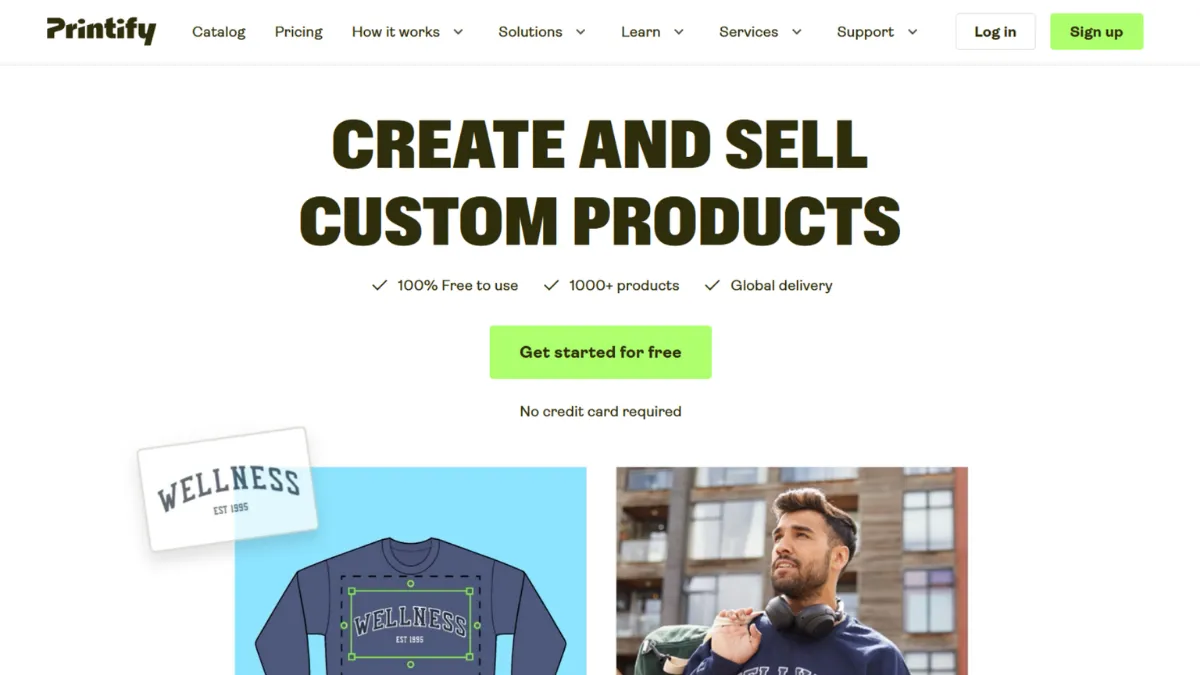
Selling custom merchandise without touching a warehouse is the premise every print-on-demand platform promises. Printify delivers on it more consistently than most, and at a price point that makes the model viable from day one. The platform connects you to a global network of over 80 independent print providers, giving you access to more than 1,300 products and a level of per-unit cost competition you do not get from vertically integrated alternatives. For a solo creator or early-stage brand, that network is the product: more provider choice means more control over margins, delivery speed, and product quality once you know how to use it.
Printify operates as a marketplace layer between you and the printers. You create designs using the browser-based Product Creator, select a print provider from the catalogue, set your retail price, and connect your store. When a customer orders, Printify routes the job to your chosen provider, who prints, packs, and ships directly to the buyer. You collect the difference between your retail price and the base production cost. There are no minimum order quantities and no inventory commitments. The mechanism that drives results is provider selection: two providers offering the same blank T-shirt can differ by several dollars in base cost and several days in production time. Sellers who spend an afternoon testing providers and ordering samples consistently outperform those who rely on defaults.
Realistic expectations matter here. Printify does not generate your customers. It fulfils orders. Building a store on Shopify or listing on Etsy still requires your own traffic strategy, and per-unit margins in the print-on-demand model typically sit in a range that rewards volume over single sales. Most sellers reach meaningful monthly revenue after consistent listing activity and product-market validation over several months, not several weeks. Printify accelerates the operational side; it does not replace the commercial side.
The platform suits creators who already have an audience or a clear niche, small brand operators testing merchandise lines without upfront investment, and Etsy sellers looking to automate fulfilment beyond handmade production capacity. It works well for anyone whose business case depends on keeping base costs low and product variety high.
The most significant limitation is quality variance. Because Printify does not own its production facilities, print consistency depends entirely on which provider you choose. Provider ratings are aggregated across all product types, which means a provider rated highly for mugs may underperform on apparel. You have to test before you scale, and you have to re-test if you switch products or providers. Sellers who skip this step carry the quality risk into customer orders.
The sections below cover how the platform works mechanically, its key features, pricing tiers, and how it compares to the main alternatives in the print-on-demand space.
What Is Printify?
Printify is a print-on-demand fulfilment platform that lets you design and sell custom physical products without holding stock. You upload artwork, choose from a catalogue of over 1,300 products across apparel, accessories, home goods, and more, then connect your sales channel. Printify handles the production and shipping relationship with its network of independent print providers. The problem it solves is the capital barrier to merchandise: traditional product launches require inventory investment, warehousing, and fulfilment infrastructure. Printify removes all three. It differs from a generic dropshipping arrangement because the products are made to order with your design, giving each item a degree of brand identity you cannot get from reselling generic stock. The platform is used by a large base of independent sellers across Etsy, Shopify, and other channels, making it one of the most established names in the print-on-demand category. What sets it apart from vertically integrated competitors is the open provider marketplace, where the pricing and performance of each provider is visible before you commit. Understanding how that marketplace functions in practice is where the operational details become important.
How Printify Works
Setup takes minutes. You create a free account, connect a sales channel such as Shopify, Etsy, WooCommerce, or Wix, and open the product catalogue. Selecting a product surfaces a list of print providers who offer that item, each showing a base cost, performance score, production time estimate, and shipping rates by destination. You pick a provider, open the Product Creator, upload your design file, and position it on the product template. The mockup generator renders a preview in real time. Set your retail price, publish to your store, and the product goes live. When a sale comes in, Printify captures the order automatically and routes it to the print provider you selected. The provider prints, packs, and ships to your customer. You pay the base cost at the point of order, not upfront.
Output quality is a function of three variables: your design file resolution, the print method of the provider you select, and the blank product itself. High-resolution artwork in the correct colour profile will always outperform a scaled-up low-resolution file. Different providers use different print methods, including direct-to-garment, sublimation, embroidery, and all-over print, each suited to different design styles and product types. Providers using direct-to-garment work best with detailed multicolour artwork; sublimation is the correct choice for all-over coverage. Most sellers get this backwards, applying detailed artwork to products that need sublimation and ending up with muddy prints.
The counterintuitive insight most new sellers miss is this: a provider's performance score is a single aggregate rating across all products that provider offers. A high score does not mean the provider excels at every product in its catalogue. Before publishing any product at scale, order a physical sample. The sample cost is the base price plus shipping, and it is the most cost-effective quality check you can run. Skipping samples to save a few pounds is the single most common mistake among sellers who later deal with customer complaints. Which features Printify gives you to manage this workflow is where the platform earns its reputation.
Printify Key Features
Product Creator and Mockup Generator. The browser-based design tool lets you upload artwork, add text layers, adjust positioning, and preview your design on the product template without additional software. The mockup generator produces lifestyle-style preview images suitable for store listings. The editor handles most common design tasks at a beginner level. Sellers with more complex artwork requirements may find the built-in tool limiting and prefer to prepare finalised files in a dedicated design application such as Canva before uploading, but for straightforward placement work it removes a meaningful barrier to entry.
Provider Marketplace with Transparent Pricing. Unlike platforms that route orders to a single fulfilment centre, Printify shows you every provider offering a given product alongside their base cost, performance score, and shipping rates. You can filter by location to prioritise providers near your customer base, reducing shipping times and costs. This transparency is one of the most commercially useful features on the platform. Sellers targeting European customers, for example, can select EU-based providers and avoid the customs delays and surcharges that come with cross-Atlantic fulfilment.
Order Routing and Printify Choice. Order Routing automatically redirects an order to an alternative provider if your primary selection is out of stock or experiencing delays. Printify Choice is a curated subset of top-rated providers, weighted toward the US market, designed to simplify provider selection for sellers who do not want to evaluate the full marketplace. Both features reduce operational friction but do not replace the need to understand your provider options. The platform integrates natively with Shopify, Etsy, WooCommerce, Wix, eBay, BigCommerce, and PrestaShop, as well as offering a public API for larger operations, keeping order flows automated once your store is connected.
Pop-Up Store. Printify offers a built-in storefront tool that generates a shareable link without requiring an external platform. This suits creators validating a product range before committing to a full Shopify subscription, or those running a limited merchandise drop for an existing audience. It is a low-friction entry point, though the branding and conversion optimisation options are limited compared to a dedicated store builder.
AI-Assisted Design Tools. Printify includes an AI image generator within the Product Creator, allowing you to generate design artwork directly in the platform. For sellers without a graphic design background, this lowers the barrier to producing original artwork, though the output quality is variable and benefits from editing before use on physical products. The integration coverage across mainstream ecommerce channels is broad; sellers needing connections beyond the listed platforms will require the API, which is an Enterprise-tier feature.
Printify Pros and Cons
Where Printify performs well:
- Free plan is genuinely functional. You can design, list, and sell on the free tier without hitting artificial feature limits. The core workflow is fully accessible, which is uncommon in the print-on-demand space where free tiers often restrict catalogue access or publish limits.
- Provider competition drives lower base costs. Multiple providers offering the same product create price competition you can exploit directly. Switching providers to find a lower base cost on your bestseller is a standard margin-management tactic that no vertically integrated alternative supports in the same way.
- Catalogue breadth is exceptional. Over 1,300 products across apparel, accessories, home goods, pet products, and more means you can test niche product categories without platform restrictions. This breadth is a genuine differentiator versus competitors with narrower catalogues.
- Pricing transparency at the product level. Seeing the full cost breakdown, including production and shipping, before publishing a product lets you set retail prices with accurate margin knowledge. Many platforms obscure this until after you have committed to a provider.
- Integration with major channels is reliable. Connecting to Shopify or Etsy takes under five minutes, and order sync is consistent. Sellers managing multiple storefronts find the unified dashboard reduces operational overhead meaningfully.
Where Printify has real gaps:
- Quality variance across providers is a structural limitation. Because Printify does not control production, print consistency differs between providers and product types. The aggregate performance score does not tell you how a provider performs on a specific product, which makes sampling mandatory, not optional.
- Branding options are limited and provider-dependent. Custom packaging inserts and branded labels are available through some providers, but not all. Sellers building a premium brand identity will find the unboxing experience hard to control at scale.
- International shipping can be slow and expensive. Delivery times outside the US and EU are variable and can stretch beyond three weeks for some routes. Sellers with a global customer base need to select providers carefully and communicate delivery estimates clearly to buyers.
- No phone support. Support operates via live chat and email. Response times are generally acceptable for standard queries, but complex fulfilment issues can take longer to resolve without direct voice access.
- Per-unit margins require volume to be meaningful. At typical retail price points, a single sale generates a modest profit. The model rewards consistent order volume; it does not generate substantial income from low-volume stores.
How to Get the Most Out of Printify
Before publishing anything, set up your sales channel integration and verify that order sync is working. Create a test product in draft mode to confirm the workflow from design to order routing before going live. This takes thirty minutes and prevents the more disruptive errors that surface after a real customer order.
For your first products, choose two or three hero SKUs rather than building a wide catalogue immediately. A bestselling T-shirt blank paired with a mug covers two of the highest-demand print-on-demand categories and gives you clear data on which provider and price point converts. Order physical samples of both before publishing. The sample cost is negligible relative to the cost of a customer complaint and a refund.
Provider selection is the highest-leverage decision you make on the platform. Filter by location first: if most of your customers are in the UK, choose a provider with UK or EU production capacity. Then sort by performance score within that geography. For US-focused sellers, Printify Choice simplifies this step. Avoid selecting a provider on base cost alone; a cheaper provider with slower production times costs you in repeat purchase rate.
If you want to know how to start a print-on-demand business with Printify, the practical path is: validate a niche with three to five designs, use the free plan to test conversion rates, and upgrade to Premium once your monthly order volume makes the product discounts cover the subscription. Most sellers reach that threshold at somewhere between fifteen and twenty orders per month. Track your actual profit margin per product, not the theoretical markup. Factor in the platform fees from your sales channel, payment processing, and sample costs. Use Google Analytics alongside your store dashboard to monitor which products drive profitable orders. The sellers who build sustainable businesses on the platform treat margin tracking as a weekly habit.
Who Should Use Printify?
This is for you if you are a content creator or community builder with an engaged audience who wants to sell branded merchandise without a fulfilment operation. You are solving the problem of production overhead: you have the designs and the buyers, but you do not want to handle stock. Printify gives you the operational infrastructure to focus on the product and the audience.
It also suits early-stage brand operators running product experiments. To test whether a niche product concept converts before investing in bulk inventory, the free plan and zero minimum order quantities make Printify the lowest-risk testing environment available. A founder validating a new merchandise category can publish ten products and measure real customer demand for under fifty pounds in sample costs.
Etsy sellers scaling beyond handmade capacity are a strong third fit. If you are hitting the ceiling of what you can produce manually and want to move high-demand designs into automated fulfilment without changing your Etsy presence, Printify's native integration handles the transition without rebuilding your storefront.
Printify is not the right choice if your brand depends on a controlled, premium unboxing experience. Branded packaging is provider-dependent and inconsistent across the catalogue. If custom packaging is central to your customer experience, a vertically integrated service like Printful gives you more reliable control, at a higher base cost per unit. The platform is also unsuited to sellers who need phone support for operational issues or who want consistent, identical quality across every unit without a sampling process.
Printify Pricing
The free plan is a genuine starting point. You get access to the full product catalogue, all integrations, the Product Creator and mockup generator, and support for up to five stores. There are no restrictions on the number of designs you can publish. You pay only the base production cost and shipping when an order is placed. For a new seller validating a product idea, there is no financial reason to start on a paid tier.
The Premium plan is priced at around $29 per month (or approximately $25 per month on an annual billing cycle) and delivers up to 20% discounts on base production costs across most products. At fifteen to twenty orders per month, the discounts typically cover or exceed the subscription cost. It also extends your store limit to ten. Always check the Printify pricing page for current rates before making a subscription decision.
Enterprise pricing is custom and targets sellers processing very large order volumes. It includes deeper discounts, a dedicated account manager, and API access for custom integrations. The threshold for Enterprise to make commercial sense is significantly higher than the Premium breakeven point. Relative to competitors, Printify's free plan is more generous than most, and the Premium discount structure is more transparent than tiered pricing models that obscure per-unit savings.
Printify vs Alternatives
Printful is the most direct competitor. Printful operates its own production facilities rather than a provider network, which delivers more consistent print quality and better branding options, including custom labels and packaging inserts at a higher base cost per unit. If your brand requires a controlled product experience and you can build those costs into your retail pricing, Printful is the stronger choice. If margin efficiency and product variety matter more, Printify wins on cost.
Gelato positions itself as the locally-produced alternative, with a network of regional print partners designed to minimise shipping distances. For sellers with a European or global customer base, Gelato's local-production model can deliver faster delivery times and lower customs exposure. Printify can replicate this benefit by selecting regional providers manually, but Gelato handles the routing logic by default. Choose Gelato when local production is a brand value rather than a tactical setting.
AutoDS and similar dropshipping automation platforms operate in adjacent territory but serve a different model: reselling existing products rather than custom-designed merchandise. If your goal is product curation rather than brand building, AutoDS addresses a different problem entirely. Choose Printify when the design identity on the product is the point of the business.
On the entry tier, Printify's free plan and provider marketplace give it a clear structural advantage over competitors for cost-sensitive new sellers, particularly those who want provider flexibility alongside a zero-commitment starting point.
Printify Review: Final Verdict
Printify earns a 4.28 overall score, which reflects a platform that executes the print-on-demand model well across most dimensions but carries a real structural limitation in quality consistency. The cost-efficiency rating of 4.8 reflects the strongest aspect: the free plan is fully capable, and the Premium discount model delivers measurable margin improvement at volume. The accuracy and reliability score of 3.8 reflects the provider-variance issue honestly. This is a function of the marketplace model, and it requires sampling discipline to manage, not a platform defect that updates will fix.
The bottom line: Printify is the best-value entry point in print-on-demand for sellers who treat provider selection and sampling as non-negotiable steps. Use it to build margin-efficient, scalable merchandise operations. Expect to invest time upfront in understanding your providers before you can rely on consistent output.
How We Rated It:
More Tool Reviews




Subscribe to Stay in the loop
Get the latest AI and technology news, honest tool reviews, and practical guides delivered straight to your inbox.
Success! Check your Inbox!

Tezons Newsletter
The latest technology news, in-depth tool reviews, and practical guides - curated and delivered to your inbox.
Latest News




Have a question?
Have any questions?
Didn’t find what you were looking for? We’re just a message away.