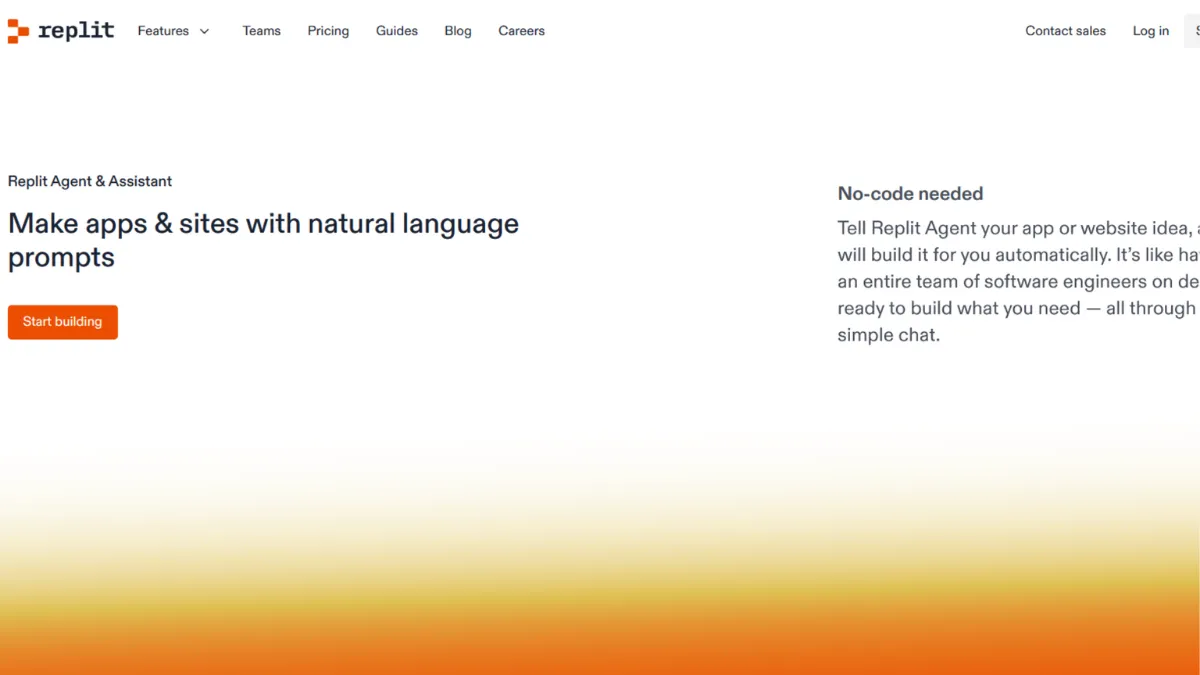
Building a working web app from a text prompt, deploying it to a live URL, and sharing it with collaborators used to require a configured local environment, a hosting account, and at least a working knowledge of version control. Replit collapses all of that into a single browser tab. The platform has evolved from a cloud IDE used mostly by students and hobbyists into an AI-first development environment where Agent 3 can plan, build, debug, and deploy a full-stack application autonomously. That shift makes it genuinely worth evaluating for founders who want to ship a tool, an internal dashboard, or an MVP without spinning up a local dev setup or hiring a contractor for the first prototype.
The mechanism that separates Replit from a simple AI code generator is its integrated runtime. When you describe what you want to build, Agent 3 does not just write code into a file and hand it back. It installs dependencies, runs the app, observes errors, and iterates within the same session. That closed feedback loop is what makes autonomous operation meaningful: the Agent can work for up to 200 minutes in a single session, testing its own output and spawning subagents for specialised tasks. The part most new users get wrong is treating every prompt like a new project. Results improve significantly when you front-load the session with a clear spec: what the app does, who uses it, what data it stores, and what integrations it needs. Vague prompts produce vague apps.
Realistic expectations matter here. Replit Agent handles standard web application patterns well: CRUD apps, landing pages with form capture, dashboards pulling from a database, lightweight automations. Expect a functional prototype in fifteen to forty-five minutes depending on complexity. Complex business logic, advanced algorithms, or production-grade security hardening are different territory. The generated code is functional, but it often lacks the input validation and error recovery a senior developer would include by default. Treat Agent output as a starting point for a prototype, not a production codebase ready to handle sensitive data at scale.
Replit suits non-technical founders who want to build and own a working prototype without hiring a developer, developers who want to skip local environment setup for side projects and experiments, and small teams who need a shared cloud workspace without the overhead of configuring infrastructure. If you are evaluating whether an idea is worth building before committing to a full development investment, the time-to-live-URL advantage is hard to match. Tools like Bolt.new and Lovable compete in the same prompt-to-app space, but Replit gives you a fuller development environment with version history and deployment control baked in.
The one limitation that has frustrated the most users is cost unpredictability. Replit moved to effort-based credit pricing, meaning each AI task costs based on compute resources and time used. A simple edit might cost almost nothing. A complex feature request, or a session where the Agent loops on a bug it created, can drain credits fast. There is no way to get a cost estimate before running a prompt, and credits do not roll over on the entry paid plan. Builders running frequent Agent sessions on substantial projects routinely spend well beyond the base subscription price.
The sections below cover how the platform works mechanically, which features matter most, what you pay at each tier, and how Replit stacks up against its closest alternatives.
What Is Replit?
Replit is a cloud-based development platform that lets you build, run, and deploy applications entirely in the browser without installing anything locally. It launched as a collaborative online IDE supporting dozens of programming languages, and its core promise was removing the setup barrier: you open a project and start writing code immediately, with compute happening in the cloud. The AI pivot transformed that foundation into something broader. Replit's Agent now takes natural language instructions and produces working applications, making the platform relevant to people who have never written a line of code. What separates it from a standalone AI code assistant like ChatGPT is the integrated runtime: code runs inside Replit, errors surface in real time, and deployment happens with a single action from the same interface. The platform hosts millions of projects across education, prototyping, and lightweight production use. How the Agent actually executes that build loop is worth understanding before you start your first session.
How Replit Works
Every Replit project lives inside a Repl, a containerised environment running in the cloud. When you create a new Repl and activate Agent 3, you write a natural language description of what you want to build. The Agent reads your prompt, generates a build plan, writes code across multiple files, installs the required packages, and runs the application. You see the live preview update as it works. If the app throws an error, the Agent reads the error output and attempts a fix within the same session, without you needing to copy a stack trace into a separate chat window.
Agent 3 operates in three effort modes: Economy, Power, and Turbo. Economy uses fewer compute resources and costs less per task but handles simpler requests. Power is the default for most active builders. Turbo, available on Pro and Enterprise plans, applies more compute to complex or long-running builds. Choosing the right mode for the task is one of the most effective ways to manage credit consumption, and most users on the entry paid plan stick with Power for general development work.
The platform stores your project files, database, and deployment configuration together. Built-in database support means you do not need a separate service for basic data persistence. Deployment to a public URL happens from within the interface, and you can configure a custom domain on paid plans. Real-time collaboration lets multiple users edit the same Repl simultaneously, closer to the model of Figma for design than to a shared GitHub repository. The counterintuitive thing most new users discover: the Agent performs better on shorter, more frequent prompts than on one large, exhaustive description. Breaking a build into stages, confirming the Agent's output at each step, produces more consistent results than asking it to build the entire app in one session.
Replit Key Features
Replit's value comes from the integration of its features rather than any single capability. Each component would be weaker in isolation; together they form a pipeline from idea to deployed app.
Agent 3 Autonomous Builder. Agent 3 is the core of the current platform. Given a natural language prompt, it generates a full-stack application, installs dependencies, handles errors autonomously, and deploys to a live URL. The 200-minute autonomous session window means it can handle substantial builds without constant human intervention. Three effort modes let you trade speed and cost against each other depending on the complexity of the task at hand.
Integrated Cloud IDE. The code editor, terminal, file explorer, and live preview run together in the browser with no local installation required. Replit supports over fifty programming languages and frameworks. The environment resets cleanly between projects, eliminating the version conflict and dependency issues that consume time in local setups. For developers who move between machines or want to hand off a project to a collaborator instantly, the cloud-native approach removes significant friction.
Built-in Database and Hosting. Each Repl includes access to persistent storage and database options without requiring a separate account or configuration. Deployment to a public URL is a single action, and always-on deployments keep your app running after the session ends. This removes the need to separately provision infrastructure through a service like a cloud provider for early-stage projects, though always-on deployments and autoscale configurations consume credits beyond the base subscription.
Real-Time Collaboration. Paid plans allow multiple users to work inside the same Repl simultaneously, with live cursor presence. On Core, you can invite up to five collaborators. The Pro plan supports up to fifteen builders sharing pooled credits, which significantly reduces per-person cost for small teams. This feature addresses the gap between solo prototyping and team development without requiring a separate project management or repository tool.
Design Mode. Shipped as part of the Agent 3 rollout, Design Mode lets you make visual changes to your app through a more direct interface rather than writing prompts for every styling adjustment. It is more useful for layout and colour changes than for complex interaction design, but it reduces the prompt overhead for iterating on appearance. The practical trade-off worth knowing before you start: heavy Agent use across all these features is where credit costs climb, and that spend scales with project complexity in ways the base subscription price does not fully signal.
Replit Pros and Cons
Replit has clear strengths for the right user at the right stage. It also has real limitations that the pricing and marketing tend to understate.
- Zero setup to first line of code. You are inside a working development environment within sixty seconds of creating an account. No local installation, no environment configuration, no dependency conflicts. For anyone who has spent an afternoon fighting a local setup, this is a material time saving.
- Agent handles the full build loop. Unlike standalone AI code assistants, Replit Agent runs the code, reads the errors, and fixes them without you acting as the go-between. The closed feedback loop is where it earns its price premium over pasting code into a chat window.
- Collaboration without a separate tool. Real-time multi-user editing on paid plans removes the need to set up a shared repository just to show a collaborator what you are building. For early-stage teams, the friction reduction is meaningful.
- Genuinely accessible to non-technical users. The combination of natural language input, live preview, and one-click deployment makes it possible for a product manager or founder with no coding background to produce a working prototype. That is not true of most development environments.
- Continuous improvement cadence. Agent 3 represented a significant speed and capability improvement over its predecessors, and the platform ships updates at a fast pace. The product you evaluate today will be meaningfully better in six months.
The downsides are real and worth weighing against the convenience.
- Credit costs are unpredictable. Effort-based pricing means you do not know what a task will cost before running it. A looping Agent session on a tricky bug can drain credits in ways that feel arbitrary. Many active builders spend substantially more than the base plan price each month.
- Generated code quality has limits. The Agent produces functional code, but it frequently lacks the security hardening, input validation, and error recovery an experienced developer would include. Shipping Agent output to production handling sensitive data without a code review carries risk.
- Complex projects hit context limits. The Agent's context window means it can lose consistency across large codebases, sometimes introducing conflicting patterns in different parts of the same project. Large-scale applications are not where Replit performs best.
- Design output is functional, not polished. Interfaces the Agent generates tend toward the utilitarian. If visual quality matters for your use case, expect to spend additional time on styling iterations or supplement with a dedicated design tool.
- Vendor dependency for hosting. Apps built on Replit run on Replit's infrastructure. Migrating a project to another host is possible but involves meaningful effort. That lock-in is a real consideration for anything you intend to scale or hand off.
How to Get the Most Out of Replit
Before your first session, write a one-paragraph spec for what you are building. Include the user type, the core action the app enables, what data it stores, and any integration it needs to connect to. Agent 3 produces better output when it has a clear target at the start than when it is discovering requirements mid-build.
In your first session, build to a working skeleton before asking for features. Get the app running, confirm the data model is correct, and verify the core flow works end to end. Adding features on top of a broken foundation costs more in credits and time than starting clean. Use Economy mode for simple tasks like copy changes or colour adjustments, and reserve Power or Turbo mode for generating new functionality.
Building results over time comes from treating each Agent session as a focused sprint rather than an open-ended conversation. Shorter prompts with clear success criteria produce more consistent results than long, multi-requirement requests. When the Agent produces something unexpected, roll back to the last checkpoint rather than trying to fix forward: fixing Agent-introduced bugs with more Agent prompts is the most common way costs spiral.
The mistake most users make is underestimating the credit cost of iteration. If you are asking how to build a web app with Replit efficiently, the answer is: front-load your thinking, minimise re-work, and use checkpoints aggressively. Each rollback saves you the cost of a fix loop. Measure success by whether the app covers the core user flow correctly, not by how much the Agent did in a single session. Pairing Replit with a project management tool like Notion to track what you have built and what remains keeps complex builds from losing coherence across sessions.
Who Should Use Replit?
Replit works best for people who need to go from a described idea to a deployed URL quickly, without a local development environment or a contractor.
This is for you if you are a non-technical founder at the idea validation stage who wants a functional prototype to test with users before committing to a development budget. You want to own the code and iterate on it yourself, not wait for a developer's availability. It is also for you if you are a developer who wants a clean, persistent cloud environment for side projects without configuring a local setup for each one. And it suits small teams of up to five on the Core plan, or up to fifteen on Pro, who want a shared workspace where anyone can view and edit the project without setting up shared repository access.
Replit is not the right tool if you are building a production application that will handle sensitive personal or financial data at scale. The Agent-generated code requires security review before it is appropriate for those contexts, and the platform's vendor dependency on its own hosting infrastructure is a meaningful constraint at that stage. It is also a poor fit if your primary need is a polished, visually refined user interface: the Agent's design output is functional rather than crafted, and closing that gap through iteration on Replit is time-consuming compared to starting with a dedicated design tool.
Replit Pricing
A free Starter plan exists and covers a basic exploration of the platform. It gives you limited Agent usage, a small number of development apps, and a workspace with restricted compute. Every project on the free tier is public, there is no persistent deployment, and database access is not available. It is enough to understand how the Agent works and whether the platform fits your workflow, but insufficient for any serious project.
The Core plan is where most individual builders and small teams land. Priced at around twenty dollars per month, it includes a meaningful credit allocation for Agent use, unlimited apps, the latest AI models, autonomous long builds, and the ability to invite up to five collaborators. The practical catch is that the included credits disappear quickly under heavy Agent use or always-on deployments. Unused credits do not roll over on Core: they expire each billing cycle. Many active builders report spending beyond the base plan price once usage costs are factored in.
The Pro plan, introduced to replace the retired Teams tier, is priced at around one hundred dollars per month for up to fifteen builders. It includes tiered credit discounts, priority support, credit rollover, and enhanced collaboration. At roughly seven dollars per builder on a full team, it represents strong value for small professional teams. Enterprise pricing requires a direct conversation with the sales team. Always verify current rates on Replit's pricing page, as the structure has changed several times. Compared to alternatives like Lovable or Bolt.new, Replit's base tier is competitive, but total cost of ownership depends heavily on how aggressively you use Agent modes.
Replit vs Alternatives
The closest competitors sit in two camps: prompt-to-app builders and cloud IDEs with AI assistance.
Lovable is the most direct prompt-to-app alternative and is generally faster at producing polished-looking interfaces. It suits founders who prioritise visual quality in their prototype and are less concerned with having a full IDE available. Replit wins when you want more control over the underlying code, need real-time collaboration, or are building something that requires custom backend logic beyond what a front-end-focused tool handles.
Bolt.new operates similarly to Lovable: fast prototype generation from a prompt, with a cleaner default aesthetic than Replit's Agent output. It is a reasonable starting point for simpler, front-end-heavy projects. Replit has the edge on project persistence, database integration, and the depth of the development environment available when you want to write or edit code directly.
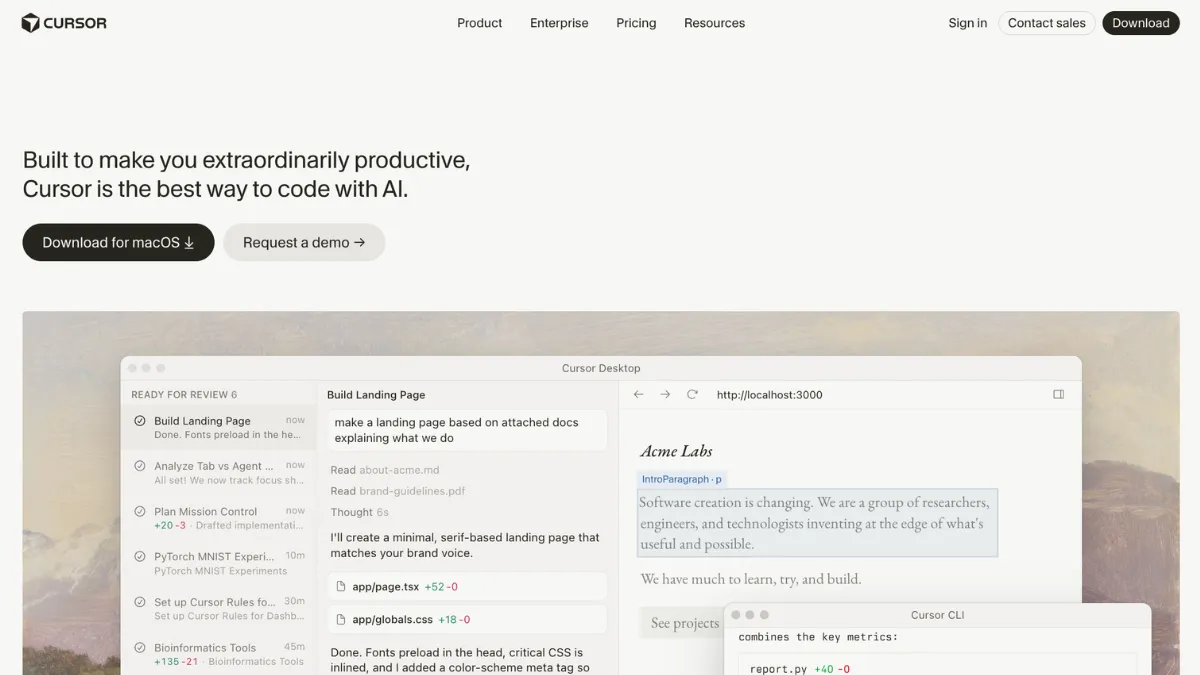
Replit is itself in the internal tools list, so linking is skipped. For teams already using GitHub-style workflows, Cursor or a cloud IDE extension may integrate more naturally with existing processes, though those tools assume more technical knowledge and do not include the same prompt-to-deployment pipeline.
For production internal tools built on top of databases and enterprise data, Replit is the wrong layer: the Agent is optimised for building apps from scratch, not for connecting to existing production infrastructure with access controls and audit requirements. In that context, a more governance-focused tool is the appropriate choice.
Replit Review: Final Verdict
Replit earns a 4.10 out of 5 overall, a score that reflects a platform doing something genuinely difficult well, while carrying real trade-offs in cost predictability and production-readiness. Its ease of use score is its clearest strength: the time from idea to deployed URL is shorter here than almost anywhere else in its category. Cost efficiency scores lower because the effort-based credit model introduces unpredictability that experienced builders consistently flag as a frustration, and that weakness is reflected plainly in the pricing section above.
The bottom line: Replit is the fastest path from a described idea to a live, shareable web app, and it is the right tool for that job. Treat it as a prototyping and validation environment rather than a production platform, manage your Agent sessions with discipline, and the value is clear.
How We Rated It:
More Tool Reviews





Subscribe to Stay in the loop
Get the latest AI and technology news, honest tool reviews, and practical guides delivered straight to your inbox.
Success! Check your Inbox!

Tezons Newsletter
The latest technology news, in-depth tool reviews, and practical guides - curated and delivered to your inbox.
Latest News




Have a question?
Have any questions?
Didn’t find what you were looking for? We’re just a message away.