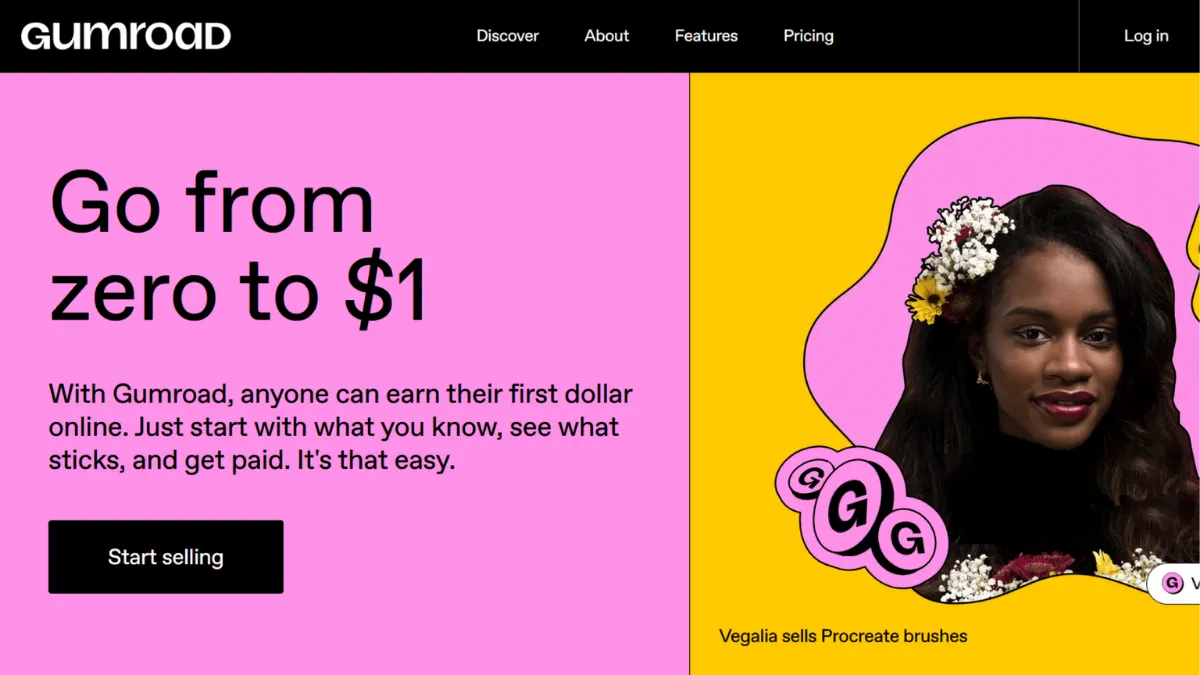
The fastest path to your first sale is not always the cheapest path to your thousandth. Gumroad earns its reputation as the go-to starting point for solo creators selling digital products: no monthly fee, a product live in under ten minutes, and global tax compliance handled automatically since it became a Merchant of Record. For a first-time seller testing whether anyone will pay for an ebook, a template pack, or a standalone course, that frictionless entry is genuinely valuable. The tension arrives later, when the 10% flat transaction fee starts to feel expensive relative to what the platform actually does at scale, and when the storefront limitations make growth harder than it should be.
Gumroad's model is deliberately minimal. You upload a file, set a price, publish, and share a link. The platform handles payment processing, file delivery, and tax remittance across global jurisdictions. What drives results is not the platform's sophistication but the audience you bring to it. Gumroad will not find buyers for you except through its Discover marketplace, and Discover sales carry a 30% fee rather than the standard 10%, which makes it a passive option rather than a primary channel. Most creators who succeed on Gumroad do so because they have an existing email list, social audience, or distribution through a tool like Beehiiv for newsletters. The platform converts traffic well, but it does not generate traffic reliably.
Realistic expectations matter here. Gumroad works best when your product is simple and your sales volume is modest. At a few hundred sales per month, the 10% fee is an acceptable trade for zero setup complexity. Once you cross into consistent four-figure monthly revenue, the maths tilts against you. A seller making $3,000 per month pays Gumroad $300 in platform fees before payment processing costs are added. At that point, a subscription-based alternative often delivers better value, even accounting for the monthly fee. Time your migration before the cost becomes painful rather than after.
The platform suits writers selling ebooks or PDFs, designers moving templates and Procreate brushes, educators offering standalone course materials, and software makers needing automatic license key generation. It is not designed for creators who need structured course delivery with progress tracking, community tools, or complex subscription tiers. If your product is a multi-module programme with quizzes, drip content, and cohort management, a dedicated platform like Thinkific will serve you better from day one.
The most significant limitation is the fee structure compounding with growth. The 10% platform cut sits on top of payment processing charges, meaning your effective take rate on each sale is closer to 13% at standard transaction sizes. Gumroad does not reward loyalty with lower fees the way some competitors do, so the cost of staying scales linearly with your revenue rather than flattening over time.
The sections below cover how Gumroad works mechanically, which features matter, where the pricing model works in your favour, and when you should move to a different platform.
What Is Gumroad?
Gumroad is a digital commerce platform built for independent creators who want to sell products without setting up a full online store. It solves the problem of payment infrastructure: you get a checkout page, file delivery, and payment processing without writing a line of code or configuring a payment processor. What separates it from a generic e-commerce builder is its creator-first focus: the product types it supports (ebooks, audio files, software, memberships, physical goods), the free-tier entry point, and its Merchant of Record status, which means it handles VAT, GST, and sales tax collection across global markets automatically. The platform hosts tens of thousands of active sellers across categories from graphic design to music to indie software. Its simplicity is both the feature and the constraint, and understanding which side of that trade-off you sit on determines whether it is the right tool for your stage. The question is not whether Gumroad is capable of processing a sale; it clearly is. The question is how it handles that sale technically, and what it does and does not give you around it.
How Gumroad Works
Setup follows a four-step sequence: create an account, add a product, upload your file or connect your content, and publish. The product page is generated automatically. You share a link, embed a button on an existing site, or list the product on Gumroad's Discover marketplace. When a buyer pays, Gumroad processes the transaction, collects any applicable taxes, delivers the file, and queues your payout. No configuration is required for tax compliance. No payment processor account is needed on your side. The whole infrastructure runs through Gumroad's systems.
Product types include digital downloads (PDFs, ZIP files, audio, video), software with automatic licence key generation, memberships with recurring billing, physical goods with basic fulfilment tracking, and course-style content delivered through Gumroad's posts system. Workflows, the platform's automation layer, let you trigger post-purchase actions such as sending a sequence of emails or unlocking additional content over time. Analytics cover sales volume, revenue, referral sources, and customer geography, with the dashboard having been improved to surface retention-style signals alongside raw transaction data.
The Discover marketplace deserves separate attention because most new users misread it. Enabling Discover lists your product in Gumroad's browsable catalogue and can bring in sales you did not generate through your own channels. The counterintuitive reality is that those sales cost you 30%, not 10%. Many experienced Gumroad sellers keep Discover disabled entirely and treat the platform purely as a checkout layer on top of their own audience. That approach keeps fees at the standard rate and puts distribution entirely in your hands, which is where it already needs to be for Gumroad to work well. The platform rewards creators who already have an audience and need a frictionless sales layer on top of it, not creators who are looking for the platform to provide discovery.
Gumroad Key Features
Gumroad's feature set is narrower than its competitors but deliberately so. Each core capability is designed to work without configuration, which is the right trade-off at the early stage where most users start.
Merchant of Record and Tax Compliance. Since becoming a Merchant of Record, Gumroad collects and remits VAT, GST, and sales tax across global jurisdictions on every transaction. For a solo creator selling internationally, this removes a compliance burden that would otherwise require either a tax specialist or dedicated software. The practical value of this feature scales with how internationally distributed your customer base is. If most of your buyers are in one country, it matters less. If you sell globally, it is the single most important thing Gumroad does for you.
Automatic File Delivery and Licence Keys. Every product purchase triggers immediate, automated delivery. Digital files are served through Gumroad's infrastructure without any manual involvement. Software sellers get automatic licence key generation per purchase, which removes the need to manage keys externally. The delivery system handles large file sizes reliably, including HD video, which makes it usable for video-heavy products without requiring a separate video hosting tool.
Memberships and Subscriptions. Gumroad supports recurring billing for memberships, paid newsletters, and subscription-based content. You can set billing intervals, offer free trials, and restrict content to active subscribers. The system works for simple membership setups but lacks the depth of dedicated membership platforms, and there is no built-in community space, so subscriber interaction requires an external tool. Pairing Gumroad memberships with a newsletter tool such as Kit is a common workaround.
Affiliate System. Creators can recruit affiliates who earn a commission you set on sales they generate. Affiliates receive unique tracking links and payouts are handled by Gumroad. The limitation is that affiliates must have Gumroad accounts, and there is no self-serve signup page, so onboarding affiliates requires manual addition. For small affiliate programmes this is manageable. For anything larger, the friction is noticeable and a dedicated affiliate platform would serve better.
Workflows and Post-Purchase Automation. Gumroad's Workflows let you build simple post-purchase sequences: send a follow-up email after purchase, deliver bonus content a week later, or trigger an action when a subscription renews. The automation templates cover the most common creator use cases. For more complex multi-step automations or cross-platform triggers, most sellers connect Gumroad to Zapier or Make via webhooks. The native automation layer covers the basics but not sophisticated sequence logic, which is a practical limitation worth knowing before you plan a complex launch funnel.
Gumroad Pros and Cons
Where Gumroad earns its place:
- Zero setup barrier. A product can be live and accepting payments in under ten minutes. No payment processor configuration, no hosting, no technical decisions. For a first-time creator this is the platform's most valuable property.
- Merchant of Record tax handling. Global tax compliance is automatic. Selling to customers in the EU, UK, Australia, or Canada requires no manual configuration. This saves meaningful time and potential liability for international sellers.
- Automatic file delivery. Every purchase triggers delivery without manual involvement, including large files and HD video. The system is reliable and requires no additional tools for standard digital products.
- Overlooked: free product email capture. When you offer a free download, Gumroad requires an email address to complete the delivery. This builds your mailing list automatically without any integration work, making free lead magnets a low-effort list-building tool.
- No monthly fee at entry. Testing whether a product will sell costs nothing beyond the transaction fee. For validation purposes this removes financial risk entirely.
Where Gumroad creates friction:
- 10% transaction fee compounds quickly. At modest sales volumes the fee is acceptable. At $3,000 per month in revenue you are paying $300 to the platform before payment processing costs. Competitors charge lower percentage fees, and the maths shifts against Gumroad as volume grows.
- Discover marketplace fee is 30%. Enabling Gumroad's internal marketplace triples the platform fee. This makes Discover unsuitable as a primary sales channel and limits its value to passive, low-expectation discovery.
- Storefront customisation is limited. Product pages follow Gumroad's templates. Customisation options exist but are constrained, and the storefront cannot match the branded experience of a purpose-built site on Webflow or Squarespace.
- Affiliate system requires manual onboarding. Affiliates must have Gumroad accounts and must be added manually. For any meaningful affiliate programme this becomes an operational problem rather than a minor inconvenience.
- No built-in course structure. Gumroad can deliver course content but lacks progress tracking, module sequencing, quizzes, and the student management features that a proper learning management system provides.
How to Get the Most Out of Gumroad
Before you publish your first product, connect your payout method and verify your account details. Payout delays are the most common early frustration, and they are almost always caused by incomplete account setup rather than platform issues. Sort that in the first session and you avoid the problem entirely.
Your first week on the platform should focus on the product page itself. Gumroad's pages are clean but not differentiated, so the quality of your copy, your cover image, and your preview content determines conversion rate. Spend more time on the product description than on anything else. A strong first paragraph that names the specific problem the product solves will outperform a longer, vaguer description every time. If you want to know how to sell digital products on Gumroad effectively, the answer starts with the product page and distribution, not with any platform feature.
For distribution, build the habit of exporting your customer list regularly and importing it to your email platform. Gumroad gives you buyer data, but it does not replace an owned list. Connecting Gumroad to your email tool via webhook or a connector like Zapier means every buyer is automatically added to your list, which compounds over time. Free products with email capture are a specific tactic worth using early: a free PDF or template that requires an email to download builds your list without requiring a sale.
The mistake most Gumroad sellers make is treating the platform as their primary audience relationship. Gumroad holds the transaction, but your relationship with your buyer should live in your email list, your newsletter, or your community space. Sellers who grow consistently on Gumroad do so because they drive repeat buyers through owned channels, not because Gumroad surfaces them through Discover.
Measure success through revenue per email subscriber, not through total transaction count. That metric tells you whether your product-audience fit is working and whether your pricing is calibrated correctly. If revenue per subscriber is low, the problem is usually either the offer or the price, not the platform.
Who Should Use Gumroad?
Gumroad is built for a specific type of creator at a specific stage, and it works best when both conditions are met.
You are a good fit if you are a writer or educator selling standalone digital products (ebooks, PDF guides, templates, or single-module courses) who already has an audience and needs a frictionless checkout layer. You are also a good fit if you are a software developer selling indie tools or plugins and want automatic licence key generation without configuring a separate system. Finally, it suits creators at the validation stage who want to test whether a product will sell before committing to a paid platform subscription, since the zero monthly fee removes financial risk during the experiment.
Gumroad is not the right tool if you are building a structured online course with progress tracking, quizzes, and cohort management: that use case belongs on a dedicated learning platform. It is also not suitable for sellers doing consistent four-figure monthly revenue who need lower transaction fees, or for anyone building a complex affiliate programme at scale. If your growth plan depends on a branded, SEO-optimised storefront rather than direct link sharing, the templated product pages will become a constraint before long.
Gumroad Pricing
Gumroad has no monthly subscription fee. The platform operates on a transaction fee model: a flat 10% of each sale plus a per-transaction charge, on top of payment processing fees from the underlying processor. At small volumes, this structure is genuinely favourable because you pay nothing when you earn nothing. At higher volumes, the 10% becomes the most expensive line item in your cost structure.
Products sold through Gumroad's Discover marketplace carry a 30% fee rather than 10%, which makes Discover a passive channel at best. For direct sales, the total effective cost per transaction sits closer to 13% once processing fees are included, using typical transaction amounts as the basis. Global tax compliance is included at no additional charge, which adds meaningful value for international sellers who would otherwise need to address VAT and GST obligations separately.
The pricing model rewards early-stage creators and penalises growth. A competitor charging a $29 per month subscription with a 2% to 5% transaction fee will cost less than Gumroad once your monthly revenue reaches a threshold that depends on your average product price. Run the specific numbers for your product price and expected volume before committing long term. Always verify current rates directly on Gumroad's pricing page, as fee structures in this category change. Relative to alternatives, Gumroad's cost sits at the higher end for established sellers, which frames the comparison with other platforms directly.
Gumroad vs Alternatives
Payhip is the most direct comparison for simple digital product sellers. It offers a free tier with a 5% transaction fee rather than Gumroad's 10%, and paid tiers that reduce the fee further in exchange for a monthly subscription. Payhip's storefront customisation is broadly similar to Gumroad's, its setup is equally fast, and it handles VAT for EU and UK sales. At most revenue levels, the maths favours Payhip. Gumroad wins on brand recognition and slightly more mature affiliate tooling, but for a new seller with no preference for either platform, Payhip's lower fee is a concrete advantage.
Lemon Squeezy targets a different primary audience: software founders, SaaS builders, and developers who need subscription management, licence key handling, and Merchant of Record tax compliance in a single platform. Its transaction fee is 5% plus $0.50, which is lower than Gumroad's 10% at most price points, and its checkout experience is widely regarded as higher-converting. If your product is software or a subscription rather than a one-off download, Lemon Squeezy is the stronger choice.
Whop takes a community-first approach, combining digital product sales with Discord-style community spaces and access management. For creators whose product includes ongoing community access or group interaction, Whop provides tools that Gumroad does not. Its fee model differs and suits a different type of offer, but it is worth evaluating if community is central to your product.
Stan Store is built for creators who operate primarily through social media and want a link-in-bio style storefront. It charges a monthly fee rather than a transaction percentage, which makes the economics predictable and competitive at scale. Gumroad wins on pure simplicity for a single product launch. Stan Store wins for creators managing multiple products from a social-first presence.
Gumroad Review: Final Verdict
Gumroad earns a 4.03 overall rating, which reflects a platform that does its core job reliably but carries a pricing model that creates real friction as revenue grows. Its ease of use score is among the strongest in the category: the barrier to a first sale is lower here than almost anywhere else. The cost-efficiency score of 3.6 reflects the honest reality that the 10% transaction fee, while acceptable at entry, becomes a meaningful drag for sellers with consistent monthly revenue, and that competitors offer better fee structures at scale.
The bottom line: Gumroad is the right starting point for a creator who wants to test a digital product with no upfront cost and no technical setup. Plan your migration to a lower-fee platform before you need to, not after the cost has already accumulated.
How We Rated It:
More Tool Reviews







Subscribe to Stay in the loop
Get the latest AI and technology news, honest tool reviews, and practical guides delivered straight to your inbox.
Success! Check your Inbox!

Tezons Newsletter
The latest technology news, in-depth tool reviews, and practical guides - curated and delivered to your inbox.
Latest News




Have a question?
Have any questions?
Didn’t find what you were looking for? We’re just a message away.