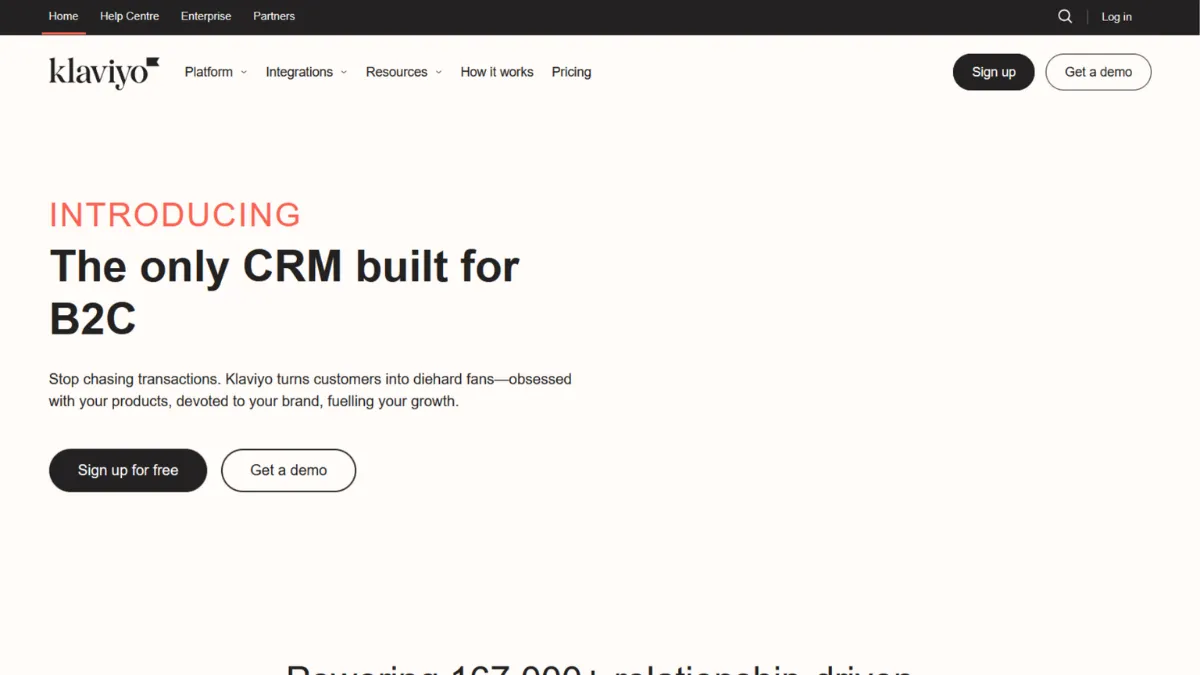
Email revenue does not come from sending more email. It comes from sending the right message to the right person at the right moment, and Klaviyo is the platform built almost entirely around that idea. For ecommerce brands doing meaningful volume, Klaviyo is the closest thing the market has to a default choice, not because it is the cheapest or the easiest to learn, but because it treats customer data as the engine of every campaign rather than an afterthought. The verdict is direct: if you run a product-based business on Shopify or a comparable platform and you want email to be a serious revenue channel, Klaviyo is where you should be.
The mechanism that sets Klaviyo apart is its customer data model. When you connect your store, Klaviyo pulls in purchase history, browsing behaviour, cart activity, lifetime value, and dozens of other signals to build a live profile for every contact. Those profiles feed into segments, and those segments trigger flows. A flow is an automated sequence of messages, whether a welcome series, an abandoned cart reminder, or a post-purchase upsell, that fires based on what a customer actually does rather than a fixed schedule. The detail most new users get wrong is treating flows as set-and-forget. The brands generating the most revenue from Klaviyo review and iterate their flows regularly, adjusting timing, copy, and branching logic based on performance data the platform surfaces in its analytics dashboard. Campaigns and flows serve different purposes: campaigns are broadcast messages to a segment, flows are behavioural sequences. Conflating the two leads to overuse of campaigns and underuse of the automation that produces the highest return per send.
Realistically, expect two to four weeks before your flows are properly configured and your segments are meaningful. Klaviyo is not slow to set up, but getting accurate data requires your store integration to be clean, your historical data to be correctly mapped, and your suppression lists to be maintained. Brands that move past setup quickly but skip list hygiene end up paying for contacts that hurt deliverability. The platform's predictive analytics, which forecast customer lifetime value and churn probability, become genuinely useful only after enough purchase events have been recorded, typically a few months of real transaction data. Do not expect predictive features to carry your strategy on day one.
Klaviyo suits ecommerce founders and retention marketers at product-based businesses, particularly those on Shopify or WooCommerce, who want to convert email from a broadcast channel into a revenue system. It also works well for DTC brands scaling past early revenue thresholds who need behavioural automation rather than basic newsletter tools. Teams with a dedicated email operator or agency partner get the most from it; solo founders with no time to manage flows will underuse it.
The platform's cost structure is its most notable limitation. Pricing scales with active profile count, and the jumps between tiers can be sharp. Brands with large lists that include many lapsed or low-engagement contacts will find themselves paying significantly more than competitors charge for equivalent functionality. List hygiene becomes a financial discipline, not a best practice. SMS, reviews, and analytics add-ons are priced separately, so the total cost of a fully configured Klaviyo stack is often higher than the headline email plan suggests.
The sections below cover how Klaviyo works mechanically, which features matter most, how to build a real retention strategy with it, and how it compares to the main alternatives.
What Is Klaviyo?
Klaviyo is an email and SMS marketing platform built for ecommerce. Where a general-purpose email tool stores contacts in a flat list and lets you send campaigns to them, Klaviyo functions as a customer data platform with a sending engine attached. It pulls behavioural and transactional data from your store, structures it into individual customer profiles, and uses those profiles to power both automated flows and targeted broadcast campaigns. The problem it solves is the gap between knowing what your customers have done and being able to act on that knowledge at scale. A basic email tool can tell you someone opened a message. Klaviyo can tell you that the same person has bought three times, is predicted to buy again within thirty days, and has a lifetime value that places them in your top ten per cent of customers. The question that raises is how, mechanically, all of that data gets translated into messages that actually reach the right person.
How Klaviyo Works
Klaviyo connects to your store via a native integration. For Shopify users, the connection is direct and pulls historical order data, customer records, and real-time event tracking immediately. For other platforms including WooCommerce, the integration depth varies but the core data sync covers orders, products, and customer profiles. Once connected, Klaviyo places a tracking snippet on your site that captures browse events, including which pages a visitor views, which products they look at, and whether they add items to their cart.
From that data, Klaviyo builds segments. A segment is a dynamic audience defined by conditions: customers who purchased in the last sixty days but have not opened an email in thirty, for instance, or customers with a predicted lifetime value above a threshold who have not been sent a win-back flow. Segments update automatically as customer behaviour changes, so they are always current without manual intervention. Flows, which are Klaviyo's automation sequences, attach to segments or events. An abandoned cart flow fires when the cart event is recorded. A browse abandonment flow fires when a product is viewed but not added to the cart. Each flow can branch based on properties: whether the contact has purchased before, which product category they browsed, or how they entered your list.
The counterintuitive insight most users miss is this: Klaviyo's power is not in the number of flows you build. It is in the quality of your segment conditions. Brands that build dozens of flows but leave their segmentation generic produce mediocre results. Brands that invest heavily in precise audience definition, then attach well-timed flows to those audiences, consistently outperform. The question that sends most founders to the features section is a practical one: which specific capabilities make that precision possible?
Klaviyo Key Features
Klaviyo's feature set is built around the assumption that your marketing should be driven by what customers do, not by a fixed calendar. The following capabilities are the ones that create the most measurable difference in practice.
Behavioural Segmentation. Klaviyo's segmentation engine lets you build audiences from any combination of profile data, event history, predicted values, and engagement signals. You can create a segment of customers who bought a specific product category, have a predicted lifetime value above a certain threshold, and have not opened an email in the past twenty-one days, and Klaviyo will update that audience automatically as the underlying data changes. The practical value is that you stop sending the same message to everyone and start sending messages that are accurate to where each customer sits in their relationship with your brand. To use it well, audit your segment conditions monthly and retire any segment that has stopped being meaningful.
Automated Flows. Flows are the core automation layer. Pre-built templates cover the highest-value scenarios: abandoned cart, browse abandonment, welcome series, post-purchase sequences, and win-back campaigns. Each flow can include multiple branches based on conditions, so a post-purchase flow can split between first-time buyers and repeat customers and send different messages to each. The flow analytics view shows revenue attributed to each step, open and click rates, and conversion data, making it straightforward to identify which messages are pulling weight and which need work.
Predictive Analytics. Klaviyo calculates predicted lifetime value, expected next purchase date, and churn probability for each customer profile using historical transaction patterns. These predictions can be used directly as segment conditions, so you can target customers predicted to churn before they lapse rather than after. The accuracy of predictions improves over time as more purchase events are recorded. Treat them as useful signals rather than precise forecasts, particularly in the first months of using the platform.
AI-Assisted Content and Segmentation. Klaviyo has built AI tools into campaign and flow creation, including subject line suggestions, copy generation, and an AI-driven segment builder that accepts natural language input. Segments AI lets you describe the audience you want in plain terms and translates that into segment conditions. For teams without a dedicated email strategist, this meaningfully reduces the friction of building complex audiences from scratch.
SMS Marketing. Klaviyo handles email and SMS within a single platform, with SMS managed through a separate credit-based pricing model. The value is that SMS flows can share the same contact data and segment logic as email, so you can build a single abandoned cart sequence that sends an email first and follows up with an SMS if the customer does not convert. Managing both channels in one tool removes the data gap that appears when email and SMS sit in separate systems. The trade-off is that SMS credits are priced separately, and costs can accumulate quickly at scale. Brands considering Klaviyo primarily for SMS should compare the credit economics carefully against dedicated SMS tools before committing.
Klaviyo Pros and Cons
Klaviyo delivers genuine advantages for ecommerce teams, but it also carries real costs and trade-offs worth naming clearly.
- Ecommerce data depth. No comparable platform integrates purchase, browse, and predictive data as tightly into its automation logic. The customer profile model gives your flows more to work with than almost any alternative at this price point.
- Segmentation precision. The combination of real-time segment updates, historical data depth, and AI-assisted segment building makes Klaviyo's audience management one of the strongest in the market. You can target with a level of specificity that general-purpose tools cannot match.
- Revenue attribution. Klaviyo attributes email and SMS revenue to specific flows, campaigns, and individual messages. This gives marketers a direct line between what they send and what it generates, which is operationally valuable and helps justify the platform's cost to stakeholders.
- Integration breadth. Over 350 native integrations cover the main ecommerce, loyalty, reviews, and advertising platforms. Connecting Klaviyo to your broader tech stack, including tools like Google Analytics for site-level data or loyalty platforms, is generally well-supported.
- Free plan availability. The free tier includes access to automation, segmentation, and forms for small lists. Most founders can run a genuine proof of concept before paying anything.
Alongside those strengths, Klaviyo has limitations that affect specific users meaningfully.
- Cost escalation at scale. Pricing scales with active profile count, and the increases between tiers can be steep. Brands with large lists of lapsed contacts pay for those contacts whether they are generating revenue or not. List hygiene directly affects your monthly bill.
- Learning curve. The flow builder and segmentation logic are powerful but not immediately intuitive. Founders without email marketing experience or agency support typically need several weeks before they are using the platform confidently.
- SMS priced separately. Adding SMS to an email plan requires separate credit purchases. A fully configured email-plus-SMS setup costs more than the base plan implies, and projecting costs requires separate calculations for each channel.
- Non-ecommerce fit is limited. Klaviyo's data model is built around transactions and product behaviour. B2B brands, service businesses, and content publishers will find that much of the platform's sophistication simply does not apply to their use case.
- Support varies by plan. Live chat support is not available on all tiers. Smaller accounts may find the support experience slower than the platform's complexity warrants, particularly during initial setup when help is most needed.
How to Get the Most Out of Klaviyo
The brands that see the strongest results from Klaviyo treat setup as a strategic project rather than a technical one. Before you send a single message, spend time on your data foundation. Confirm that your store integration is pulling in all order events, that your historical data is mapped correctly, and that your suppression lists include bounced addresses and previous unsubscribes from any prior platform. Skipping this step means your segments will be built on incomplete data from the start.
In your first week, prioritise three flows above all others: welcome series, abandoned cart, and post-purchase. These three alone generate the majority of automated email revenue for most ecommerce brands, and they require relatively little data to perform well because they are triggered by specific events rather than historical patterns. Set them live with simple, direct copy and let them run for two to three weeks before making changes. Resist the urge to add complexity before you have baseline performance data.
To get more from Klaviyo's email marketing automation over time, build your segmentation strategy around customer lifecycle stage rather than product category. Identify your active buyers, your lapsed buyers, and your high-value customers, then create distinct flows for each group rather than sending everyone the same broadcast campaign. The difference in engagement rates between a well-segmented send and a blanket campaign is substantial, and Klaviyo's analytics will make that difference visible quickly.
The mistake most operators make is over-investing in campaigns and under-investing in flows. Campaigns require ongoing creative effort and produce diminishing returns as list fatigue builds. Flows, once calibrated, generate revenue continuously without additional work. Allocate your time accordingly. Measure success through revenue per recipient and flow conversion rate, not open rate alone. Open rate as a primary metric leads to optimising for curiosity rather than purchase intent, which is a different and less valuable outcome.
Who Should Use Klaviyo?
Klaviyo delivers its best results for a specific set of users. Three profiles describe where it adds the most value.
The ecommerce founder scaling past initial revenue thresholds who has outgrown a basic newsletter tool and needs automation that responds to purchase behaviour rather than time-based triggers. At this stage, the difference between a platform that knows what a customer bought and one that does not starts to show up in retention rates and repeat purchase frequency. Klaviyo is built for exactly that transition.
The retention marketer at a DTC brand who owns email and SMS as dedicated channels and needs a platform that can power complex lifecycle sequences across both. This person will use segmentation, predictive analytics, and A/B testing regularly, and will benefit from the depth that Klaviyo makes available.
The agency or consultant managing email for multiple ecommerce clients who needs a platform with enough flexibility and data depth to customise strategy per client rather than applying a one-size approach. Klaviyo's integration breadth and template library support this use case well.
Klaviyo is not the right choice if you run a B2B business, a service firm, or a content-led brand where transactions are infrequent or absent. The platform's segmentation and prediction features rely on purchase event data, and without that data, you are paying for capability you cannot access. Bloggers, coaches, and newsletter publishers will find a lighter tool better suited to their needs.
Klaviyo Pricing
Klaviyo offers a free tier for very small lists, which includes access to core features including automation, segmentation, and sign-up forms. It is a genuine starting point, not a stripped-down preview, though the send limits mean it serves proof-of-concept use rather than ongoing operations at scale. Paid plans for email start at the lower end of the market for small contact counts and scale based on the number of active profiles in your account. The pricing model means that list hygiene has a direct financial impact: contacts you are not actively engaging cost you money every month if left unsuppressed.
SMS credits are priced separately from email plans. If you want both channels, calculate your expected SMS volume and add that cost to your email plan before comparing Klaviyo against alternatives. The combined cost of a full email-plus-SMS configuration is higher than the email plan headline implies. Additional products including Klaviyo Reviews and the analytics add-on carry separate pricing as well. Always check the current rates directly on Klaviyo's pricing page, as the structure has changed periodically and tier thresholds can shift. For most brands doing meaningful ecommerce volume, the paid email plan is the right starting point. The free tier is adequate for testing but not for building a retention programme.
Against competitors priced at similar entry points, Klaviyo's cost efficiency is reasonable at small list sizes and less competitive as lists grow into the tens of thousands. That trade-off is worth knowing before you commit, particularly if your contact list is large relative to your active buyer base.
Klaviyo vs Alternatives
Choosing between Klaviyo and its closest competitors comes down to your business model and how sophisticated your email programme needs to be.
Mailchimp is the most common starting point for email beginners and remains easier to learn than Klaviyo. Its ecommerce integrations work but lack the data depth that makes Klaviyo's behavioural automation genuinely useful. Mailchimp suits small businesses and content creators who want reliable broadcast campaigns without complexity. Klaviyo wins when purchase behaviour needs to drive automation.
Omnisend is a strong ecommerce-focused alternative that combines email, SMS, and push notifications in a single flow builder. Its visual automation is often cited as more intuitive than Klaviyo's, and its pricing is competitive at mid-range list sizes. Choose Omnisend if onboarding speed and multi-channel simplicity matter more than raw data depth. Klaviyo wins on segmentation precision and predictive analytics.
ActiveCampaign is the better choice for B2B businesses, service companies, and teams that need sophisticated conditional branching across non-transactional customer journeys. Its CRM capabilities and automation depth exceed Klaviyo's for lead-nurturing workflows. Klaviyo wins decisively for ecommerce use cases where purchase and browse data should drive every message.
GetResponse offers a broader feature set at lower price points, covering email, landing pages, and webinar hosting. It suits businesses that want a multi-purpose marketing tool rather than a specialist retention platform. Klaviyo wins where ecommerce data integration is the priority.
Klaviyo Review: Final Verdict
Klaviyo earns an overall score of 4.31 out of 5, which reflects a platform that genuinely leads its category for ecommerce email and SMS marketing but carries real cost and complexity trade-offs that matter at scale. Its segmentation and automation capabilities score at the top of the range, reflecting capabilities that competitors have not matched for product-based businesses. Cost efficiency scores more modestly, because the profile-based pricing model becomes expensive as lists grow and additional products are priced separately.
The bottom line: if you run an ecommerce business and email is a meaningful revenue channel, Klaviyo is the strongest tool available for turning customer data into automated, behavioural marketing. Every other use case should look elsewhere first.
How We Rated It:
More Tool Reviews


Subscribe to Stay in the loop
Get the latest AI and technology news, honest tool reviews, and practical guides delivered straight to your inbox.
Success! Check your Inbox!

Tezons Newsletter
The latest technology news, in-depth tool reviews, and practical guides - curated and delivered to your inbox.
Latest News




Have a question?
Have any questions?
Didn’t find what you were looking for? We’re just a message away.