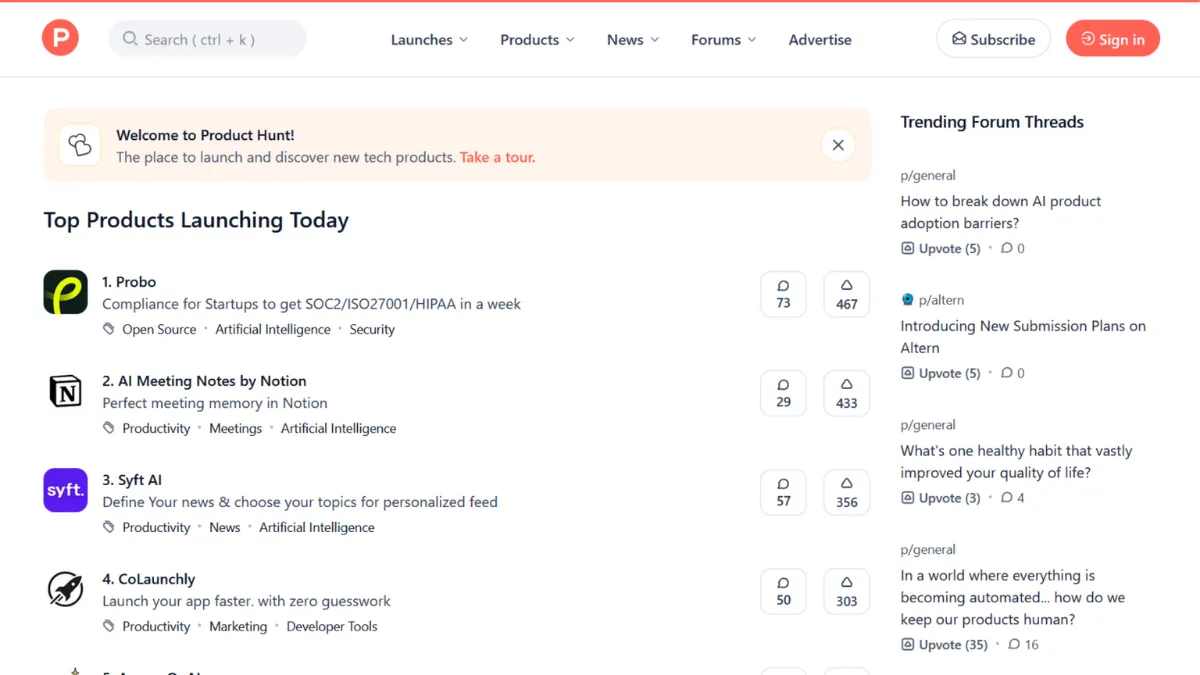
Launching a product without a warm audience behind it is the most reliable way to waste a Product Hunt day. The platform rewards preparation more than almost any other single factor, yet most founders treat it as a destination rather than a culmination. Product Hunt is the internet's highest-profile launch platform for digital products, and a top-5 finish on any given day still carries real weight with press, investors, and early adopters. Get the fundamentals wrong, though, and you will spend 24 hours watching your ranking slide while better-prepared products overtake you.
The mechanism driving Product Hunt is a weighted voting algorithm that most makers misread entirely. Upvotes are not equal. The platform assigns significantly more value to votes from established, active accounts than to votes from users who registered recently or have little engagement history. A vote from someone with years of activity and a substantial following can outweigh ten votes from accounts created the same week. This is why founders who blast a cold email list asking for upvotes often see their products demoted rather than boosted: the algorithm runs periodic clearing cycles that strip out low-quality votes, and a sudden surge from new accounts is a red flag the system is designed to catch. Asking for feedback rather than votes is not just good etiquette; it is the mechanically correct framing, because engaged users who find your product through genuine curiosity register as higher-quality signal than people fulfilling an obligation.
Expect a meaningful traffic spike on launch day, followed by an 80 to 90 percent drop within 72 hours. This is normal and is not a verdict on your product. The practical benefit of a strong Product Hunt launch compounds over time through the badge you earn: Product of the Day, Week, or Month functions as persistent social proof that you can display on your site and reference in outreach long after the launch window closes. Teams that plan for post-launch conversion, with a dedicated landing page, a clear offer for PH visitors, and a follow-up email sequence, capture far more value than those focused only on the leaderboard position itself. Building your email list through tools like Kit or Mailchimp in the weeks before launch gives you a warm audience to notify on the day, which is one of the highest-leverage actions available to any maker.
Product Hunt suits indie makers, bootstrapped SaaS founders, and small product teams shipping software, apps, browser extensions, or AI tools to a tech-forward early-adopter audience. It works particularly well when the product has a strong visual identity and a tight, memorable tagline. B2B tools with complex enterprise sales cycles, products targeting non-technical audiences, and physical goods tend to see weaker results relative to the preparation required.
One real limitation is that Product Hunt's audience skews heavily toward other makers and tech enthusiasts, not end-users in most verticals. A conversion rate from PH traffic to paying customers is often lower than founders expect, which makes post-launch nurturing essential. The platform also runs entirely on a 24-hour cycle: miss the day, and you cannot revisit without launching a meaningfully updated version of your product.
The sections below cover how the platform works mechanically, its key features, a practical launch strategy, pricing, and how it compares to the most relevant alternatives.
What Is Product Hunt?
Product Hunt is a daily product discovery platform where makers submit new apps, tools, and services to be voted on and discussed by a community of early adopters, investors, and fellow builders. Founded in late 2013 and later acquired by AngelList, it has become the default launch venue for consumer software and SaaS products seeking their first wave of users and press coverage. What separates it from a generic directory is the community layer: makers can respond to comments in real time, creating a public conversation that functions as both a demo and a trust signal. The question that follows naturally is how the ranking system actually works behind the scenes, because understanding the algorithm is the difference between a launch that trends and one that disappears by midday.
How Product Hunt Works
Every day at 12:01 AM Pacific Time, the slate resets. Products submitted before midnight enter the new day's competition and have 24 hours to accumulate upvotes, comments, and engagement. The homepage ranks products dynamically throughout the day based on a weighted score the platform does not publish in full, though its main inputs are well understood: upvote quality, comment volume, engagement diversity across time zones, and click-through behaviour from the listing.
Submitting a product requires a thumbnail image, a tagline, a description, screenshots or a demo video, and a maker's comment introducing the product and its story. Each element functions as a conversion lever. The thumbnail needs to stand out in a dense visual feed. The tagline should communicate the core value in under ten words. The maker's comment, pinned at the top of the discussion thread, sets the tone for every subsequent conversation and is the first thing most active community members read before deciding whether to engage.
Hunters are community members who submit products on behalf of makers. Collaborating with a hunter who has a large, active following on the platform can meaningfully amplify early visibility, because their followers receive a notification when they submit a product. The maker tag can be added after submission, so founders who use a hunter retain full credit and can respond in comments as a verified maker. Pairing your listing with a well-designed landing page built in Webflow or similar, dedicated to the PH launch and offering something exclusive to the community, is a reliable way to improve conversion from curious upvoter to email subscriber or paying customer.
The counterintuitive insight most founders learn too late: the majority of your preparation must happen before launch day, not during it. Community standing built over 30 or more days of genuine participation, a network of supporters with warmed-up accounts, and a staggered outreach plan that spreads engagement across the full 24 hours all outperform scrambling for votes on the morning of launch. Velocity matters throughout the day, not just at the start. This sets up the practical question of which specific features on the platform you should actually focus on to support that preparation.
Product Hunt Key Features
Daily Leaderboard. The homepage ranks every product launched that day by its weighted engagement score, updating continuously. Reaching the top five is the primary objective for most makers, as those positions receive disproportionate traffic and press attention. The 24-hour window means every hour of the day matters: maintaining momentum through the afternoon and evening Pacific Time, when US and European audiences overlap, is as important as a strong morning start.
Maker Dashboard and Comments. Verified makers can respond directly to comments on their listing, turning the discussion thread into a live Q&A with potential users. Active maker participation correlates with better ranking outcomes, because comment engagement is one of the weighted signals the algorithm uses. Founders who check in and respond every hour throughout launch day consistently outperform those who post and disappear. Using a tool like Notion to prepare answers to likely questions in advance means you can respond thoughtfully under pressure without losing time.
Badges and Social Proof. Products that reach the top five in a day earn a Product of the Day badge; weekly and monthly badges are awarded for cumulative performance. These badges are persistent, embeddable, and credible to a tech-savvy audience. Many founders embed them directly on pricing pages and in investor decks, where they function as an independent signal of early traction. The badge is arguably the most lasting tangible output of a successful launch.
Collections and Following. Users can save products into curated collections and follow specific makers or categories. Over time, a well-maintained Product Hunt presence allows you to build a following that receives notifications when you post updates or new products, functioning as a lightweight distribution channel independent of the daily competition cycle.
Upcoming Page and Scheduling. Makers can list products on the Upcoming page before launch to build a pre-launch subscriber list directly within the platform. Subscribers opt in to receive a notification when the product goes live, giving you a seeded audience on day one without relying entirely on external outreach. The size of this list at launch time is one of the more controllable inputs available to founders before they submit. One practical implication worth acknowledging: all of these features are free to use, which raises the question of what you actually lose by not paying, and whether that matters for most launches.
Product Hunt Pros and Cons
Where Product Hunt earns its position:
- Unmatched reach within the tech early-adopter segment. No other launch platform concentrates this volume of product-curious users in a single daily feed. A top-five finish on a competitive day can drive thousands of visitors and hundreds of signups within 24 hours, and the press and investor attention that follows a strong ranking is difficult to replicate through other channels at launch stage.
- The badge provides durable social proof. Unlike a spike in referral traffic that disappears, the Product of the Day badge is a credential you display permanently. It shortens trust-building conversations with investors, journalists, and prospective customers who recognise what a strong Product Hunt ranking means.
- Free to launch, genuinely accessible to solo makers. You do not need a budget to compete seriously on Product Hunt. Many top-ranked products are built and launched by a single founder with no paid promotion. The platform's free tier covers everything needed for a full launch, including listing, maker verification, and community engagement.
- Community feedback is unusually candid. Product Hunt users tend to leave specific, critical comments rather than generic praise. The discussion thread from a launch day often surfaces real UX friction, positioning gaps, and feature requests that are more actionable than survey responses or user interviews conducted in controlled settings.
- The Upcoming page is an underused subscriber funnel. Building a pre-launch list within Product Hunt itself, rather than only through external channels, compounds your day-one engagement. Most makers skip this step entirely, which means those who use it hold a meaningful structural advantage.
Where Product Hunt falls short:
- The algorithm is opaque and can be unforgiving. Vote clearing happens without warning and can strip a significant portion of your upvotes if the system flags suspicious patterns. There is no appeal process, and the platform does not notify you when clearing occurs. Founders who put weeks into launch preparation have watched their rankings collapse due to factors outside their control.
- Traffic conversion is lower than it appears. A Product Hunt audience skews toward makers evaluating tools rather than buyers ready to pay. Conversion from PH traffic to paying customers is often in the low single digits, meaning the real value is list-building and brand awareness rather than immediate revenue.
- One product, one chance per iteration. Product Hunt does not allow you to relaunch the same product without a significant update. If your launch day coincides with a particularly strong field of competing products, you cannot try again next week with the same listing.
- Integrations with your wider marketing stack are limited. Product Hunt does not offer native connections to CRMs, email platforms, or analytics tools beyond its own internal metrics. Tracking attribution from PH traffic requires setting up UTM parameters and connecting your own Google Analytics separately.
- Paid tier value is unclear. The pricing structure for advanced features has not been consistently documented by the platform itself. Third-party sources describe paid tiers, but the features and prices they cite vary enough that verifying what you actually get for a subscription requires checking the platform directly. Most founders find the free tier entirely sufficient for launching.
How to Get the Most Out of Product Hunt
The single most important thing you can do before you launch on Product Hunt is spend 30 days as a participant rather than a spectator. Comment on products in your category, upvote things you genuinely find interesting, and engage with makers whose work relates to yours. This behaviour builds your account's credibility and surfaces you to potential supporters before you need anything from them. Founders who skip this phase and show up only on launch day are operating with a structural disadvantage the algorithm was designed to create.
In the week before launch, activate every warm channel you have. Email your existing list, post in relevant Slack communities, and notify your network on social. The key framing is feedback, not votes. Ask people to check out what you've built and share their thoughts on Product Hunt. This phrasing converts better, avoids triggering the algorithm's spam detection, and brings in the kind of engaged commenters who improve your ranking more than passive upvoters.
On launch day, stagger your outreach across the full 24 hours rather than pushing everything in the first hour. A product that sustains consistent engagement from morning through evening Pacific Time outperforms one that peaks at 9 AM and fades. Designate someone to monitor comments and respond within minutes throughout the day. If you are running solo, batch responses every hour rather than leaving threads unanswered.
Learning how to launch on Product Hunt successfully means treating the listing like a landing page, not a form. Every visual element, from thumbnail contrast to the first five words of your description, should be optimised for a user scrolling quickly on a phone. If you want to maximise conversion from PH traffic, send visitors to a dedicated page with an exclusive offer rather than your homepage.
After launch, share your final ranking publicly and embed your badge immediately. The 48 hours after a strong finish are when inbound press and investor interest is highest. Have a short summary of your traction numbers ready to send on request, and follow up with everyone who left a meaningful comment during launch day. Those conversations often produce your first paid customers.
Who Should Use Product Hunt?
This is for you if you are building a software product, AI tool, browser extension, or SaaS targeting a tech-forward audience and you need an initial wave of users, press coverage, or investor visibility. It works particularly well for indie makers and small teams who have spent time building in public and have a warm community they can activate. It also suits founders preparing to raise a seed round who want a credible traction signal to reference in conversations.
A second strong fit is any maker who has shipped a meaningful update to an existing product and wants to re-enter the public conversation. Product Hunt allows relaunches of products with genuine new capabilities, and experienced makers sometimes plan their product roadmap specifically to create relaunch opportunities at strategic moments.
A third persona is the bootstrapped B2B SaaS founder targeting other builders or technical users. Product Hunt's audience is disproportionately composed of product managers, developers, and founders, making it one of the most efficient channels for tools aimed at that segment.
Product Hunt is not a strong fit if your target customer is non-technical, outside the maker and startup ecosystem, or making purchasing decisions through an enterprise sales process. A healthcare tool targeting clinical staff, a restaurant management system, or an e-commerce store built on Shopify will find that PH traffic converts poorly, because the audience does not match the buyer. If your product needs hands-on enterprise evaluation rather than a self-serve trial, the 24-hour sprint format works against you.
Product Hunt Pricing
Launching on Product Hunt itself is free, and for the large majority of makers, the free tier provides everything required for a full, competitive launch: product submission, maker verification, community engagement, the Upcoming page, and access to your listing's performance data. There is no pay-to-play mechanism for the daily leaderboard; a well-prepared free launch can and does outperform paid promotions.
Product Hunt has offered paid plans with features such as advanced analytics, promoted listings, and priority support, but the exact structure and pricing of these tiers changes over time and is not consistently documented across third-party sources. The figures cited in various guides range from roughly $29 to $300 per month depending on the tier, and some sources describe features that may no longer reflect the current product. You should verify the current paid tier structure directly on the Product Hunt website before budgeting for anything beyond the free plan.
The practical verdict: for indie makers and early-stage founders, free is sufficient. The supporting costs of a strong launch, such as a dedicated landing page, email sequencing tools, and design assets, are where budget is better spent. Compared to alternatives like BetaList, which charges for expedited review, or paid placement on other directories, Product Hunt's free access to its scale of audience represents strong cost-efficiency for the category. That said, if you are evaluating where to spend limited launch budget, direct comparison with alternative platforms is the sensible next step.
Product Hunt vs Alternatives
Hacker News Show HN is the most powerful free alternative for technical products and developer tools. A front-page Show HN post can drive an enormous volume of highly qualified visitors in a single day, and the audience is more willing to engage with infrastructure, open-source, or low-level software than Product Hunt's community tends to be. The trade-off is complete unpredictability: there is no scheduling, no algorithm you can prepare for, and the community is known for pointed criticism that can dominate the conversation if your product has obvious gaps. Product Hunt wins when you want a structured, manageable 24-hour window with a maker-friendly format.
BetaList targets pre-launch products specifically, focusing on gathering a waitlist before a full release. It brings smaller volume than Product Hunt but delivers higher-intent early adopters who are explicitly opting in to test unfinished software. For founders who want to validate demand before a public launch, BetaList and Product Hunt serve different moments in the same journey rather than competing for the same slot.
Indie Hackers is not a launch directory but a community platform for bootstrapped founders. Products gain traction there through storytelling, milestone posts, and genuine participation over weeks and months rather than a single day. The audience values revenue transparency and sustainable growth over launch-day hype, making it a better long-term channel than a one-time launch vehicle. Product Hunt and Indie Hackers are most effective when used together across different stages.
Peerlist Launchpad runs on a weekly cadence rather than daily, giving products seven days of visibility and a more measured community evaluation. For founders who find the pressure of a 24-hour sprint difficult to manage around a small team's workload, Peerlist offers a more forgiving format, though it reaches a smaller total audience than Product Hunt at the same stage.
Product Hunt Review: Final Verdict
Product Hunt earns an overall score of 4.16 out of 5, reflecting its exceptional value as a free launch channel with a uniquely engaged audience, balanced against real limitations in integration capabilities and a conversion profile that requires deliberate post-launch work to monetise. Its cost-efficiency score of 4.5 is the most significant single dimension: no other platform of comparable reach and credibility is free to use for a full launch. The one dimension that consistently underwhelms is integrations, scored at 3.5, because Product Hunt does not connect natively to the CRM and email tools that make launch traffic actionable, meaning you carry that stitching work yourself.
The bottom line: if you are shipping a digital product to a tech-forward audience and you are willing to put in four to six weeks of preparation, Product Hunt remains the single highest-leverage free launch channel available. Treat the badge as the output you are building toward, and plan your post-launch nurturing before the day arrives.
How We Rated It:
More Tool Reviews



Subscribe to Stay in the loop
Get the latest AI and technology news, honest tool reviews, and practical guides delivered straight to your inbox.
Success! Check your Inbox!
Tezons Newsletter
The latest technology news, in-depth tool reviews, and practical guides - curated and delivered to your inbox.
Latest News




Have a question?
Have any questions?
Didn’t find what you were looking for? We’re just a message away.