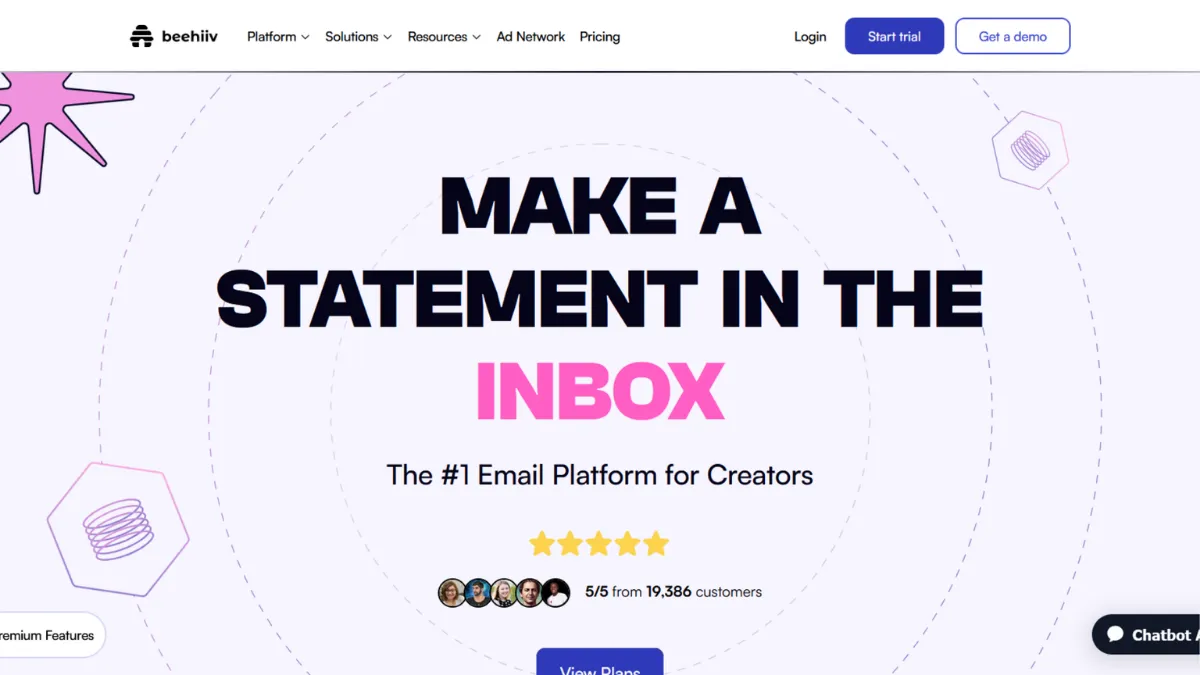
Building a newsletter audience is one thing. Building a newsletter business is another, and most platforms only help you do the first. Beehiiv was designed from the start to handle both, packaging content creation, audience growth, and revenue tools into a single dashboard aimed squarely at creators who want to turn subscribers into income. The platform has earned genuine traction among serious newsletter operators, not because it is the flashiest option on the market, but because it removes the need to stitch together five separate tools to run what should be a straightforward publishing operation.
The mechanism behind Beehiiv's appeal is its integrated growth and monetisation stack. Most newsletter platforms give you an editor and an email sender, then leave you to figure out the rest. Beehiiv goes further with a built-in ad network that connects you with brand sponsors once you pass 1,000 active subscribers, a Boosts system that lets you earn money by recommending other newsletters to your readers, a referral programme that turns subscribers into recruiters, and a native paid subscription layer that charges zero platform commission on revenue. That last point is significant: platforms like Substack take 10% of every subscription payment. Beehiiv takes nothing beyond the standard payment processor fee. For a newsletter generating meaningful subscription revenue, the difference compounds fast. What most users get wrong is treating the growth tools as optional extras. The referral and Boosts features only produce results when they are set up from day one, not bolted on after you have already built your sending habits.
Realistic expectations matter here. The ad network becomes genuinely valuable above 1,000 engaged subscribers, and the Boosts payouts are proportional to list size and engagement rate. A new newsletter on the free plan will find the platform useful for building early momentum, but the real leverage comes at the Scale tier and above, where automations, A/B testing, and monetisation tools unlock. Operators who commit to weekly sending and treat their analytics dashboard as an active feedback loop tend to see subscriber quality improve faster than those who publish inconsistently.
Beehiiv is specifically suited to solo creators, independent journalists, and small founding teams who want a single platform to write, grow, and earn from a newsletter without managing a complicated tech stack. It also works well for early-stage startups using a newsletter as a primary distribution channel and content businesses looking to reduce their dependency on social platforms.
The design flexibility ceiling is a real constraint. Template options are limited compared to general-purpose email marketing tools, and advanced layout or CSS control is gated behind the Max tier. Creators with strong brand aesthetics who need granular visual control will feel the walls.
The sections below cover how Beehiiv works mechanically, which features actually move the needle, where the platform falls short, and how it compares to the main alternatives.
What Is Beehiiv?
Beehiiv is a newsletter platform built to serve creators who want to grow and monetise an email audience without relying on external tools for every step of the process. Where a general-purpose email marketing platform like Mailchimp is built around broad campaign management and e-commerce automation, Beehiiv is purpose-built for the newsletter format: regular issues, subscriber growth, and direct reader revenue. The platform combines a web-hosted archive, a custom domain, an email editor, native analytics, paid subscriptions, an ad network, a referral programme, and audience growth tools under one login. It launched with backing from founders who previously built newsletter infrastructure at Morning Brew, which shaped its emphasis on growth mechanics from the outset. What separates it from a basic email sender is the deliberate layering of monetisation into the core product rather than treating it as an add-on. The natural question that follows is how those layers actually work together once you sit down to build.
How Beehiiv Works
Setting up a Beehiiv newsletter takes less than an hour from account creation to first send. You configure your publication name, connect a custom domain if you have one, choose a template layout from the available options, and the platform provisions a hosted web archive automatically. No separate hosting arrangement is required. The email editor uses a block-based drag-and-drop interface that handles text, images, polls, social embeds, and dynamic content blocks without requiring any code.
The growth tools work as a network effect layer on top of your existing list. The referral programme lets you define rewards at subscriber milestones and generates a unique tracking link for each reader. The Boosts system is a cross-promotion marketplace: you can pay a cost-per-acquisition fee to appear in other newsletters on the platform, or earn that fee by recommending other publications to your own readers. The ad network operates separately, with Beehiiv matching brand advertisers to newsletters based on audience size and engagement. You receive inbound ad opportunities through the dashboard once you meet the minimum threshold.
Analytics in Beehiiv track opens, clicks, subscriber growth by source, and revenue across all monetisation channels. The platform labels its more advanced analytics layer '3D analytics', which segments subscriber behaviour over time rather than presenting a flat open-rate number. Automations handle welcome sequences and triggered email flows, with a visual workflow builder available on paid tiers.
The counterintuitive thing most operators miss is that Beehiiv's growth tools compound with list quality rather than list size. A smaller, highly engaged list earns more from the ad network, converts better on Boosts, and generates more referrals per reader than a large, disengaged one. This means the platform rewards operators who actively manage inactive subscribers out of their list, not just those who accumulate the highest raw subscriber count. That insight shapes how you should think about measuring success, which the features section below addresses directly.
Beehiiv Key Features
Built-in Ad Network. Beehiiv operates its own advertising marketplace connecting newsletter publishers with brand sponsors. Once your publication crosses 1,000 active subscribers and maintains a consistent sending cadence, you become eligible to receive inbound sponsorship opportunities through the dashboard. The network handles the matching, negotiation framework, and payout via Stripe, removing the need to cold-pitch advertisers yourself. Revenue scales with audience size and engagement rate rather than raw subscriber count, which means operators focused on list quality earn disproportionately more than those chasing vanity metrics.
Boosts Cross-Promotion System. Boosts is a paid subscriber acquisition network where newsletters pay per confirmed engaged subscriber rather than per click or impression. As a publisher, you can earn by recommending vetted newsletters to your readers, and spend to acquire new subscribers from relevant publications. The cost-per-acquisition model means you only pay for readers who actually sign up and confirm their subscription, which makes growth spend more predictable than paid social advertising. Setting a conservative budget cap and monitoring subscriber quality weekly is the correct way to use it, not setting and forgetting.
Paid Subscriptions with Zero Platform Commission. Beehiiv allows you to gate content behind paid tiers and collect subscription revenue directly, with no percentage taken by the platform beyond the payment processor's standard fee. This is a structurally different arrangement from Substack's 10% cut and is worth real money at scale. You can configure multiple subscription tiers, offer free trials, and create exclusive content for paying readers. The subscription tools integrate with the segmentation system so paid subscribers receive different content flows from free ones automatically.
Referral Programme. The built-in referral system generates a unique tracking link for each subscriber and lets you define milestone rewards, physical or digital, for readers who bring in a set number of new sign-ups. Setup takes under 30 minutes: define your reward tiers, set the milestones, embed the referral block in your newsletter template, and the platform tracks attribution and reward eligibility automatically. The most effective operators make the referral block a permanent fixture in every issue rather than a one-off campaign.
3D Analytics and Subscriber Attribution. Beehiiv's analytics layer goes beyond open and click rates to track where each subscriber came from, how their engagement changes over time, and which acquisition channels produce the highest-quality readers. Subscriber attribution tells you whether a given reader arrived via a Boost, a referral link, a web search, or direct sign-up. This data changes how you allocate growth spend significantly. The trade-off is that the segmentation system, while sufficient for newsletter use cases, is less granular than what dedicated marketing automation platforms like Klaviyo offer, particularly for behavioural trigger sequences.
Beehiiv Pros and Cons
Beehiiv gets more right than it gets wrong, but the gaps are worth understanding before you commit.
- Zero commission on paid subscriptions. Keeping the full subscription fee, minus payment processing, is a genuine financial advantage over platforms that take a percentage. For a newsletter generating several thousand pounds per month in subscriptions, this difference is material.
- Integrated growth stack. The referral programme, Boosts network, and ad marketplace are built into the same platform as the email editor and analytics. You do not need a separate tool for each growth lever, which reduces setup friction and keeps data in one place.
- Generous free tier. The Launch plan supports up to 2,500 subscribers with unlimited email sends and no credit card required. This is among the highest free subscriber limits in the newsletter platform category and gives you meaningful runway to test your content before committing to a paid plan.
- Rapid feature development. Beehiiv ships new features at a faster pace than most established email platforms. Tools like dynamic content blocks, mobile app publishing, and AI writing assistance have been added progressively, giving operators more capability without switching platforms.
- SEO-friendly web archive. Every newsletter issue publishes to a hosted, indexed web page automatically. The platform handles metadata and site structure in a way that gives newsletter content a reasonable chance of ranking in search without additional configuration. Pairing this with a tool like Semrush for keyword research can extend the organic reach of your archive significantly.
The platform has real limitations that some operators will find disqualifying.
- Automation depth is limited. Beehiiv handles welcome sequences and basic triggered emails competently, but anything resembling a multi-branch conditional funnel requires workarounds or a connection to an external automation tool. Operators who need complex behavioural sequences will find the automation builder constraining.
- Design flexibility is intentionally capped. The template library is small and CSS-level control is restricted to the Max tier. Creators with precise brand standards or complex visual layouts will encounter friction that dedicated design tools do not impose.
- Support response times vary. Free plan users access documentation only. Paid plan support tickets can take 12 to 36 hours for a response according to user reports, and the AI-assisted chat assistant receives mixed feedback. Priority support is a Max-tier feature.
- Third-party integrations are narrower than legacy platforms. Beehiiv connects to a useful set of tools via native integrations and Zapier, but the library is smaller than Mailchimp or ActiveCampaign. Complex tech stacks may require custom workarounds.
- Pricing scales with subscriber count. Once you move past the free tier, costs rise with list size on both the Scale and Max plans. At high subscriber volumes, the pricing becomes less competitive relative to some alternatives, and the enterprise tier requires custom negotiation.
How to Get the Most Out of Beehiiv
Before you write a single issue, connect your custom domain, configure your subscriber welcome automation, and embed the referral block in your default template. These three actions take less than two hours and determine the baseline performance of every issue you send thereafter. Skipping them and coming back later means retrofitting a live publication, which is harder and more disruptive than doing it correctly from the start.
In your first month, prioritise list quality over list size. Import any existing subscribers, clean out known inactive addresses, and set up a re-engagement automation for anyone who does not open your first three issues. Beehiiv's analytics will show you which acquisition sources produce the highest engagement rates. Shift your growth budget, whether time or money, toward the channels that produce engaged readers rather than the ones that produce the most raw sign-ups.
Activate Boosts once your list reaches a few hundred subscribers and your open rate is above industry average. The cost-per-acquisition model makes Boosts one of the most capital-efficient subscriber growth mechanisms available in the newsletter space, but it only produces a positive return if your content retains the subscribers it acquires. Earning from Boosts by recommending relevant newsletters to your own audience is a parallel revenue stream worth enabling on the same timeline.
To get the most out of how to monetise a newsletter on Beehiiv, treat the ad network, paid subscriptions, and Boosts as complementary rather than competing channels. Ad revenue scales with audience size and engagement. Subscription revenue scales with content quality and reader trust. Boosts earnings scale with audience relevance. Running all three in parallel from an early stage produces a more resilient revenue base than concentrating on a single monetisation method.
Measure success with subscriber engagement rate and revenue per subscriber rather than total list size. A list of 3,000 readers with a 50% open rate and active Boosts participation will outperform a list of 10,000 disengaged subscribers on every financial metric the platform offers.
Who Should Use Beehiiv?
Beehiiv suits three types of operators particularly well. The solo creator turning a weekly newsletter into a primary income source will find the combination of zero-commission subscriptions, built-in advertising, and the Boosts network gives them more monetisation levers in a single login than any comparable platform at this price point. The early-stage startup using a newsletter as a distribution and audience-building channel benefits from the SEO-friendly archive, the referral programme, and the analytics that show which channels produce the most engaged readers rather than just the most subscribers. The independent journalist or subject-matter expert who writes consistently and wants to convert audience trust into paid memberships will find the subscription tools and content gating straightforward to set up and maintain without technical help.
Beehiiv is not the right choice for e-commerce teams that need deep behavioural segmentation tied to purchase history, or for marketing operations running complex multi-branch automation funnels across multiple product lines. If your primary use case is transactional email, CRM integration, or lead scoring across a large sales pipeline, you will run into the platform's limits quickly. It is also a poor fit for agencies managing many client brands simultaneously, since the multi-publication tools are gated behind the Max tier and the account structure was not designed for client-facing workflows.
Beehiiv Pricing
Beehiiv offers a free Launch plan supporting up to 2,500 subscribers with unlimited email sends and access to the core editor, web archive, and basic analytics. The free tier does not include monetisation tools: the ad network, Boosts, paid subscriptions, and automations all require a paid plan. For most creators testing a concept, the free tier provides enough runway to validate the idea before spending anything.
Paid plans start at approximately $49 per month for the Scale tier, which adds monetisation, A/B testing, automations, advanced analytics, and the referral programme. The Max plan starts at around $109 per month and adds the ability to remove Beehiiv branding, manage up to ten publications, access dynamic content, and receive priority support. Pricing on both paid tiers scales upward with subscriber count, so costs rise meaningfully once you move into larger list sizes. An annual billing discount is available. A 30-day free trial of paid features is offered, which gives you time to test the monetisation tools with a live audience before committing.
The value proposition is strongest at moderate list sizes where the zero-commission subscription model and Boosts earnings meaningfully offset the monthly plan cost. At very high subscriber volumes the enterprise tier requires custom pricing, and the per-subscriber cost model becomes less competitive. Always check the current pricing page on Beehiiv's site for the latest tier structure, as rates have been adjusted previously. Compared to the alternatives below, pricing sits in the middle of the market rather than at either extreme.
Beehiiv vs Alternatives
Substack is the most common comparison. It offers a simpler setup and a built-in discovery network that can surface new writers to readers already on the platform. The fundamental difference is economics: Substack takes 10% of subscription revenue, Beehiiv takes nothing. Substack also has no meaningful automation, no ad network, and no cross-promotion tools beyond its own recommendation system. Choose Substack if you want the lowest-friction start and plan to grow purely through Substack's own discovery. Choose Beehiiv if you intend to build a monetised operation with multiple revenue streams.
Kit (formerly ConvertKit) is a stronger choice for creators who need sophisticated automation and sell digital products or courses alongside a newsletter. Its automation builder is more capable than Beehiiv's, and its commerce tools cover a wider product range. Beehiiv wins on newsletter-specific growth tools: Boosts, the ad network, and the referral programme have no Kit equivalent. For a pure newsletter business, Beehiiv's feature set is more directly useful. For a creator selling courses or coaching alongside a newsletter, Kit may offer a better fit.
Ghost is an open-source publishing platform with more design flexibility and better content management for long-form publication archives. It suits technically confident operators who want full control over their site's appearance and are comfortable with self-hosting or managed hosting costs. Ghost's monetisation is limited to memberships. It has no ad network, no Boosts equivalent, and no referral infrastructure. Beehiiv wins for operators who want growth mechanics built in and are willing to accept tighter design constraints in exchange.
Moosend targets broader email marketing use cases with stronger automation and lower entry pricing, but it is not built for newsletter monetisation and lacks the growth tools that make Beehiiv distinctive. It suits teams with existing marketing automation needs rather than newsletter-first businesses.
Beehiiv Review: Final Verdict
Beehiiv earns a 4.27 out of 5 overall, a score that reflects a platform doing the hard things well: monetisation infrastructure, subscriber growth mechanics, and a zero-commission revenue model that holds up financially at scale. Its functionality rating of 4.5 is deserved for a newsletter-specific platform, though a cost-efficiency score of 4.0 acknowledges that pricing rises noticeably with list size and the best features sit behind paid tiers.
If you are building a newsletter with serious monetisation intent, Beehiiv is the strongest single platform for the job. If you need deep automation or full design control, budget time to work around its constraints or consider a different tool for those specific functions.
How We Rated It:
More Tool Reviews





Subscribe to Stay in the loop
Get the latest AI and technology news, honest tool reviews, and practical guides delivered straight to your inbox.
Success! Check your Inbox!

Tezons Newsletter
The latest technology news, in-depth tool reviews, and practical guides - curated and delivered to your inbox.
Latest News




Have a question?
Have any questions?
Didn’t find what you were looking for? We’re just a message away.