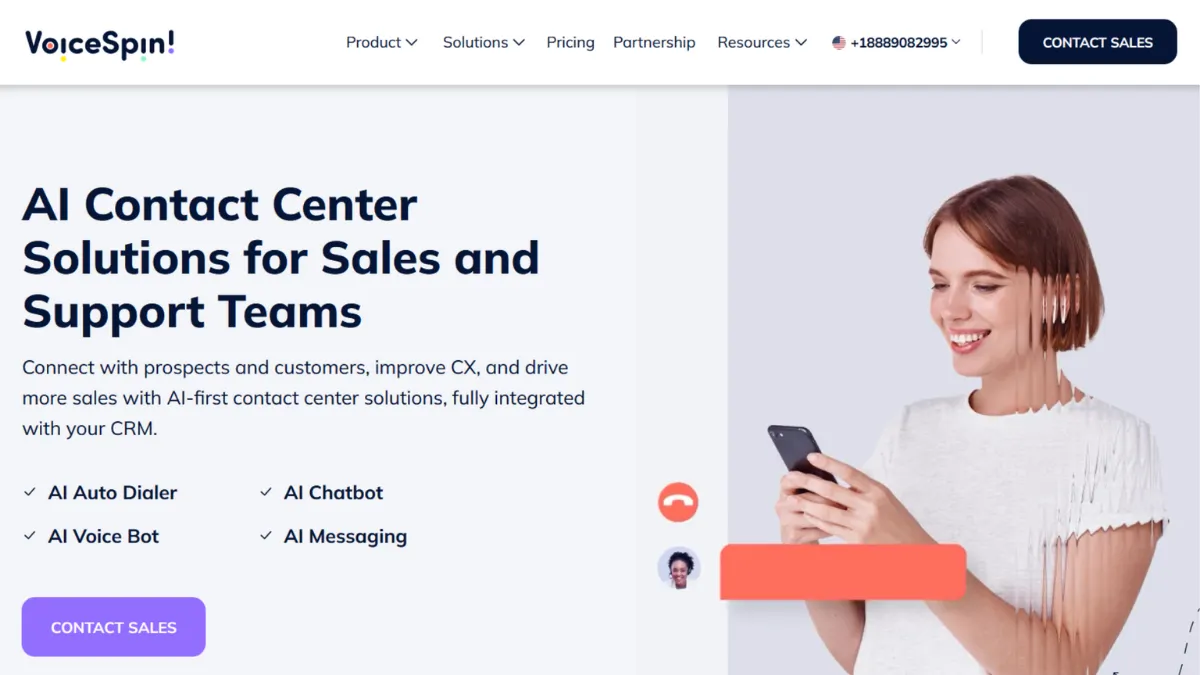
Outbound call volume is the metric most sales-focused contact centres obsess over, yet the gap between dials made and conversations held is where most teams lose. VoiceSpin closes that gap with an AI-powered predictive dialler and a lead-agent matching engine that together determine not just who to call, but when to call and which agent is statistically most likely to convert that specific lead. The result is a platform built for teams whose business model depends on outbound velocity, not one that treats dialling as an afterthought bolted onto a phone system.
The mechanism behind VoiceSpin is worth understanding precisely because most teams deploy it wrong. The predictive dialler uses machine learning to model agent availability and lead behaviour simultaneously, initiating multiple calls per agent before they finish the previous conversation so idle time drops to near zero. The lead-agent matching layer then scores both the lead and the available agent, routing connections based on probability of a positive outcome rather than simply queue position. Teams that treat the platform as a straight replacement for a basic auto-dialler and ignore the scoring configuration typically see modest gains. Teams that spend time calibrating the matching logic against their own conversion data see substantially better results. The AI speech analyser adds another layer: monitoring live and recorded calls for keywords, sentiment shifts, and compliance triggers, which means quality assurance happens at scale rather than through random manual sampling.
Realistic expectations matter here. VoiceSpin suits teams running meaningful outbound volumes, and the platform's economics only make sense above a certain call threshold. A solo founder doing twenty calls a day will not extract value proportional to the cost. A team of ten or more agents handling hundreds of daily outbound calls, particularly in industries where local caller ID and global number access matter, will find the platform earns its price. Onboarding takes longer than lighter tools. New users consistently report a learning curve with configuration, so expect to invest time in setup before the system performs at its best.
The ideal buyer is a sales-led business in a high-frequency outbound category: insurance, real estate, finance, telemarketing, or similar sectors where volume, global reach, and compliance monitoring are operational requirements rather than nice-to-haves. Teams integrating with HubSpot, Salesforce, or Zoho will benefit from native two-way sync that removes manual CRM logging entirely.
The clearest limitation is internet dependency. VoiceSpin is fully cloud-based VoIP, so call quality is directly tied to connection stability. Reviewers have noted occasional server outages, and the platform lacks an automatic failover routing option when connectivity drops. For teams in locations with inconsistent infrastructure, this is a genuine operational risk rather than a minor inconvenience.
The sections below cover VoiceSpin's core features, who gets the most value, pricing tiers, and how it compares to the main alternatives in the cloud contact centre space.
What Is VoiceSpin?
VoiceSpin is a cloud-based AI contact centre platform built for outbound-heavy sales and customer service teams. It solves a specific problem: the inefficiency of manual or basic auto-dialling operations where agents spend a large proportion of their working time waiting for calls to connect rather than in live conversations. What separates it from a generic VoIP phone system is the predictive intelligence layer, which uses machine learning to drive dialling pace, lead prioritisation, and agent matching. The platform supports both inbound and outbound operations, covers voice and SMS, and offers an omnichannel messaging environment that brings email, WhatsApp, Telegram, and social channels under one interface. International local numbers from over 160 countries give global teams the ability to display familiar area codes, which materially improves answer rates in cold outbound campaigns. The scale of the integration library, covering more than 50 leading CRM and business applications, distinguishes VoiceSpin from narrower dialler-only tools. The practical question is how these components work together in a live environment.
How VoiceSpin Works
Setup begins with connecting your CRM and importing your lead lists. Once the CRM integration is live, lead data flows automatically into VoiceSpin, and agents can initiate or receive calls directly from within the platform without switching between windows. The AI dialler then operates across three modes depending on your team's needs: predictive, which dials multiple numbers simultaneously ahead of agent availability; power, which dials one number per agent at a time; and preview, which shows agents lead details before dialling. Most outbound-focused teams default to predictive mode after initial configuration, but the right mode depends on lead quality and conversation complexity.
The lead and agent scoring system is the part most users underestimate at first. VoiceSpin's algorithm assigns scores to leads based on historical response patterns, then matches available agents to incoming connections based on their own performance metrics against similar lead profiles. This is not a simple round-robin queue. It is a probability engine, and its accuracy improves as it accumulates more data from your campaigns. Teams that start with thin historical data will see less sophisticated routing early on, which is why the first weeks of operation tend to produce more modest efficiency gains than the platform is ultimately capable of delivering.
The AI speech analyser works across both live and recorded calls, scanning for preset keywords, competitor mentions, objection patterns, and compliance language. Supervisors receive real-time alerts when a flag is triggered, and the system generates call summaries and sentiment scores automatically. The counterintuitive insight here is that speech analytics delivers its biggest value not through flagging individual calls, but through identifying patterns across hundreds of calls simultaneously, which is analysis no human QA team can replicate at volume. That aggregate view is where coaching decisions should be made, and teams that use it this way typically improve script adherence and conversion rates faster than those using it purely for compliance monitoring. The practical question that raises is which specific features drive that improvement most reliably.
VoiceSpin Key Features
AI Predictive Dialler. VoiceSpin's dialler uses machine learning to calculate the optimal number of simultaneous calls per agent based on real-time availability data, historical connection rates, and campaign patterns. It filters out unanswered calls, busy signals, and voicemails before connecting agents to live conversations. Teams running high-volume outbound campaigns typically see a significant reduction in idle time compared to manual dialling. The dialler also includes a voicemail drop function that deposits a pre-recorded message automatically, keeping agents available for live connections.
Lead and Agent Scoring and Matching. Rather than routing calls by availability alone, VoiceSpin scores both leads and agents on conversion probability and matches them accordingly. Leads are ranked by likelihood of engagement based on historical data; agents are scored by their performance with similar lead profiles. The system improves as it accumulates campaign data, which means teams that use it consistently over time see better matching than teams that run it intermittently. This feature requires thoughtful initial configuration to set relevant scoring parameters for your specific market.
International Local Numbers and Caller ID. VoiceSpin provides access to local numbers in over 160 countries, allowing outbound callers to display a local area code rather than an unrecognised international number. In cold outreach campaigns, answer rates are heavily influenced by whether a number appears local to the recipient. This feature is particularly valuable for teams running cross-border campaigns in insurance, real estate, or financial services where pick-up rates directly affect campaign economics.
AI Speech Analyser. The speech analytics engine monitors calls for keywords, sentiment shifts, objection patterns, and compliance triggers in real time and post-call. Supervisors receive alerts during live calls when specific keywords are detected. The system generates automated summaries and sentiment scores, reducing the time managers spend on manual call review. Compliance-sensitive industries use this feature to ensure agents follow required scripts and disclosures consistently across all interactions.
Omnichannel Messaging and Bulk SMS. Beyond voice, VoiceSpin unifies email, SMS, WhatsApp, Telegram, and social messaging channels into a single agent interface. Bulk SMS campaigns can be sent and tracked from the platform, with reply management handled in the same inbox as voice interactions. This matters for teams that follow up calls with SMS sequences or run multi-channel outreach, as it removes the need to switch between separate communication tools. Note that no public API is listed on the platform's documentation; teams requiring custom API access should verify this directly with VoiceSpin before committing. This integration depth is a genuine strength, though it comes with a trade-off that S5 addresses directly.
VoiceSpin Pros and Cons
Where VoiceSpin performs well:
- Outbound efficiency at scale. The predictive dialler with lead-agent matching is among the more sophisticated approaches in the mid-market contact centre category. Teams running high-volume outbound campaigns get a measurable productivity advantage over basic auto-diallers or manual dialling operations.
- CRM integration breadth. With over 50 native CRM integrations covering Salesforce, HubSpot, Zoho, and Pipedrive among others, call data syncs automatically without manual logging. This alone removes a significant source of CRM data decay.
- Global reach via local numbers. Access to numbers in 160-plus countries gives internationally active teams a genuine advantage in cold outreach, where local caller ID materially affects pick-up rates.
- 24/7 live support. Support via phone, chat, and email around the clock is a meaningful differentiator for contact centre operations that run across time zones. Reviewers consistently rate the support team positively for responsiveness.
- AI speech analytics included. Automated QA at call volume is not a feature most basic VoIP tools provide. Having it built into the platform rather than as a separate tool reduces both cost and the friction of cross-tool data analysis.
Where VoiceSpin falls short:
- Steep onboarding and configuration. New users frequently report a learning curve that extends well beyond initial setup. The platform's feature depth is a strength in operation, but it means early-stage teams without a dedicated admin will spend significant time on configuration before the system performs optimally.
- Fully cloud-dependent with no failover routing. VoiceSpin operates entirely over cloud VoIP, and some users have reported server outages without automatic call diversion. For teams in regions with unreliable internet infrastructure, this is a real operational risk.
- Minimum agent requirement for predictive dialling. The predictive dialler requires at least three agents to function effectively. Solo operators or very small teams cannot unlock the platform's core outbound feature without reaching that threshold.
- Pricing suits volume, not small teams. Entry pricing is accessible at a per-user monthly rate, but the feature tiers that include the AI dialler and premium integrations sit at a higher price point. Small teams making low call volumes will struggle to justify the cost against lighter alternatives.
- Limited customisation flexibility. Some reviewers note constraints in tailoring the platform to niche workflow requirements. Teams with highly specific or unconventional routing logic may find the configuration options narrower than expected at this price tier.
How to Get the Most Out of VoiceSpin
Before your first campaign goes live, connect your CRM and import a cleaned lead list. The quality of your input data directly affects the quality of the AI matching output. Leads with incomplete records, stale phone numbers, or missing context fields give the scoring algorithm less to work with, and you will see poorer routing decisions early on. Spend time during setup configuring the lead and agent scoring parameters to reflect what good and poor conversion looks like in your specific market. This is the step most teams skip, and it is the primary reason some teams report underwhelming results in the first month.
In the first week, run the platform in power dialler mode rather than predictive. This gives you a controlled baseline: you can observe how calls are handled, how CRM sync is behaving, and whether agent training needs adjustment before you introduce the speed of predictive dialling. Moving to predictive mode too early, before your agents are comfortable with the interface and your lead data is validated, typically produces a worse experience for prospects and lower conversion than a slower, more deliberate approach.
Use the speech analyser from the start, not as an afterthought once the campaign is running. Set keyword triggers that reflect your highest-priority compliance requirements and your most common objections. Review aggregate pattern reports weekly rather than individual call alerts daily; the value is in the trend across hundreds of conversations, not in monitoring individual agents in real time. For teams asking how to increase outbound call answer rates with VoiceSpin, the local caller ID feature combined with time-zone-aware dialling scheduling has the most direct impact on pick-up rates before any script or agent quality changes are considered.
Measure success through talk-time-per-agent-per-hour rather than total dials. Total dials is a vanity metric in a predictive dialling environment; talk time reflects how efficiently the system is connecting agents to live conversations. Track this weekly against your baseline from the first week of power dialler operation. If talk time is not increasing as you scale call volume, revisit lead list quality and scoring configuration before adjusting dialler settings.
Who Should Use VoiceSpin?
VoiceSpin is a strong fit for three types of teams. The first is a mid-sized outbound sales operation in insurance, real estate, or financial services, running ten or more agents with a mandate to increase the volume of live conversations without proportionally increasing headcount. The predictive dialler and lead matching directly address this problem. The second is a contact centre team with cross-border campaigns who needs local caller ID in multiple countries; the 160-plus country number library makes this operationally straightforward rather than a patchwork of local SIM solutions. The third is a compliance-sensitive sales team that needs QA at scale: speech analytics monitoring every call automatically removes the manual sampling problem that plagues quality assurance in high-volume environments.
VoiceSpin is not the right fit for solo operators or teams of fewer than three agents, as the predictive dialler requires a minimum agent count to function correctly. Teams with very low outbound volume, inbound-only support operations, or those needing deep workflow customisation beyond standard CRM sync will likely find the pricing difficult to justify and the configuration overhead disproportionate. If your primary requirement is a lightweight business phone system rather than a contact centre platform, simpler tools will serve you better at lower cost.
VoiceSpin Pricing
VoiceSpin structures its pricing across tiered plans, starting with a base tier covering core call centre features including business phone service, international numbers, call recording, and standard integrations. Higher tiers add the AI dialler, local caller ID, premium CRM integrations, and advanced analytics. An enterprise tier provides custom packages with workflow automation and additional development support at pricing available on request. A free trial or demo is available, which is worth using before committing given the onboarding investment involved.
The entry-level per-user monthly pricing is competitive with mid-market contact centre tools, but the features most buyers actually need, particularly the AI dialler and advanced integrations, sit in the higher tiers. Teams on a tight budget should calculate the all-in cost per agent at the tier that includes the dialler before comparing against alternatives. Annual billing typically carries a discount versus monthly, so this option is worth evaluating if you are confident in the platform after a trial period. Check VoiceSpin's pricing page directly for current rates, as tier structures and pricing can change. Relative to the alternatives discussed below, VoiceSpin sits in a similar price range to CloudTalk and above lighter tools like basic VoIP phone systems.
VoiceSpin vs Alternatives
CloudTalk is the most direct comparison. Both offer cloud-based contact centre software with predictive dialling, CRM integrations, and analytics. CloudTalk tends to appeal to teams that want strong inbound routing alongside outbound, with a user interface reviewers generally describe as slightly more accessible for non-technical users. VoiceSpin's AI matching and speech analytics are more developed for outbound-heavy, high-volume use cases. If your primary metric is outbound conversion rate at scale, VoiceSpin has the edge. If inbound and outbound carry equal weight and ease of adoption is a priority, CloudTalk is worth evaluating alongside.
Aircall is a strong option for smaller teams and those where simplicity of setup is the primary requirement. It integrates with over 100 tools and has a reputation for quick onboarding. Its dialling capabilities are more basic than VoiceSpin's predictive engine, and it charges separately for AI features. Teams choosing Aircall typically prioritise workflow simplicity over outbound dialling sophistication. VoiceSpin wins when volume and AI-driven outbound performance matter more than minimal configuration time.
HubSpot's built-in calling feature is worth mentioning for teams already running HubSpot as their primary CRM. It covers basic outbound calling within the CRM environment at no additional tool cost, but it offers no predictive dialling, speech analytics, or omnichannel contact centre capabilities. Teams outgrowing HubSpot calling and needing dedicated contact centre functionality are a natural upgrade candidate for VoiceSpin.
Zapier is not a direct competitor but is relevant for teams who want to connect a lighter VoIP tool to their existing CRM stack without native integration. VoiceSpin's 50-plus native integrations remove the need for Zapier-mediated workarounds for most common CRM platforms, which simplifies data reliability and reduces maintenance overhead. For teams already using Zapier to connect a basic dialler, the native integration depth is a meaningful reason to evaluate VoiceSpin directly.
VoiceSpin Review: Final Verdict
VoiceSpin earns an overall score of 4.21 out of 5, reflecting a platform that delivers genuine capability in outbound contact centre operations while carrying real trade-offs in ease of adoption and cost efficiency at lower volumes. Its integration score of 4.7 reflects one of the strongest CRM connectivity libraries in its category, and the AI dialling and speech analytics features are more developed than most mid-market competitors. The ease-of-use score of 3.8 is the number to take seriously: this platform rewards teams with a dedicated admin and a willingness to invest in setup.
The bottom line: if you run outbound at volume and need AI-driven dialling, lead matching, and compliance-grade speech analytics in one platform, VoiceSpin is among the most capable tools available at this price point. If you need something running in under a day with minimal configuration, look elsewhere.
How We Rated It:
More Tool Reviews




Subscribe to Stay in the loop
Get the latest AI and technology news, honest tool reviews, and practical guides delivered straight to your inbox.
Success! Check your Inbox!

Tezons Newsletter
The latest technology news, in-depth tool reviews, and practical guides - curated and delivered to your inbox.
Latest News




Have a question?
Have any questions?
Didn’t find what you were looking for? We’re just a message away.