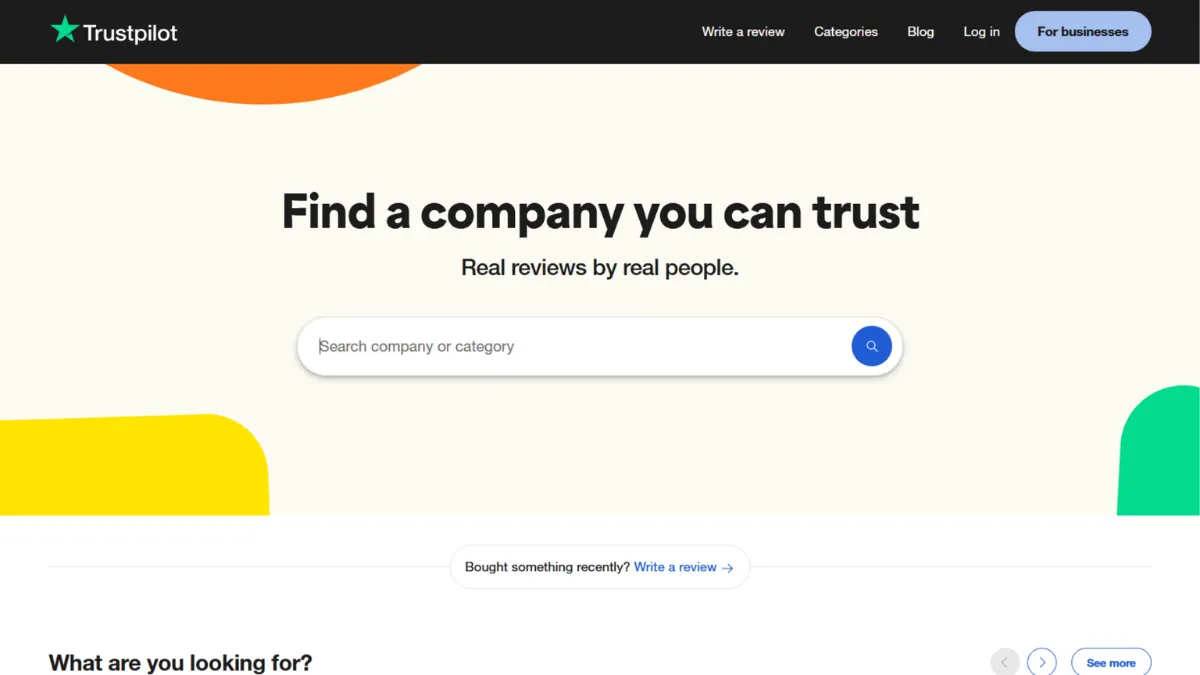
Reputation is one of the few assets that compounds over time, and Trustpilot is the platform that most mid-market businesses reach for when they decide to take it seriously. The verdict: it works, but the cost structure means you will feel its limitations before you feel its full benefits. For businesses that sell online and need verified social proof to improve conversion rates, reduce ad spend friction, and qualify for Google Seller Ratings, Trustpilot delivers a credible and widely recognised trust signal. The tradeoff is that meaningful access to its toolset requires a paid plan, and the entry price point is steep enough to exclude a significant portion of early-stage businesses.
The mechanism behind Trustpilot is straightforward. Businesses send review invitations to customers via email, either manually or through automated triggers connected to e-commerce platforms, CRMs, or order management systems. Customers complete reviews on the open Trustpilot platform, which means the reviews are publicly visible regardless of whether the business pays. Paid tiers unlock the ability to respond to reviews, access analytics, display TrustBox widgets on-site, and integrate review content into advertising. The open platform model is both its greatest strength and its most common source of frustration: competitors, disgruntled ex-employees, and fraudulent actors can leave reviews, and moderation processes do not catch everything fast enough for businesses dealing with coordinated negative campaigns.
Realistic expectations matter here. Trustpilot is not a short-term fix for a damaged reputation and should not be treated as one. Businesses that see the strongest results are those that build review collection into operational workflows, sending invitations consistently at the right moment in the customer journey, typically shortly after delivery or service completion. Volume and recency both affect how a Trustpilot profile performs in search and in consumer perception. A profile with 30 reviews collected two years ago carries considerably less weight than one with 300 reviews collected over the past six months. The platform's reminder email system helps with this, reportedly driving a material uplift in response rates on average, though individual results vary significantly by industry and customer base.
Trustpilot suits e-commerce operators, SaaS companies, and service businesses that transact online and need a credible third-party trust signal to support conversion at scale. It is particularly valuable for businesses running Google Shopping or paid search campaigns, since Trustpilot reviews can qualify for Google Seller Ratings, adding star ratings to ads and improving click-through rates. Companies already using Shopify or operating a content-driven acquisition strategy alongside Semrush will find that Trustpilot integrates naturally into both the commerce and SEO layer of their growth stack.
The most honest limitation is price relative to the stage of business. The free plan offers 50 review invitations per month, which is enough to start building a profile but not enough to build one at pace. Moving to a paid plan represents a significant monthly commitment, and the tiered structure means that features most businesses actually want, such as advanced analytics and competitive benchmarking, sit at the higher tiers. Small businesses often find they are paying for a brand signal rather than a complete reputation management suite.
The sections below cover how Trustpilot works mechanically, what each plan actually gives you, and where it outperforms or falls short against the closest alternatives in the review management category.
What Is Trustpilot?
Trustpilot is an open review platform that enables businesses to collect, manage, and display customer feedback at scale. It operates as a consumer-facing directory as well as a business tool: any consumer can leave a review of any listed company, while businesses use the platform's dashboard to invite reviews, respond to feedback, and syndicate review content across their websites, ads, and email marketing. What distinguishes Trustpilot from collecting testimonials on your own site is third-party credibility. Reviews sit on a domain the reviewer did not control, which makes them more persuasive to prospective customers applying appropriate scepticism to brand-owned content. Trustpilot has built significant scale, with hundreds of millions of reviews across close to a million domains, giving it enough authority that a strong profile there carries genuine weight in purchase decisions. The practical question for any business evaluating it is not whether the platform works in principle, but whether its pricing model and feature set match the stage and size of the business considering it, and how it competes mechanically with alternatives at a similar price point.
How Trustpilot Works
Setup begins with claiming or creating a business profile, which is free and takes under an hour. From there, businesses configure their invitation workflow, choosing between manual sends, bulk CSV uploads, automated integrations with e-commerce platforms, or the Trustpilot API. The free plan limits monthly invitations to 50, while paid plans increase this cap substantially, with automated invitation volumes scaling by tier. Once an invitation is sent, the customer receives a branded email with a direct link to the review form. Trustpilot's invitation templates are available in multiple languages and can be customised at higher tiers to match brand style, though the extent of customisation is broader on paid plans.
Review fraud detection runs automatically on every submission. Trustpilot's systems flag suspicious patterns, and businesses can formally report reviews they believe violate platform guidelines. This process is documented publicly as part of the platform's transparency commitment, though the speed and outcomes of flagging decisions attract consistent criticism from businesses dealing with bad-faith reviews. The important mechanic to understand is that Trustpilot cannot remove negative reviews simply because the business disputes them. Removal requires a platform guideline violation to be established. Many businesses learn this after their first negative review arrives and expect a faster resolution than the process delivers.
TrustBox widgets sit at the centre of the display layer. Businesses embed these on product pages, checkout flows, landing pages, and email campaigns to show star ratings, review counts, and individual review quotes. The counterintuitive reality most businesses miss: the widget is not just cosmetic. Properly configured review schema from Trustpilot content can feed Google's rich result systems, influencing how your paid ads display star ratings and how organic listings appear in search. Treating Trustpilot purely as a testimonials tool leaves significant search and ad performance value on the table. How aggressively you use the widget layer, and where in the customer journey you place it, determines a large part of the return on what is a material subscription cost.
Trustpilot Key Features
Automated Review Invitations. The core mechanic of the platform. Businesses configure invitation triggers to fire automatically when a transaction completes, connecting Trustpilot to their e-commerce backend, CRM, or order management system. The free plan allows 50 manual invitations per month. Paid plans scale volume significantly and unlock automated sequences including reminder emails, which Trustpilot reports drive a meaningful increase in response rates. The practical value is consistency: businesses that automate invitations build review volume steadily without requiring manual effort per transaction. Invitation templates support multiple languages and can be styled to reflect brand identity on higher-tier plans.
TrustBox Widgets. Embeddable widgets that display star ratings, review counts, and individual reviews directly on business websites. Widgets range from compact score badges to full review carousels and can be filtered to highlight reviews by topic, recency, or rating. Trustpilot's AI-driven topic clustering can surface reviews grouped by theme, such as delivery speed or customer service, allowing businesses to display contextually relevant social proof at specific points in the purchase journey. The widget library is configurable in terms of size and colour, though deep visual customisation requires API access, which is reserved for enterprise plans.
Review Analytics and Insights. Paid plans give access to dashboards covering review volume, TrustScore trends, response rates, and, at higher tiers, competitor benchmarking and topic-level sentiment analysis. This data is useful for identifying recurring service issues, tracking the impact of operational changes on customer satisfaction, and monitoring how the business compares to category competitors. The depth of analytical access scales with plan tier, so entry-level paid subscribers work with a more limited data view than those on premium or advanced plans.
Google Integration and Seller Ratings. Trustpilot reviews can qualify a business for Google Seller Ratings, which display star ratings on Google Shopping and paid search ads. This is one of the highest-value outcomes the platform offers, since ad star ratings typically improve click-through rates without additional spend. Reviews must meet Google's volume and recency thresholds to activate Seller Ratings, which is another reason consistent invitation volume matters more than most businesses initially appreciate.
Response Management and Reporting Tools. Paid plans allow businesses to respond publicly to reviews, which matters both for customer relations and for the signal it sends to prospective buyers reading the profile. Trustpilot also provides flagging and reporting tools for reviews that appear to violate platform guidelines, feeding into the moderation process. The platform does not allow businesses to hide or remove reviews unilaterally, which is a deliberate design choice that maintains the open model but frustrates businesses on the receiving end of coordinated negative feedback. This limitation connects directly to the trade-offs discussed in the next section.
Trustpilot Pros and Cons
The strengths of Trustpilot are most visible at scale. The limitations tend to surface earliest for smaller operations still deciding whether the investment is justified.
- Globally recognised brand signal. Trustpilot carries consumer recognition that newer or less prominent review platforms do not. A strong TrustScore on a widely known platform carries more persuasive weight in purchase decisions than an equivalent score on an unfamiliar one, particularly in markets where Trustpilot has deep penetration.
- Google Seller Ratings eligibility. Qualifying reviews feed directly into Google's ad enhancement systems, adding star ratings to paid search and Shopping campaigns. For businesses running paid acquisition, this is a tangible return on the subscription cost that can be measured against click-through rate improvements.
- Extensive e-commerce integrations. Native connections exist for major e-commerce platforms, making it straightforward to automate review invitations without custom development. Businesses on WooCommerce or similar platforms can configure automated triggers without engineering resource.
- Transparent open platform builds consumer trust. The fact that businesses cannot remove reviews at will is understood by consumers, which makes positive Trustpilot ratings more credible than moderated or gated review systems. This is the overlooked pro: the platform's constraints are part of its value proposition to the people whose trust you are trying to earn.
- Multi-channel review syndication. Reviews and ratings can be deployed in email campaigns, display advertising, social media posts, and print materials through Trustpilot's marketing asset tools, extending the reach of review content beyond the platform itself.
The cons are real and should influence the decision at the evaluation stage rather than as a post-purchase surprise.
- Pricing excludes early-stage businesses. The gap between the free plan and the entry paid tier is significant. Businesses with modest transaction volumes will struggle to justify the monthly cost against the incremental benefit over the free account, particularly when competitors offer more generous entry-level access.
- Limited control over fraudulent or bad-faith reviews. The open platform model means anyone can leave a review. The flagging process exists but is slow, and outcomes are not guaranteed. Businesses dealing with coordinated negative review campaigns find the platform's dispute resolution process frustrating and opaque.
- Widget customisation is constrained below enterprise tier. TrustBox widgets cover the standard use cases well but deep visual integration requires API access, which is not available on entry or mid-tier plans. Businesses wanting review displays that match bespoke site designs will hit this ceiling relatively quickly.
- Analytics depth scales with spend. Competitor benchmarking and advanced topic-level sentiment analysis sit at higher tiers. Entry-level paid subscribers work with a reduced view of their data, which limits the strategic value the platform could otherwise deliver.
- Review volume thresholds affect real-world utility. Google Seller Ratings, meaningful TrustScore credibility, and competitive profile strength all depend on sustained review volume. Businesses in low-transaction categories or with long sales cycles may take considerable time to build a profile that performs meaningfully.
How to Get the Most Out of Trustpilot
The businesses that extract the most value from Trustpilot treat review collection as an operational process, not a marketing campaign. Before sending the first invitation, map your customer journey and identify the two or three moments where satisfaction is highest: typically shortly after a successful delivery, service completion, or product activation. Invitations sent at the wrong moment, such as immediately after purchase before the customer has experienced the product, produce lower conversion rates and occasionally negative reviews from buyers in a pre-fulfilment anxiety state.
Connecting Trustpilot to your order management system or CRM in the first week eliminates the need for manual sends and ensures collection runs continuously. Once automated, the focus shifts to response management. Responding to reviews, including negative ones, within 48 hours signals to prospective customers that the business is attentive. Public responses to negative reviews, handled professionally, often do more reputational work than an equivalent number of additional positive reviews.
Building results over time requires monitoring your TrustScore trend rather than fixating on individual reviews. A downward trend in TrustScore usually signals a service issue, not a review platform problem, and the data can surface operational improvements worth addressing. At the paid tier, the topic analysis tools identify recurring themes in negative feedback that may not be visible in individual review reading.
The mistake most users make is treating the TrustBox widget as a homepage decoration rather than a conversion tool. Placement matters: review widgets positioned near purchase decisions, such as on product pages, checkout pages, and pricing pages, outperform those buried in footers or on dedicated testimonials pages. If you want to know how to improve conversion rates using Trustpilot review content, the answer is almost always about widget placement and the specificity of reviews displayed at each decision point, not about accumulating a higher TrustScore in isolation.
Businesses using HubSpot or a comparable CRM can connect review invitation timing to lifecycle stage, ensuring customers who have completed onboarding or received their first delivery are targeted before the satisfaction peak fades. This kind of sequencing, rather than bulk sending, consistently produces better review quality and higher response rates.
Who Should Use Trustpilot?
Trustpilot is worth the investment for three distinct types of operation. E-commerce businesses running Google Shopping or paid search campaigns gain the most immediate measurable return, since qualifying for Google Seller Ratings improves ad performance in a way that can be tracked directly against the subscription cost. Service businesses with a high volume of transactional customers, such as insurance providers, travel companies, or financial services operators, benefit from the brand signal that a well-maintained Trustpilot profile provides in categories where consumer scepticism is high. SaaS companies at the growth stage, particularly those selling into markets where social proof on a recognised third-party platform is part of the evaluation process, find that a strong profile reduces friction in the consideration phase of the sales cycle.
Trustpilot is not the right fit for every business. Sole traders and very early-stage startups with low monthly transaction volumes will find the paid plan cost difficult to justify against the limited additional utility over the free account. Businesses operating in B2B categories where purchase decisions are driven by case studies, references, and procurement processes rather than open consumer reviews will gain less from Trustpilot than from platforms built specifically for verified B2B software reviews. If your customers primarily discover and evaluate you through industry-specific channels rather than general search, a significant portion of what Trustpilot offers will not reach the audience you are trying to influence.
Trustpilot Pricing
Trustpilot offers a free plan as a starting point. It provides 50 review invitations per month, basic profile management, and access to the public profile page. This is sufficient to begin building a review presence but falls well short of what most growing businesses need to collect reviews at a pace that maintains profile freshness and credibility.
Paid plans begin at a price point that positions Trustpilot firmly as a mid-market and above product rather than a small business tool. The entry paid tier increases the monthly invitation allowance substantially and unlocks review response capability, basic widgets, and reporting. Higher tiers, covering premium and advanced plan levels, add competitor benchmarking, deeper analytics, expanded widget options, more user seats, and higher automated invitation volumes. Enterprise plans offer custom pricing with unlimited invitations, AI-assisted response tools, and full API access. Pricing is per domain, and businesses with multiple domains or brands pay accordingly.
The honest verdict on pricing is that the free plan is genuinely useful for getting started, but the value proposition of a paid plan depends heavily on whether the Google Seller Ratings integration and higher invitation volumes apply to your specific business model. Always verify current pricing directly on Trustpilot's pricing page, as rates and plan structures are updated periodically. Relative to alternatives like Feefo or Reviews.io, Trustpilot's paid tiers are priced at a premium that reflects its brand recognition, which may or may not justify the delta depending on your market.
Trustpilot vs Alternatives
Feefo is the most direct like-for-like competitor for businesses that prioritise verified reviews over open-platform volume. Feefo only collects reviews from confirmed customers, which eliminates the fraud and bad-faith review risk that Trustpilot's open model carries. The tradeoff is lower volume potential and less consumer name recognition. Choose Feefo when review integrity and verified purchase confirmation matter more than platform authority. Trustpilot wins when you need a globally recognised brand signal and Google Seller Ratings eligibility from the same platform.
Reviews.io targets a similar audience at a lower entry price point, with stronger e-commerce platform integrations and more flexible widget customisation at comparable tiers. For Shopify-first businesses that want more design control over how reviews display on their storefront, Reviews.io is frequently the more practical choice. Trustpilot's edge remains its consumer recognition and the weight that a TrustScore carries in markets where the platform has established authority.
Yotpo occupies a different position, functioning as an e-commerce retention platform with reviews as one component alongside loyalty programmes, referrals, and visual user-generated content tools. If your review collection need sits inside a broader customer retention strategy and you want those systems in one place, Yotpo is the stronger platform. Trustpilot focuses purely on the review and reputation layer, which keeps it leaner but also limits it for businesses wanting a more integrated customer marketing approach.
Google Reviews deserve a mention, not as a platform to manage through a dedicated tool, but as context. Google Reviews are tied to verified Google accounts and appear directly in search and maps results, making them extremely high visibility. Trustpilot complements Google Reviews rather than competing with them, since Trustpilot reviews can feed Google Seller Ratings while Google Reviews serve local and branded search. Businesses using Google Analytics to track conversion paths will find it useful to monitor both sources of social proof as distinct signals serving different stages of the purchase journey.
Trustpilot Review: Final Verdict
Trustpilot earns an overall score of 4.06 out of 5, reflecting a platform that performs well across core functionality and integration capability but loses ground on cost-efficiency, particularly for smaller operations. The cost-efficiency score of 3.6 is the honest acknowledgement that the pricing model creates a real access gap between the free plan and the tier where the platform becomes genuinely powerful. For e-commerce and service businesses with consistent transaction volume, a Google Seller Ratings strategy, and the budget to commit to a paid plan, Trustpilot is the strongest broadly recognised review platform available. The bottom line: it works, and the brand recognition it carries is a genuine asset, but you need to be operating at a scale where the monthly cost represents a small fraction of the conversion value it unlocks.
How We Rated It:
More Tool Reviews





Subscribe to Stay in the loop
Get the latest AI and technology news, honest tool reviews, and practical guides delivered straight to your inbox.
Success! Check your Inbox!

Tezons Newsletter
The latest technology news, in-depth tool reviews, and practical guides - curated and delivered to your inbox.
Latest News




Have a question?
Have any questions?
Didn’t find what you were looking for? We’re just a message away.