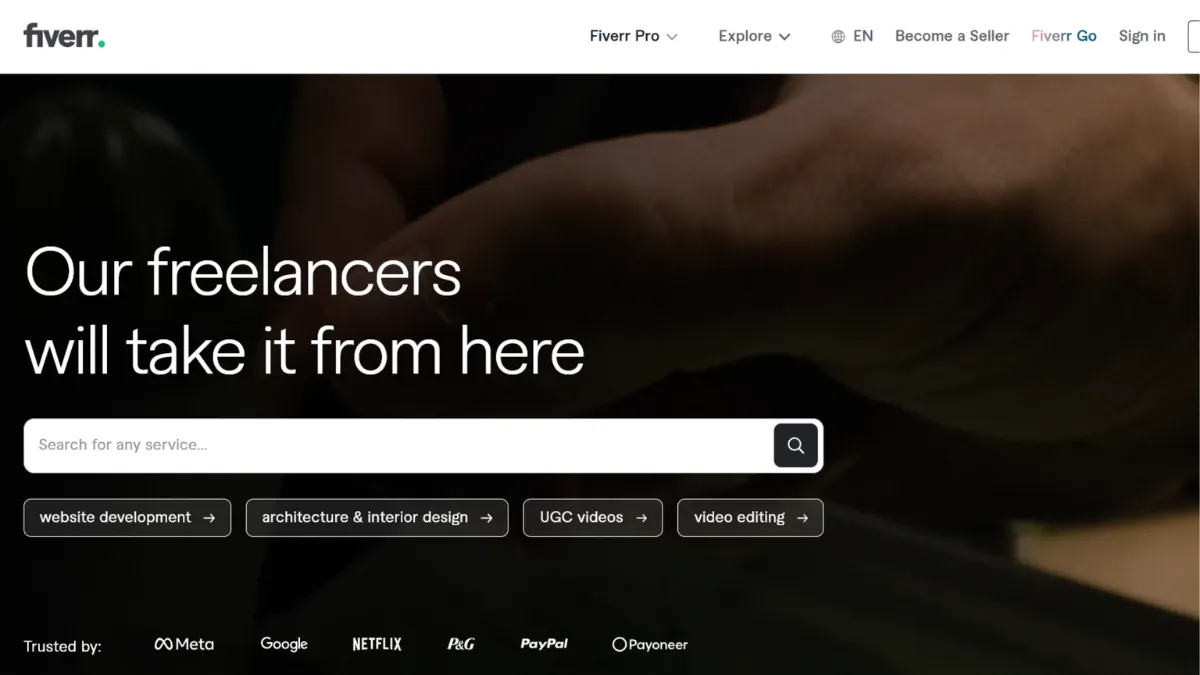
Speed is the real product Fiverr sells. Not design, not copy, not code. Speed. The platform built its entire model around the idea that a founder with a defined task and a tight timeline should be able to hire, brief, and receive work within 24 to 72 hours, often for less than the cost of a business lunch. That promise holds up for a specific slice of work. Where it falls apart is when scope is ambiguous, quality expectations are high, or the task requires genuine strategic thinking rather than execution. Knowing which side of that line your project sits on is the decision Fiverr forces you to make before you open your wallet.
The mechanism is a gig marketplace, meaning freelancers pre-package their services into fixed offerings with set deliverables, timelines, and prices across Basic, Standard, and Premium tiers. You are not negotiating scope from scratch. You are choosing a product off a shelf. That structure accelerates procurement, which is genuinely valuable, but it also means the freelancer has designed the gig around what they want to deliver, not necessarily what your project needs. The gap between those two things is where most bad Fiverr outcomes originate. Buyers who spend ten minutes reading gig reviews, checking portfolio samples, and sending a brief message before purchasing close that gap considerably. Buyers who click and pay immediately do not.
Realistically, Fiverr works best when you can describe the output precisely. A logo with three concepts and two revision rounds. A 1,000-word blog post in a defined tone. A 30-second explainer video from a provided script. The tighter the spec, the more the gig model plays to your advantage. Turnaround for standard tasks typically runs one to five business days depending on the seller tier and package selected. Fiverr Pro, the platform's vetted tier, delivers more consistent results at higher price points, though even there you should review portfolio work before committing. Budget at least one to two hours per project to evaluate candidates properly.
Fiverr suits early-stage founders who need to ship assets without hiring, solo operators who want to delegate defined creative or technical tasks, and small teams using tools like Notion or Airtable to manage project pipelines who need external execution capacity on demand. If you are comfortable writing a clear brief, reading reviews critically, and managing one round of revisions, the platform delivers strong value at its price point.
The central limitation is quality variance. Because anyone can list a gig, the standard tier contains a wide spread of skill levels, and the review system has enough inflated ratings to make sorting genuinely difficult. You will occasionally hire the wrong person and absorb the cost of that mistake, either in time or money. Fiverr's dispute resolution process provides some protection, but it is not fast and the outcome is not guaranteed.
The sections below cover how the platform works mechanically, which features matter most, and how to extract reliable results from a system that rewards preparation over impulse.
What Is Fiverr?
Fiverr is a freelance services marketplace that connects buyers with independent sellers offering digital work across hundreds of categories, from graphic design and copywriting to web development, video production, voice-over, and AI automation. Founded in 2010 and now operating at significant global scale, the platform processes millions of transactions annually and lists sellers from virtually every country. What separates Fiverr from hiring a freelancer directly or posting a job on a general board is the gig structure: freelancers pre-define their services, price them, and present them as purchasable packages. Buyers browse rather than recruit. That inversion removes the lengthy back-and-forth of traditional freelance hiring and compresses procurement to minutes. The model also applies to tools like Canva or CapCut, where founders often start work themselves before realising the execution gap. Fiverr fills that gap without the overhead of a hire. The question worth asking before you sign up is not whether Fiverr has someone who can do the work. It almost certainly does. The question is whether the gig model gives you enough control to get the result you actually need.
How Fiverr Works
Signing up takes under two minutes. Once registered, you search by category or keyword, and Fiverr returns gig listings ranked by a combination of relevance, seller level, and review score. Each listing shows the starting price, delivery time, seller badge, and a snippet of the package scope. Filtering by seller level, delivery time, and budget narrows the field quickly.
Fiverr's seller levels run from New Seller through Level 1 and Level 2 to Top Rated Seller, with each tier reflecting completed order volume, review scores, and response rates. Fiverr Pro sits above all of these: a separately vetted tier where sellers have been approved by the platform's team and tend to work at higher price points with stronger consistency. For most one-off tasks, Level 2 and Top Rated sellers offer the best balance of quality and price. For brand-critical or technically complex work, Fiverr Pro is worth the premium.
Payment works on an escrow model. You pay upfront, Fiverr holds the funds, and releases them to the seller after you approve the delivery. If you do not respond within three days of delivery, the order auto-completes. That auto-completion clause catches many first-time buyers off guard: if you go quiet, the seller gets paid regardless of whether you reviewed the work. Revision terms are set within the gig, not negotiated separately, so check how many rounds are included before purchasing.
The counterintuitive insight most buyers miss is this: seller level is a weaker quality signal than portfolio specificity. A Level 1 seller whose portfolio contains six examples that look exactly like what you need will outperform a Top Rated seller whose portfolio covers twelve different styles loosely. Gig breadth is a flag, not a feature. The narrower and more consistent a seller's portfolio, the more reliable the output will be. Last thought before moving into features: the fee structure adds cost on both sides of the transaction, and knowing what you will actually pay before selecting a package changes the value calculation considerably.
Fiverr Key Features
Gig Packages. Every listing on Fiverr is structured as a tiered package: Basic, Standard, and Premium. Each tier defines deliverables, revision rounds, and turnaround time explicitly. This pre-scoping removes the negotiation phase that slows traditional freelance hiring and makes side-by-side comparison between sellers fast. The trade-off is that packages are built around what sellers want to offer, so buyers with non-standard requirements need to message sellers before purchasing to confirm the work falls within scope.
Fiverr Pro. The Pro tier applies a vetting layer to a subset of sellers, requiring them to pass a platform review process before receiving the badge. Pro sellers charge meaningfully more than the standard marketplace, but the quality floor is considerably higher. For work that will represent your brand publicly, such as brand identity, website copy, or video production, the Pro tier is the more reliable starting point and worth checking before defaulting to the cheapest available option.
Fiverr Neo. Neo is the platform's AI-powered matching assistant. You describe your project in plain language, and Neo asks clarifying questions before surfacing relevant gigs and sellers. It performs well for niche or hybrid requirements that do not map cleanly to a single category. For straightforward tasks, standard search is faster. Neo adds most value when you are unsure how to categorise the work you need done.
Seller Reviews and Badges. Every completed order generates a buyer rating, and those ratings accumulate into a public score visible on every gig listing. Alongside star ratings, Fiverr displays order count, completion rate, response time, and any cancellations. These signals, read together rather than individually, give a reasonable picture of seller reliability. The system is imperfect because ratings skew positive on most platforms, but outliers and low completion rates surface real problems worth heeding.
Fiverr Business. The Business tier adds multi-user access, team workspaces, and a curated pool of pre-vetted talent for organisations managing multiple concurrent projects. It suits small agencies or teams delegating work across several verticals simultaneously. Solo founders rarely need it. The relevant limitation here is that Fiverr's integration with external project management tools is limited: if you manage work in ClickUp or similar, you will coordinate manually rather than through any native connection.
That manual coordination overhead is worth weighing honestly before committing to Fiverr as a long-term procurement layer rather than an occasional resource.
Fiverr Pros and Cons
Fiverr carries a combination of genuine structural strengths and real operational friction that affects buyers differently depending on how they use it.
- Speed of procurement. Going from a defined task to a hired freelancer takes minutes rather than days. For founders managing time-sensitive campaigns or product launches, the low friction of the gig model is a meaningful operational advantage over traditional hiring or agency briefing.
- Price accessibility. Standard gigs cover a wide range of budgets, and even mid-market quality work is available at price points well below agency rates. For defined, repeatable tasks, cost per output is hard to beat on a comparable platform.
- Scale of category coverage. Fiverr lists services across several hundred categories. Niche requirements, such as a very specific illustration style or an obscure programming language, have a realistic chance of matching a qualified seller somewhere in the marketplace.
- Escrow payment protection. Funds are held until delivery is approved, which provides a baseline of financial protection that direct freelance arrangements rarely offer. Disputes can be raised through the platform if work does not meet the agreed brief.
- Fiverr Pro quality floor. The Pro vetting process creates a meaningfully more reliable subset of the marketplace. Buyers who default to Pro for brand-sensitive work avoid the quality variance that makes standard-tier sourcing feel like a gamble.
The cons are structural rather than incidental, and most of them compound for buyers who use the platform regularly rather than occasionally.
- Quality variance on the standard tier. Open registration means skill level varies enormously. Review inflation on the platform makes sorting genuinely difficult, and even highly rated sellers can be inconsistent across order types.
- Fee stacking on both sides. Buyers pay a service fee on top of the gig price. Sellers absorb a 20% platform commission. That dual structure means the effective cost of a transaction is higher than the listed price, and sellers on tight margins may cut corners to protect their take-home.
- Limited suitability for ongoing or strategic work. Fiverr's gig model is built for discrete tasks. Projects requiring iteration, feedback loops, or long-term relationship-building with a freelancer fit the platform poorly compared to Upwork, which is better designed for hourly and retainer arrangements.
- Auto-completion risk. Orders auto-complete three days after delivery if the buyer does not respond. First-time users who miss this can find themselves in a completed order they have not reviewed.
- Customer support is inconsistent. Dispute resolution is slow, and a significant share of user feedback highlights support responsiveness as a frustration, particularly when order outcomes are contested.
How to Get the Most Out of Fiverr
Before you place a single order, build a two-sentence brief that defines the deliverable, the format, and one concrete example of the style or quality you want. Sellers who receive a clear brief before the order begins perform noticeably better than those given a vague title and a deadline. This step takes five minutes and reduces revision rounds significantly.
When shortlisting sellers, filter by delivery time and seller level first, then open the top five profiles and read the one-star and two-star reviews specifically. Positive reviews cluster and tell you little. Negative reviews reveal recurring failure modes: slow communication, missed scope, low-resolution files, and non-responsive revision handling. If the same complaint appears more than twice, move to the next candidate.
For your first order with any seller, keep the scope small. A short test task at Basic tier costs little and reveals how the seller communicates, how closely they follow a brief, and whether their delivery matches their portfolio. Building that track record before assigning higher-value work saves considerably more money than the test task costs.
If you want to know how to hire on Fiverr effectively for recurring output, such as monthly blog content or regular social assets, the answer is not to repeat the search process every time. Identify one or two sellers who deliver consistently, save them to a list, and message them directly before each new order. Treating Fiverr as a relationship platform rather than a vending machine shifts the quality of results substantially.
On fees: buyer service charges are applied per transaction. For high-volume use, consolidating work into larger packages rather than placing multiple small orders reduces the cumulative fee load. Always check the total at checkout rather than the headline gig price. On the seller side, the 20% platform commission is flat regardless of order size, so there is no financial benefit to building volume with a single buyer outside the platform.
Measure success by tracking revision rounds and re-order rate. If you are requesting revisions on more than half your orders, your briefs need to be more specific, not your seller pool more curated.
Who Should Use Fiverr?
Fiverr is the right choice for a specific profile of user, and identifying whether you fit that profile before signing up saves the frustration that most bad Fiverr experiences come from.
This is for you if you are an early-stage founder who needs brand assets produced quickly without agency costs, and you can write a clear brief for each task. It is for a solo content creator who needs regular video editing or thumbnail design and has a defined visual style you can communicate via example. It is also for a small business owner who has genuinely one-off tasks, such as a logo refresh or a product description set, where the scope is fixed and the need for ongoing iteration is low.
It is not for you if you are looking for a long-term creative partner who will develop familiarity with your brand over time. The gig model does not support that kind of relationship well, and chasing continuity across multiple sellers on a task-by-task platform is exhausting. It is also not suited to technical or strategic roles, such as growth marketing or product architecture, where the output quality depends on understanding your business context deeply rather than executing a defined spec. If that is the work you need, a platform that supports longer engagements is a better fit.
Fiverr Pricing
Fiverr has no subscription cost for buyers. You pay per order, which makes entry frictionless: create an account and start browsing at no cost. The real pricing to understand is what you actually pay per transaction.
Buyers are charged a service fee on top of the gig price. For orders over a certain threshold, this is a percentage of the purchase value. For smaller orders, a flat additional fee applies. The specific rates can shift, so check Fiverr's pricing page for current figures before budgeting a project. As a planning assumption, add approximately 5 to 10 percent on top of any listed gig price to arrive at your actual spend.
Sellers absorb a flat 20% platform commission on every completed order, regardless of order size or seller tier. That commission does not decrease with volume, which distinguishes Fiverr from some competing platforms that use a sliding scale. Sellers factor this into their pricing, meaning the effective cost of labour on Fiverr is higher than the headline number on either side of the transaction.
Fiverr Pro gigs carry higher base prices reflecting the vetting premium. For most brand-critical work, the additional cost is justified by the reduction in quality variance. For repetitive, lower-stakes tasks, standard tier is adequate if you vet sellers carefully. Relative to alternatives in the category, Fiverr's per-transaction model is competitive at the low end but adds up quickly for teams placing orders regularly.
Fiverr vs Alternatives
The freelance marketplace category has several credible alternatives, each suited to a different buyer profile and working style.
Upwork is the strongest alternative for ongoing or complex work. Its hourly contract model, time-tracking tools, and longer-form freelancer profiles support the kind of iterative, relationship-based engagement that Fiverr's gig structure resists. If your work requires back-and-forth over weeks rather than a defined handoff, Upwork is the better fit. Fiverr wins on speed and accessibility for discrete tasks where the scope is already clear.
Toptal positions itself at the opposite end of the quality spectrum, applying a rigorous screening process that accepts a very small percentage of applicants. Rates are considerably higher than Fiverr or Upwork, but the talent floor is more predictable. Founders who need senior technical or design work and cannot afford a bad hire should consider it. Fiverr competes on price and breadth, not on that level of pre-qualification.
PeoplePerHour and Freelancer.com occupy similar ground to Fiverr's standard tier with slightly different fee structures and smaller seller pools. Neither materially improves on the quality variance problem. For buyers who have had poor experiences with Fiverr's standard tier, switching platform rarely fixes the underlying issue. The root cause is almost always brief quality or seller vetting, not the marketplace itself.
For AI-generated assets specifically, tools like Midjourney or Runway now cover territory that Fiverr freelancers once owned exclusively. If your task is image generation or video production at a simple level, those tools are faster and cheaper than a gig.
Fiverr Review: Final Verdict
Fiverr earns a 4.02 overall score, and that number reflects a platform that does one thing extremely well, procuring defined creative and digital tasks quickly at accessible prices, while carrying real weaknesses in quality consistency and support responsiveness. The 3.6 on support is the most operationally significant gap: when an order goes wrong, resolution is slow and uncertain, which raises the stakes of every purchase decision. The 3.7 on accuracy reflects the structural quality variance that comes from an open-registration marketplace.
The bottom line: Fiverr is a procurement accelerator for founders who write good briefs and vet sellers before buying. For everyone else, it is a frustration waiting to happen.
How We Rated It:
More Tool Reviews





Subscribe to Stay in the loop
Get the latest AI and technology news, honest tool reviews, and practical guides delivered straight to your inbox.
Success! Check your Inbox!

Tezons Newsletter
The latest technology news, in-depth tool reviews, and practical guides - curated and delivered to your inbox.
Latest News




Have a question?
Have any questions?
Didn’t find what you were looking for? We’re just a message away.