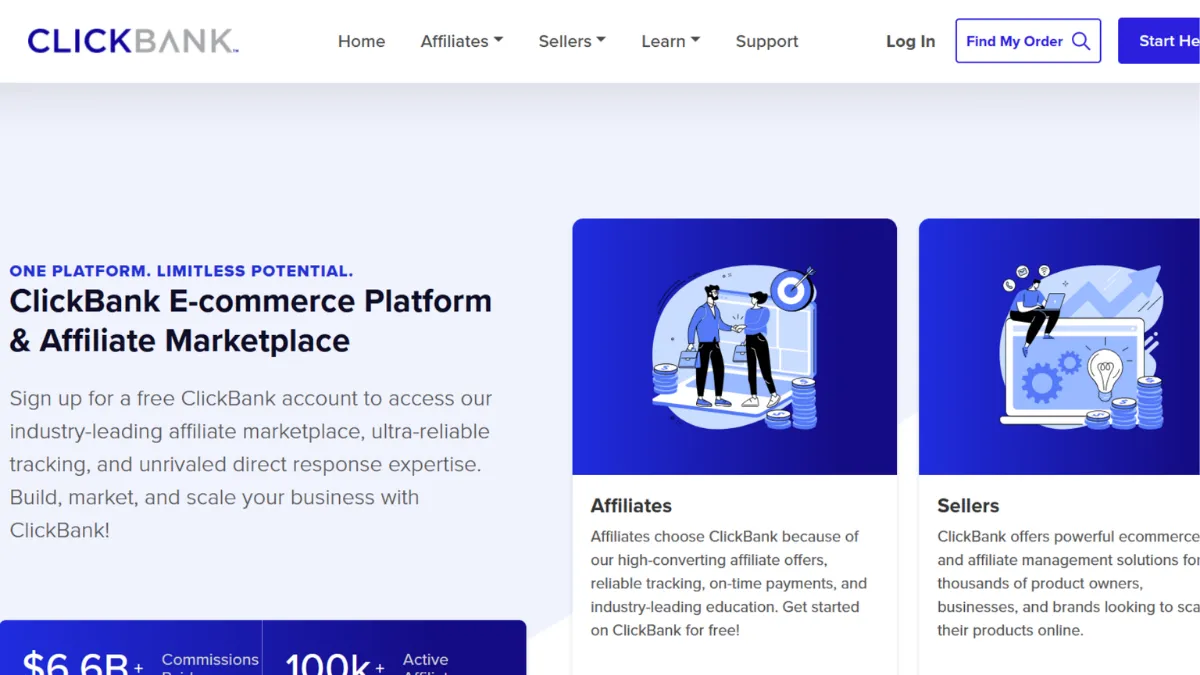
The affiliate marketing platforms that generate consistent income share one trait: a large, active network with verified tracking and reliable payment history. ClickBank has both. With over $7.3 billion in commissions paid across more than 27 years, it is one of the most established digital product marketplaces available, and that longevity matters more than most new users appreciate. The question is not whether ClickBank works. The question is whether it works for your specific situation, because the platform rewards certain approaches and penalises others in ways that are not obvious from the homepage.
ClickBank operates on a wholesale model rather than a traditional affiliate commission pass-through. When a customer purchases a product, ClickBank buys it from the vendor at 92.5% of the sale price plus $1, then handles the transaction, payment processing, and affiliate commission payout itself. This design means ClickBank absorbs payment risk and guarantees affiliate payments regardless of whether the vendor has funds available. For affiliates, the practical effect is predictable, on-time payment. For vendors, it means the platform takes 7.5% of every sale plus that flat dollar amount, on top of whatever commission rate you offer affiliates. The most common mistake vendors make is setting commission rates without accounting for both costs simultaneously, which leads to margin being squeezed faster than expected at volume.
Realistic income expectations depend heavily on the niche and offer you choose to promote. Gravity score, ClickBank's proprietary metric, tracks how many unique affiliates have made at least one sale of a given product in the past 12 weeks. A gravity score above 50 is a widely cited minimum threshold for an offer worth promoting. New affiliates frequently ignore gravity and chase high commission percentages instead. Commission rates between 50% and 75% are common for digital products, and this is where ClickBank outperforms physical-product affiliate networks, where 5% to 10% commissions are typical. The trade-off is that the highest-paying offers are also the most competitive, meaning paid traffic costs can compress margins significantly.
ClickBank suits digital product creators who want immediate access to an established affiliate pool without building their own programme from scratch, and affiliate marketers who focus on health, fitness, personal finance, and self-improvement niches where the platform's catalogue runs deepest. It also suits founders testing a direct-response offer before investing in a proprietary affiliate infrastructure.
The core limitation is product quality variance. Because ClickBank applies a relatively open product approval process, the marketplace contains offers ranging from well-structured courses to products with inflated promises and high refund rates. Refund rates of 10% to 30% are documented in certain categories, and as an affiliate you absorb refunded commissions. This is not a theoretical problem. It is a regular operational cost you need to factor into offer selection.
The sections below cover how ClickBank works mechanically, its key features, where it earns its score and where it falls short, and how it compares to the alternatives worth considering.
What Is ClickBank?
ClickBank is a digital product marketplace and affiliate network that connects product creators with performance marketers. Its core function is to sit in the middle of that relationship: handling payments, tracking sales, calculating commissions, and distributing funds to both parties. Unlike a standalone affiliate tracking tool, ClickBank provides the entire transaction infrastructure, which means vendors do not need a separate payment processor or affiliate management system to launch. The platform spans dozens of product categories, with health, fitness, e-business, and personal development generating the highest volume. What separates ClickBank from a general-purpose affiliate tool is the scale of its ready-made affiliate pool. Rather than recruiting affiliates individually and managing relationships manually, a vendor lists a product in the marketplace and becomes immediately discoverable to tens of thousands of active marketers. This raises a practical question: how exactly does matching between affiliates and offers work, and what controls does each party hold over that process?
How ClickBank Works
Affiliates browse the marketplace and generate a unique tracking link called a HopLink for any product they want to promote. When a customer clicks that link and completes a purchase, ClickBank's tracking system records the attribution and credits the affiliate's account. Payment to affiliates is processed on a scheduled basis, with a configurable payment threshold determining how much must accumulate before a payout triggers. There is a $2.50 pay period processing fee per payment issued, so affiliates who set a low threshold pay this fee more frequently than those who consolidate payouts.
Vendors submit products through a product editor and must pass an approval review before listing. Once approved, the one-time activation fee of $49.95 applies. Vendors set their commission rate and can offer either a revenue-share percentage or, once they meet eligibility requirements, a cost-per-action flat rate. CPA commission access requires an account active for 60 days or more and at least 100 initial sales within a rolling window, so it is unavailable to new vendors immediately. Subscription and rebill products follow a separate wholesale pricing calculation for recurring payments.
The counterintuitive insight most vendors miss is that listing a product does not mean affiliates will find it. ClickBank's marketplace surfaces products partly based on gravity score, which is itself a function of how many affiliates are already making sales. New products with zero gravity sit near the bottom of search results by default. Vendors who want early traction need to recruit their first cohort of affiliates directly, often through outreach or affiliate recruitment communities, rather than waiting for organic discovery. This means the first 30 to 60 days on ClickBank require active outreach work, and the platform's onboarding guidance does not always make this expectation explicit enough to prepare new vendors adequately.
ClickBank Key Features
Marketplace and Gravity Scoring. The ClickBank marketplace is the platform's primary asset for affiliates. Products are ranked and filtered by category, and each listing displays the gravity score alongside average commission per sale and rebill rates. Gravity is updated daily, making it a live signal of offer viability. For affiliates selecting offers to test, filtering by gravity above a minimum threshold is the most reliable method for avoiding products with no traction. Vendors benefit from the same visibility dynamic: a rising gravity score creates a compounding effect as more affiliates discover and test the offer. This discoverability mechanism replaces the need for a separate affiliate recruitment platform when a product is already generating sales. Pairing your ClickBank analytics with Google Analytics on your sales page gives you traffic source data that ClickBank's built-in reporting does not provide.
Dual Commission Models. ClickBank supports both revenue-share and CPA commissions, and allows vendors to set different commission rates for individual affiliates rather than applying a single rate across the board. This matters operationally because top-performing affiliates can be offered a higher rate to incentivise exclusivity. The CPA model is useful for vendors who want cost predictability, since it removes the refund clawback risk that comes with revenue-share. Affiliates on CPA do not receive additional commission for upsells, which is worth evaluating when an offer includes multiple upsell steps. For vendors building automated affiliate onboarding sequences alongside their ClickBank programme, connecting the workflow via Zapier can handle notifications and task creation without custom development.
Integrated Payment Processing and Refund Handling. ClickBank processes all transactions and guarantees a 100% refund policy to end customers. This removes payment infrastructure as a concern for vendors but introduces a refund fee of $0.50 to $1 per return depending on product value. The platform supports multiple payment methods and pays affiliates across multiple currencies. Verify current payment terms on ClickBank's support documentation before projecting revenue timing, as wholesale distribution schedules affect cash flow differently from a standard processor arrangement.
Subscription and Rebill Tracking. For products with recurring payment components, ClickBank tracks rebills and calculates affiliate commissions on subscription renewals at a separate wholesale rate. This makes the platform viable for membership programmes and subscription-based digital products beyond one-time purchases. Both vendors and affiliates can view rebill transaction history in their respective dashboard views.
Reporting Dashboard. Vendors and affiliates access separate dashboard views displaying transaction history, commission summaries, and performance data. The Marketplace Statistics feature gives affiliates vendor-level data including sales volume and category classification. A built-in CPA calculator helps vendors model commission rates before committing. The reporting is functional but not deeply customisable: you cannot build custom segments or attribution models natively, and integration with external analytics tools requires the API. ClickBank's native integrations are API-based rather than plug-and-play, which limits how easily you can connect it to broader marketing stacks without development resource.
ClickBank Pros and Cons
The platform's strengths concentrate in network scale and payment reliability. Its weaknesses sit in product quality control, support responsiveness, and customisation depth.
- No monthly fees for affiliates. Joining costs nothing and there is no subscription to maintain. This removes the barrier to testing ClickBank alongside other affiliate programmes, making it one of the lowest-risk entry points in performance marketing.
- High commission rates on digital products. Revenue-share rates between 50% and 75% are standard across many categories. For affiliates moving from physical-product networks where commissions sit in the low single digits, this represents a substantial shift in revenue per conversion.
- 27-year payment track record. ClickBank has processed affiliate payments consistently for longer than most competing platforms have existed. For affiliates who prioritise network reliability, this history carries real weight.
- CPA commission flexibility for established vendors. Setting individual affiliate CPA rates is unusual in this category. It gives vendors a lever to negotiate with high-volume affiliates and creates a performance-based incentive structure that revenue-share alone cannot replicate.
- Dormant account fees create unexpected costs. Accounts with no earnings after 90 days incur daily charges that escalate sharply: $1 per day from 90 days of inactivity, $5 per day from 180 days, and $50 per day after 360 days of no sales. This is an overlooked risk for part-time or experimental users who open an account and then pause activity.
The platform also carries limitations across both sides of the marketplace.
- Product quality is uneven. ClickBank's open listing model means the marketplace includes offers with inflated claims, particularly in health and financial niches. Affiliates promoting these offers risk audience trust damage, and vendors with quality products compete against lower-quality offers that use aggressive copy and high commission rates to attract affiliates.
- Support response times are inconsistent. Email support can take up to 7 days according to published reports. While live chat and phone support options exist, the consistency of response quality is a recurring concern in user feedback, and slow resolution can affect active affiliate programmes directly.
- Customisation and branding control are limited. Vendors cannot meaningfully customise how their product appears within the ClickBank marketplace, and the checkout experience follows ClickBank's own design. For brands with specific presentation requirements, this is a real constraint that more flexible platforms address.
- Refund rates in certain categories are high. Health supplements and make-money offers carry documented refund rates that can reduce net affiliate earnings substantially. Selecting offers without researching refund history first is a common error with direct financial consequences.
How to Get the Most Out of ClickBank
Before promoting anything as an affiliate, set your payment threshold deliberately. A higher threshold reduces the number of $2.50 processing fees you pay over time. Setting it below $50 means paying that fee repeatedly on small payouts.
Offer selection is where most affiliate income is won or lost. Filter the marketplace to your niche, sort by gravity, and shortlist offers where the average dollar value per initial sale is meaningful in absolute terms, not just as a percentage. Read the vendor's sales page as a customer would. If the page contains claims you would not repeat in your own content, the refund rate will likely reduce your net earnings below what the commission rate suggests. Check whether the vendor provides affiliate resources: swipe copy, banner assets, and email sequences. Vendors who invest in affiliate support have more stable gravity scores and lower affiliate churn.
For vendors, complete your sales page fully before submitting for approval. The review process evaluates both the product and the page, and a placeholder will delay listing. Once live, recruit 5 to 10 affiliates directly before expecting organic discovery through the marketplace. Affiliate forums, direct email outreach, and JV communities are the standard channels for this initial recruitment phase.
Understanding how to run a ClickBank affiliate programme effectively means treating your affiliates as a sales team rather than a passive distribution channel. Regular commission rate reviews, exclusive CPA rates for top performers, and updated creative assets keep affiliates active on your offer. Measure affiliate EPC in your vendor dashboard: a high EPC number reported by your affiliates means the offer converts well, and this number will spread through affiliate communities and attract new partners organically.
Track your own earnings per click as an affiliate to normalise performance across offers with different price points and conversion rates. An offer paying 75% of a $27 product that converts at 0.5% will underperform an offer paying 50% of a $97 product that converts at 1.5% on the same traffic. EPC makes this comparison direct and removes the misleading pull of headline commission percentages.
Who Should Use ClickBank?
This is for you if you match one of three clear profiles. The digital product creator who has built a course, e-book, software tool, or information product and wants an affiliate distribution channel without the overhead of building a bespoke programme: ClickBank's marketplace gives immediate exposure to an active affiliate base, and the infrastructure handles payments and commissions from day one. The performance affiliate marketer with experience in direct-response niches, specifically health, fitness, survival, or personal finance, who knows how to evaluate offers by gravity and EPC rather than headline rates. The e-commerce brand or founder who wants to test a direct-response channel for an existing product before committing to a managed programme on a platform with higher entry requirements.
ClickBank is not the right fit if you sell physical products exclusively and need network infrastructure designed for that format. It is also a poor match if your audience is in B2B software, where commission structures and attribution models differ substantially from what ClickBank provides. Marketers who need tight control over which affiliates represent their brand, or who cannot tolerate association with the broader marketplace and its uneven product reputation, will find the platform's open model a persistent concern rather than a manageable trade-off.
ClickBank Pricing
Affiliate accounts are free to create with no ongoing subscription or monthly charge, making ClickBank one of the cheapest affiliate networks to access as a marketer. The only recurring cost for active affiliates is the $2.50 pay period processing fee per payment issued, minimised by raising your payment threshold to consolidate payouts.
Vendors pay a one-time activation fee of $49.95 when their first product is approved. The platform takes 7.5% of every sale price plus $1 per transaction before affiliate commissions are calculated. Refund fees of $0.50 to $1 per return also apply to vendors. There is no monthly platform fee, which keeps fixed costs low for sellers in early stages, though the per-transaction deductions accumulate quickly at volume and require careful margin modelling before setting a product price. For vendors, this transaction-based model is cost-efficient at low volume and becomes proportionally more expensive at scale compared to a self-hosted affiliate programme. Always verify current rates on ClickBank's pricing support pages before making financial projections, as fee structures can change. Relative to enterprise-grade alternatives, the vendor entry cost is accessible, though that affordability reflects a less curated marketplace environment.
ClickBank vs Alternatives
Impact.com is the most frequently cited alternative for brands that need sophisticated tracking, fraud prevention, and partnership management at scale. Where ClickBank suits solo vendors and small teams entering affiliate distribution, Impact targets established businesses with multi-channel programmes and dedicated partnership tooling. Impact's pricing reflects this positioning and is significantly higher at entry level. Choose Impact when brand control and analytics depth outweigh cost constraints.
PartnerStack serves a different segment: B2B SaaS companies that need recurring-commission affiliate programmes with structured onboarding and partner management tooling. If your product is a subscription software tool, PartnerStack's infrastructure fits that use case better than ClickBank's digital-product marketplace model. ClickBank wins on marketplace size and immediate affiliate access. PartnerStack wins on programme structure and SaaS-specific commission handling.
Gumroad is the lightweight alternative for creators who want to sell digital products and enable affiliate promotion without entering a traditional affiliate marketplace. Gumroad's affiliate system requires creators to approve individual affiliates rather than listing in an open marketplace, which trades ClickBank's network scale for greater control over who represents your product. Choose Gumroad if you have an existing audience and want a simple creator-first commerce tool. Choose ClickBank if you need an established affiliate pool to drive discovery.
Digistore24 is a European-originated alternative with a similar marketplace model covering both digital and physical products. For vendors with European audiences or regional compliance requirements, Digistore24 is worth evaluating alongside ClickBank rather than treating it as a lesser option.
ClickBank Review: Final Verdict
ClickBank earns a 4.06 overall score, reflecting a platform that delivers reliably on its core promise of connecting digital product vendors with performance affiliates through proven payment infrastructure, while carrying real limitations in product quality control, support consistency, and customisation. Its functionality score of 4.4 reflects the breadth of commission models, subscription tracking, and marketplace tooling. Its support score of 3.7 reflects the documented inconsistency in response times that affects active users when issues arise.
The bottom line: ClickBank is the right starting point for digital product vendors who want immediate affiliate reach without building infrastructure, and for performance affiliates testing offers in high-commission niches. Success on either side requires active management, not passive participation.
How We Rated It:
More Tool Reviews






Subscribe to Stay in the loop
Get the latest AI and technology news, honest tool reviews, and practical guides delivered straight to your inbox.
Success! Check your Inbox!

Tezons Newsletter
The latest technology news, in-depth tool reviews, and practical guides - curated and delivered to your inbox.
Latest News




Have a question?
Have any questions?
Didn’t find what you were looking for? We’re just a message away.