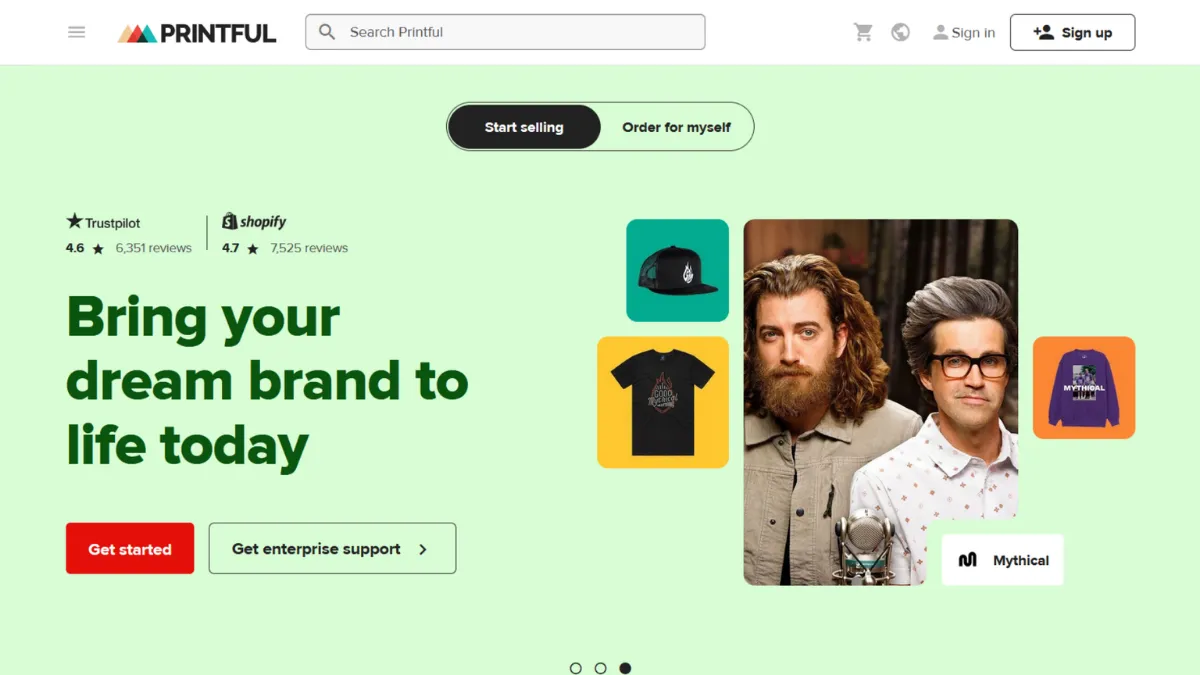
Selling custom products without holding stock sounds simple until you realise how much coordination the fulfilment side requires. Printful removes that coordination entirely: you upload a design, connect your store, and the platform handles printing, packing, and shipping every order on demand. For creators and brand builders who want to monetise an audience without running a warehouse, this is one of the most reliable routes available.
The platform operates on a fulfilment model, not a marketplace. You sell through your own storefront on Shopify, Etsy, WooCommerce, or one of 20-plus other channels, and Printful fulfils each order automatically once payment clears. You never buy inventory upfront. You pay Printful the base product cost plus shipping when a customer places an order, and you keep the difference between that cost and your retail price. The margin depends on how you price, not on volume commitments or monthly minimums.
What drives quality on Printful is the in-house fulfilment model. Unlike platforms that route orders through a network of third-party print providers, Printful operates its own facilities across North America and Europe, with partner locations in Australia and Japan. That control over production is why consistency holds up across large order volumes. Designs printed in a US facility tend to look identical to the same design fulfilled from a European one, which matters when you are shipping to an international audience.
Realistic expectations vary by what you sell. Apparel with direct-to-garment printing is Printful's strongest category, with colour reproduction and durability that holds up to repeated washing. Embroidery is a genuine strength, with fast turnaround and tightly controlled stitch quality. Other product categories, including some home and lifestyle items, can show more variability. Fulfilment times also attract criticism in user reviews: production can run slower than competing services during peak periods, and shipping times are not always the fastest option in each market. For buyers who expect two-day delivery, that gap in speed is worth communicating upfront on your product pages.
Printful suits independent creators, small brands, and agencies managing merch for clients. It works particularly well when brand presentation matters: the white-label packaging, custom neck labels, and branded packing slips let you present a polished experience without any logistics overhead. Stores testing product ideas benefit from the zero-inventory model, and established sellers gain from the Growth plan's per-unit discounts as order volume climbs.
The main limitation is cost. Printful charges more per unit than several competitors, and that gap becomes visible once you start calculating margins on lower-priced products. For sellers competing on price or operating in categories where customers expect cheap custom goods, the numbers can be difficult to make work at standard retail prices.
The sections below cover how Printful works mechanically, its key features, a strategy guide for getting margins right, pricing detail, and how it compares against the main alternatives.
What Is Printful?
Printful is a print-on-demand fulfilment platform that lets you sell custom-branded products without owning or storing any stock. You design products using Printful's tools, list them in your connected store, and Printful prints and ships each item as orders arrive. The platform solves the core problem of custom merchandise: traditional production requires minimum order quantities and upfront capital, while Printful makes each product on demand, meaning you can offer hundreds of SKUs without committing to a single unit in advance. The difference from a generic drop-shipping supplier is quality control: Printful's in-house facility network means your products go through consistent production standards rather than varying across multiple unverified providers. The platform serves hundreds of thousands of sellers globally, from solo artists to scaling brands. Understanding how Printful processes and fulfils orders mechanically makes the rest of the review easier to follow.
How Printful Works
Setup begins by creating a Printful account and connecting your existing storefront, or building a Quick Store directly within Printful if you do not yet have one. Once connected, you browse the product catalogue, choose an item, and upload your design file to Printful's Design Maker. The tool shows a live preview of how the design will appear on the product across different colour variants, and you can adjust placement, size, and orientation before saving.
When you publish a product, Printful syncs it to your store with auto-generated mockup images and a product description. You set your own retail price. When a customer purchases, the order routes to Printful automatically, the item enters production, and Printful ships it directly to your customer under your brand. Your customer sees your store name on the packing slip and any custom labels you have configured, not Printful's. You receive a notification when the order ships, along with a tracking number you can forward to your customer.
Print quality depends on the file you upload. Printful recommends a minimum of 150 DPI at print size, but 300 DPI produces noticeably sharper results on larger products. Vector files work best for text-heavy designs. The Design Maker includes an AI image upscaler that can improve lower-resolution uploads, though this works better on photographic images than fine linework. The counterintuitive thing most new sellers get wrong is treating every product identically: DTG printing on cotton performs differently than sublimation on polyester, and a design optimised for one technique often needs reworking for the other. The practical implication for your product catalogue is that choosing the right print method per product category, not just uploading the same file everywhere, determines whether your margins and quality hold up at scale.
Printful Key Features
Design Maker and Mockup Generator. Printful's browser-based Design Maker lets you position artwork, add text, and apply built-in graphics to any product in the catalogue. The Mockup Generator produces lifestyle and flat-lay product images you can use directly in your store listings without organising a photoshoot. Both tools run in the browser with no software to install. For sellers launching quickly, the mockup quality is good enough for most platforms, though ordering physical samples before going live remains the most reliable way to verify colour accuracy.
White-label branding options. Printful supports custom inside labels, outside labels, packing slips, and packaging inserts on a wide range of products. This is not a premium add-on reserved for high-volume accounts: free plan users can add branded packing slips with a logo and custom message at no extra cost. Custom neck labels and packaging inserts carry small additional fees, but they allow you to present a brand experience that feels indistinguishable from a brand managing its own fulfilment. Competitors in this space often restrict branding to paid tiers.
Product personalisation. Printful offers an option for customers to add their own text or images to selected products at the point of purchase. This feature works through the Shopify, Etsy, and WooCommerce integrations and applies to DTG, embroidery, and wall art products. Personalised products command higher prices and generate stronger repeat purchase rates in several categories, making this a meaningful revenue lever for sellers in gift, wedding, and pet niches.
Global fulfilment network. Orders route automatically to the fulfilment centre nearest to the customer, which reduces both shipping cost and delivery time. Coverage spans North America, Europe, and partner locations in the Asia-Pacific region. For sellers with an international customer base, this matters: a UK buyer fulfilled from a European facility pays lower shipping and receives the order faster than one fulfilled from a US warehouse. The flip side is that production standards vary slightly across facilities, which makes ordering samples from each regional location worthwhile if you sell globally.
Integrations with 20-plus sales channels. Printful connects to the major e-commerce platforms and marketplaces including Etsy, Amazon, eBay, TikTok Shop, and Wix. The API also supports custom storefronts for developers who want deeper integration. The breadth of integrations means most sellers can connect their existing store without rebuilding anything. One trade-off worth noting: managing multiple stores inside a single Printful account can become confusing, particularly when updating product variants across several connected channels simultaneously.
Printful Pros and Cons
Printful's strengths centre on quality and brand control.
- Consistent print quality. The in-house production model keeps output quality stable across order volumes. Sellers report far fewer reprint requests compared with platforms that use rotating third-party print providers.
- Strong white-label experience. Custom labels, branded packing slips, and packaging inserts are available to all plan tiers. You can build a premium-feeling brand without touching a single parcel.
- Generous free tier. Full access to the product catalogue, all integrations, and every design tool carries no monthly fee. You pay only when orders come in, which removes the financial risk from the testing phase.
- Product personalisation. The ability to let customers customise products at checkout addresses a growing demand category and is not a standard feature on all competing platforms.
- Embroidery quality. Printful's embroidery output stands out from DTG alternatives, with fast turnaround and tight colour control. For brands selling workwear, caps, or premium gifting products, this is a notable advantage.
The limitations are real and affect profitability for certain seller types.
- Higher base product costs. Printful charges more per unit than most competing services. Sellers moving high volumes of lower-priced items find margin compression a genuine issue, and competing on retail price becomes difficult without the Growth plan discounts.
- Support response times. Multiple user reviews across Shopify's app store and independent review platforms flag slow support, particularly for complex order issues. Live chat exists but does not always resolve technical queries on the first contact.
- Fulfilment speed inconsistency. Production times can extend during peak trading periods. Sellers whose customers expect fast dispatch may generate additional support tickets when orders sit in production longer than expected.
- Smaller catalogue than some competitors. With around 450 products, the range is narrower than platforms like Printify, which gives access to over 1,000 SKUs across multiple suppliers. Niche product categories such as sports equipment or specialised home goods may not be available.
- Multi-store management complexity. Handling several connected storefronts simultaneously, each with overlapping product variants, can produce a cluttered account structure that takes time to maintain cleanly.
How to Get the Most Out of Printful
Before launching, configure your branding settings fully. Set up a branded packing slip and, if your margins support it, add inside labels on apparel. Customers notice this detail. Doing it after you have orders in motion is harder, so build it in from the start.
In your first week, order samples of every product you plan to sell before making them live. Base product colours vary between suppliers, and some shades print differently than the Design Maker preview suggests. A sample order costs roughly 20-25% less than retail price depending on your plan tier. Treat this as a non-negotiable part of the launch cost, not an optional extra.
Building a sustainable margin requires understanding the Growth plan threshold. On the free plan, you pay full base price on every product. Once you upgrade to Growth at $24.99/month, you receive up to 33% off product pricing. For sellers moving more than 10-15 orders per month consistently, the per-unit savings outpace the subscription cost. At $12,000 in annual sales, the Growth plan subscription becomes free automatically for a year, changing the cost structure significantly.
To get the most out of Printful's product personalisation feature, activate it on your highest-margin products rather than across your entire range. Personalised gifts, custom wedding items, and branded pet accessories convert at higher average order values. Limit the personalisation options to one or two inputs per product to reduce the support load from buyers who misuse open-ended text fields.
The mistake most sellers make is treating Printful as a set-and-forget operation. Monitor your fulfilment times monthly. When a particular product or product category starts showing longer production times in your order history, add a note to the product description giving a realistic dispatch estimate. This single step reduces support tickets and negative reviews far more than any other operational adjustment. Measure success by your reprint rate per 100 orders: below 2% indicates the production quality and file preparation are both working correctly. If your rate runs higher, review your file specifications before escalating to support.
Who Should Use Printful?
This is for you if you are an independent creator, artist, or content creator who wants to sell branded merchandise to an existing audience without managing stock or shipping. The zero-inventory model and white-label fulfilment remove the two biggest operational barriers to running a physical product business alongside a content or freelance career.
Printful also fits small brands and agencies managing merch programmes for clients. If you are building a brand where packaging presentation and product quality form part of the customer experience, the branding options and consistent print output justify the higher per-unit costs. Similarly, sellers running a Gumroad or creator business who want to add physical products without building a separate fulfilment operation will find the integration workflow straightforward.
Printful is not the right choice if you are primarily competing on price. Sellers targeting budget-conscious buyers in high-volume, low-margin categories will struggle to price competitively once Printful's base costs, shipping, and platform fees combine. It is also not suited to sellers who need a very broad product catalogue spanning specialist or niche categories, since the roughly 450-product range will not cover every SKU type.
Printful Pricing
Printful operates a freemium model. The free plan carries no monthly fee and gives you full access to the product catalogue, all integrations, the Design Maker, Mockup Generator, and white-label packing slips. You pay only when an order is placed: the base product cost plus shipping and, where applicable, taxes. This structure makes the free plan workable not just for testing but for running an active store at lower volumes.
The Growth plan costs $24.99 per month and unlocks up to 33% off product pricing, 9% off branding add-ons, and 25% off sample orders. A 14-day free trial is included. The Growth plan makes financial sense once you consistently move enough orders that the per-unit discounts exceed the monthly subscription. Crucially, once your annual sales reach $12,000, Printful removes the Growth plan subscription fee for 12 months automatically. At that revenue level, the cost argument for staying on the free plan disappears entirely.
An Enterprise tier exists for large-scale brands and carries custom pricing negotiated directly with Printful. Always check the current rates on Printful's pricing page, as base product costs and shipping rates do adjust over time. Given the higher per-unit costs compared with some alternatives, the free plan is enough to validate product ideas, but the Growth plan is where the margin structure becomes viable for an ongoing business.
Printful vs Alternatives
Printify is the most direct competitor and the main reason sellers switch away from Printful. Printify offers a network of over 1,000 products across multiple print providers, often at lower base prices than Printful. The trade-off is consistency: quality and turnaround times vary depending on which provider fulfils a given order, and you carry more of the quality-control responsibility. Choose Printify if catalogue breadth and lower product costs outweigh the need for uniform quality. Printful wins when brand reliability and white-label presentation matter more than shaving cost per unit.
Gelato is a strong alternative for sellers with a heavily international customer base. Gelato operates an extensive local production network that often delivers faster shipping times and lower international shipping costs than Printful. Its product range is more limited and weighted toward print-based products such as wall art, books, and stationery. For a creator selling art prints to a global audience, Gelato's local production model often outperforms Printful on delivery speed and landed cost. Printful wins on apparel quality and branding depth.
Teespring (now rebranded as Spring) targets creators who want a built-in marketplace rather than a fulfilment backend. You do not need an external store: Spring hosts your storefront. The limitation is lower margin control and less flexibility in branding. Printful suits sellers who want their own store with Printful acting invisibly behind it. Spring suits creators who want the simplest possible route to selling merch without building any infrastructure.
Redbubble operates as a marketplace where artists upload designs and Redbubble handles sales, fulfilment, and customer acquisition. You give up control over pricing, brand presentation, and customer data in exchange for access to an existing buyer audience. For artists focused on discovery rather than brand-building, Redbubble offers reach that Printful, as a pure fulfilment tool, cannot replicate without your own marketing.
Printful Review: Final Verdict
Printful earns a 4.32 out of 5 overall, reflecting a platform that delivers genuinely strong fulfilment quality and brand control alongside a cost structure that requires careful margin management. Its integration capabilities score highest at 4.7, underlining how smoothly it connects to the sales channels most sellers already use. Support and cost efficiency score lower at 3.8 and 3.9 respectively, which are real considerations for sellers choosing between Printful and cheaper alternatives.
The bottom line: Printful is the right choice when you are building a brand and need fulfilment you can trust to represent it well. If your primary goal is maximum margin at volume, start with the free plan to validate your products, then evaluate whether the Growth plan discounts make the numbers work before committing to a longer-term strategy.
How We Rated It:
More Tool Reviews




Subscribe to Stay in the loop
Get the latest AI and technology news, honest tool reviews, and practical guides delivered straight to your inbox.
Success! Check your Inbox!

Tezons Newsletter
The latest technology news, in-depth tool reviews, and practical guides - curated and delivered to your inbox.
Latest News




Have a question?
Have any questions?
Didn’t find what you were looking for? We’re just a message away.