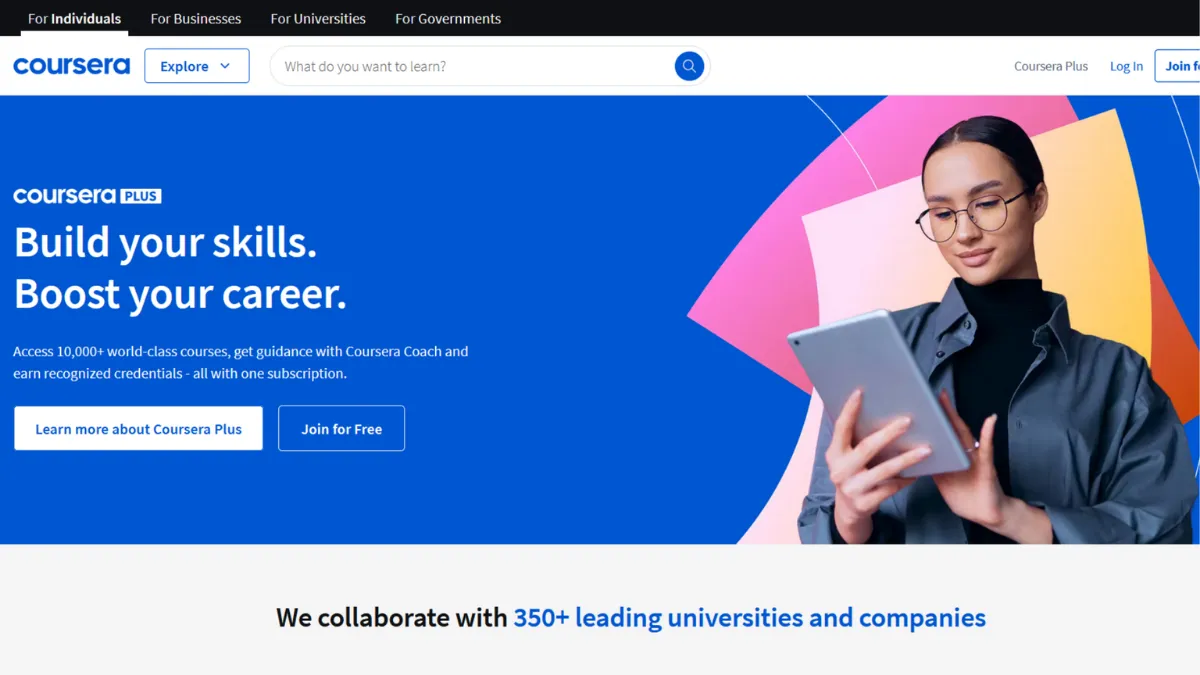
Online learning platforms tend to promise the world and deliver a library nobody finishes. Coursera is different in one measurable way: the credentials it issues carry the name of the institution that built the course, not the platform that hosts it. A certificate from a Google Professional Certificate programme or a University of Michigan Specialisation carries weight that a generic eLearning badge does not, and that distinction is the single reason Coursera has attracted over 175 million registered learners. For a founder, a career-switcher, or a team lead who needs to upskill without enrolling at a physical campus, Coursera is the closest thing to accredited education at consumer pricing.
The mechanism behind Coursera is a partnership model rather than a marketplace. Unlike Udemy, where any instructor can publish a course, Coursera works exclusively with accredited universities and established companies such as Google, IBM, Amazon, and Meta. Those partners design the curriculum, set assessments, and issue the certificates. Coursera provides the delivery infrastructure: video hosting, automated and peer-graded assessments, project environments, and now an AI-powered learning assistant called Coursera Coach. The practical implication is that course quality is governed by the partner institution, which raises the floor considerably but also means Coursera has less control over pacing, depth, and how quickly content gets updated when a technology moves fast. Most learners underestimate how structured these programmes are. Specialisations typically run three to six months at a few hours per week, and Professional Certificates can take three to nine months. Treating Coursera like a casual YouTube substitute produces poor results.
Realistic expectations depend heavily on which credential type you choose. Individual courses are the shortest commitment, usually four to eight weeks at three to five hours weekly. Specialisations bundle several courses into a coherent sequence and produce a shareable credential that is broadly recognised by hiring managers in technical fields. Professional Certificates, often built with industry partners, are oriented toward job-readiness rather than academic depth, and many employers now treat them as a meaningful signal. Degrees from partner universities are fully accredited and can cost a fraction of an on-campus equivalent, though they require the kind of multi-year commitment that most founders are not in a position to make.
Coursera suits you if you are moving into a structured professional field, specifically data, cloud computing, project management, cybersecurity, or UX design, and you need a credential that a recruiter or client will recognise without explanation. It also works well for team leads who need to upskill small groups on a defined skills gap, using the Coursera for Teams tier. The platform fits learners who can commit to scheduled study time, not those who need a quick reference or a one-hour crash course.
The most significant limitation is content staleness. Because curriculum is authored by partner institutions rather than maintained by Coursera's own team, some courses lag behind fast-moving fields. AI and machine learning content in particular can feel behind the curve within months of publication. If you are trying to learn a tool or technique that changed substantially in the last year, verify the course's last update date before subscribing. Using a tool like Google Trends to gauge whether a certification is still in demand for a target role is a worthwhile step before committing.
The sections below cover how the platform works mechanically, where it earns its scores, and how to structure your time on it to get a result rather than just an enrolment.
What Is Coursera?
Coursera is an online learning platform that distributes courses, Specialisations, Professional Certificates, and accredited degrees built by over 350 university and industry partners worldwide. It was founded by two Stanford professors and operates today as a publicly listed company with a stated mission of universal access to world-class education. The problem it solves is access: a learner in Lagos or Leeds can take the same curriculum as a student on a physical campus, earn the same certificate, and present the same credential to an employer. What separates Coursera from a generic eLearning tool is that the content author and the credential issuer are the same trusted institution. A Google Data Analytics certificate is not a Coursera certificate with Google's logo on it; Google owns and controls that curriculum. That distinction shapes how hiring managers read the credential. The question worth examining is how the platform actually translates that partnership model into a learning experience, and whether the mechanics support the credential's perceived value.
How Coursera Works
Enrolment begins by choosing a content type: individual course, Specialisation, Professional Certificate, or degree. Free audit access is available on most courses, giving you video lectures and some reading materials without graded assignments or a certificate. Paid enrolment unlocks assessments, peer-reviewed projects, and the shareable credential. Coursera Plus, the subscription tier, removes per-course payment friction and opens access to the vast majority of the catalogue, making it rational for anyone planning to complete more than one or two courses in a year.
The learning experience within a course follows a consistent structure: short video segments, in-video quizzes to maintain attention, graded assignments at the end of each module, and either automated grading or peer review depending on the assessment type. Guided Projects are a distinct format: browser-based, hands-on exercises completed in a split-screen environment with the tool or dataset on one side and the instruction on the other. These are particularly useful for technical skills where doing matters more than reading.
Coursera Coach, the platform's AI assistant, is integrated into many courses to answer learner questions and provide feedback in real time. It functions as a 24-hour study support layer rather than a substitute for the structured curriculum. For teams, the business tiers add skills benchmarking, role-based learning paths, and administrative reporting dashboards that let a manager track completion across a group.
The counterintuitive insight most learners miss is this: the audit option is not a free trial. It is a permanently available access mode, and for many courses it gives you most of the instructional content without any time pressure. The audit route fails only when the assessment and the credential are your actual goal. Learners who sign up for Coursera Plus hoping to binge courses rarely retain value from the ones they do not finish, and the platform's catalogue breadth can work against focus as much as it enables it. Which features you actually use, and how you use them, determines whether the subscription pays off.
Coursera Key Features
Coursera's feature set spans individual learning tools and enterprise-grade training infrastructure. The following are the capabilities that matter most to the majority of users.
Specialisations and Professional Certificates. These structured, multi-course sequences are Coursera's core product for anyone who needs a verifiable credential rather than casual knowledge. Specialisations typically sequence three to five courses into a coherent programme and end with a capstone project. Professional Certificates are built specifically for job-readiness in high-demand roles and are authored by employers such as Google, IBM, and Meta, meaning the curriculum is aligned to actual hiring requirements. Completing one of these programmes produces a shareable certificate that links to a verification page, which is the format most recruiters and LinkedIn profiles expect. Tools like Notion or Airtable can be useful for tracking your progress across a multi-month sequence if you are managing other work commitments simultaneously.
Coursera Coach. The AI learning assistant embedded in many courses answers content questions, surfaces relevant sections, and provides feedback on written assignments in real time. Rather than waiting for a peer reviewer or forum response, a learner stuck on a concept can query Coach and get an immediate, course-specific response. The practical value is highest in technical courses with large bodies of reference material. Where Coach is available, learners report completing courses faster than those without AI assistance.
Guided Projects. These are browser-based, hands-on exercises that run in a split-screen format: the task or dataset appears on one side, the instruction on the other, and no local installation is required. Guided Projects are available in technical areas including data analysis, cloud platforms, and programming, and they compress practical experience into a one to two hour session. They are a useful bridge between theoretical video lectures and real working environments, though they do not substitute for sustained project work in a production context.
Accredited Degrees. Coursera hosts over 55 fully accredited bachelor's and master's degree programmes from partner universities, delivered entirely online. Tuition is typically a fraction of on-campus equivalent costs, and the degree itself is issued by the university, not by Coursera. For a founder who needs an accredited credential for a specific professional or regulatory reason, this is a pathway worth examining. These programmes carry the same application and academic rigour as their campus counterparts.
Coursera for Teams and Enterprise. The business tiers add role-based learning paths, skills gap analysis, completion tracking, and administrative reporting. Managers can assign content to specific team members, monitor progress, and generate reports for HR or compliance purposes. The enterprise tier includes custom integrations and dedicated account support. One practical limitation surfaces here: the degree to which team members actually engage depends on whether completion is incentivised, and the platform provides no mechanism to enforce that beyond visibility and reporting.
Coursera Pros and Cons
Coursera performs strongly on credential quality and content depth. The trade-offs are real and worth understanding before subscribing.
- Credentials carry institutional weight. Certificates are issued by the partner university or company, not by Coursera. This makes them recognisable to employers who have no familiarity with the platform itself, which matters when the certificate needs to stand alone on a CV or LinkedIn profile.
- Audit access removes the price barrier for explorers. Most courses can be audited for free, giving you access to lectures and reading materials without commitment. This is an often-overlooked path for learners who need exposure to a topic rather than a credential, and it costs nothing.
- Course depth matches or exceeds what a bootcamp covers. University-designed curricula go further than most short-form alternatives. If your goal is to understand a field rather than pass a surface-level introduction, the academic depth is a genuine advantage.
- Coursera Plus makes multi-course learning cost-efficient. For anyone completing more than one or two certificates in a year, the annual subscription covers the cost that individual course purchases would otherwise accumulate to. Verify current pricing on Coursera's site, as tiers and promotions change.
- AI-assisted learning is embedded, not bolted on. Coursera Coach is integrated directly into the course experience rather than existing as a separate chatbot layer, which means the assistance is contextually relevant to the specific material being studied.
The limitations are specific and not trivial for certain user types.
- Content currency is uneven. Because partner institutions author the curriculum, update frequency varies. Fast-moving technical fields can produce courses that feel a version or two behind by the time a learner enrolls. Always check when a course was last updated before subscribing.
- Peer grading introduces bottlenecks. Some assessments rely on other learners reviewing your work. If enrolment in a cohort is low or learner engagement drops, turnaround time on feedback can stretch into days and stall progress through a module.
- Course deadlines can feel punitive. Some programmes set completion windows, and access lapses if you miss them. Users who need to re-access material after a 180-day period may be prompted to re-enrol, which adds friction for non-linear learners.
- Practical depth varies by subject area. Theoretical disciplines taught by university faculty can be comprehensive but lack the applied exercises a practitioner needs. Guided Projects help, but they are not available across all courses.
- Support response times are inconsistent. Community forums and learner support cover most questions, but direct support for billing or access issues can be slow. This is a genuine gap for teams operating on a deadline to complete compliance-related training.
How to Get the Most Out of Coursera
Before you open the first video, decide which credential type matches your actual goal. If you need a recognisable certificate in three months, a Professional Certificate from a major technology company is the right format. If you are building foundational knowledge in an academic field, a Specialisation from a university partner is the better fit. Choosing the wrong content type is the most common reason learners disengage halfway through.
During the first week, complete the first module of the course before deciding whether to upgrade from audit to paid enrolment. Coursera allows access to the opening content for free, and most courses now include graded assignments in the first module preview. Use that to evaluate whether the teaching style and pace suit you, not the course description page, which is written to convert enrolments rather than set accurate expectations.
Building results over time requires treating Coursera as a scheduled commitment rather than an on-demand resource. Block specific weekly study time in your calendar rather than relying on intent. Learners who schedule fixed sessions complete at significantly higher rates than those who study opportunistically. If you are managing a team through the business tier, assign specific content with a completion date rather than granting open access and expecting self-direction.
The mistake most users make is subscribing to Coursera Plus and then spreading attention across too many courses simultaneously. Pick one sequence and finish it before starting another. The certificate has no value until the programme is complete, and partial progress on five courses produces no output at all.
Measure success by whether you can demonstrate the skill to a third party: a technical screen, a client conversation, or an applied project. If you are asking how to upskill your team on data analytics using Coursera, the answer is to assign a specific Professional Certificate, track weekly completion milestones via the team dashboard, and pair certificate completion with a practical internal project that uses the skill. The certificate is the proof; the project is the outcome. For content marketing and SEO work, pairing Coursera learning with tools like Semrush for keyword research or Ahrefs for backlink analysis lets you apply what you are learning in a live environment rather than a controlled exercise.
Who Should Use Coursera?
This is for you if you match one of the following profiles. A career-switcher in their late twenties or thirties who needs a credential that signals competence to a hiring manager in a new field: data analytics, cloud architecture, project management, or cybersecurity. You cannot afford a part-time master's degree, but you can commit three to six months of structured study to a Professional Certificate that an employer will recognise on sight. Coursera is built for this scenario. A team lead at a company with 10 to 100 employees who needs to upskill several people on a defined technical skill set within a quarter. The Teams tier gives you assignment, tracking, and reporting without the overhead of a custom training programme. A professional pursuing an accredited online degree from a recognised university at materially lower cost than an on-campus programme. If the degree itself matters for career progression or professional licensing, Coursera's degree catalogue is worth examining carefully.
This is not for you if you need fast, surface-level exposure to a tool for a specific task. A founder who wants to understand how to run a paid social campaign well enough to brief an agency does not need a 16-week marketing Specialisation. Short-form resources will serve that need faster. Equally, anyone who learns best through live instruction, cohort discussion, and real-time feedback from a human instructor will find the asynchronous, self-paced format of most Coursera courses limiting, regardless of how strong the curriculum is.
Coursera Pricing
Coursera offers a free audit option on most courses, giving access to video lectures and some materials without a certificate. This works well for exploratory learners, but the graded assessments and shareable credentials require a paid enrolment or an active subscription. Coursera Plus is the main subscription tier, providing access to over 7,000 courses, Specialisations, and Professional Certificates. Pricing for Coursera Plus is available monthly or annually, with the annual option offering substantially better value. Individual courses and Professional Certificates can also be purchased separately at per-course pricing. Always check the current rates on Coursera's pricing page, as tiers and promotional pricing change regularly.
For teams and organisations, Coursera for Teams is a per-seat annual subscription covering access to the same content library with the addition of administrative tools and reporting. Enterprise pricing is available through a sales consultation and includes custom integrations and dedicated support. The free audit tier is generous enough to evaluate whether a course is worth the paid commitment, which lowers the risk of subscribing to content that does not match your needs. Relative to alternatives in the same category, Coursera's subscription pricing is competitive, which makes the comparison with those alternatives worth examining directly.
Coursera vs Alternatives
The online learning category has several well-established platforms worth comparing depending on your goal.
Udemy operates as an open marketplace where any instructor can publish a course. This produces enormous breadth, over 100,000 courses, and low per-course pricing, often discounted steeply. The trade-off is quality variance: without institutional gatekeeping, some courses are excellent and some are not, and Udemy certificates carry no institutional backing. Choose Udemy when you need a specific practical skill taught quickly and a verifiable credential is not the goal. Coursera wins when the credential matters.
LinkedIn Learning is a subscription platform owned by Microsoft, with a catalogue focused on professional and business skills. It integrates directly with your LinkedIn profile, which makes completions visible to your network without extra steps. The content is generally shallower than a Coursera Specialisation, but it updates faster. Choose LinkedIn Learning for short, frequent upskilling. Coursera wins for structured, credential-bearing programmes.
edX is Coursera's closest structural competitor, founded by MIT and Harvard. Both platforms partner with universities and offer accredited degrees. edX tends to have a higher proportion of completely free courses, while Coursera's interface and mobile experience are generally more polished. edX's unlimited subscription is priced higher than Coursera Plus, making Coursera the better value for high-volume learners. For degree-seekers, compare both catalogues against your specific field, as partner institutions differ. Thinkific occupies a different position: it is a platform for creating and selling your own courses rather than consuming institutional ones, and it is relevant only if you want to become a course creator rather than a learner.
Skillshare focuses on creative disciplines such as design, illustration, and photography. It is a subscription platform with a strong community layer and a low monthly price point. If your learning goals are in creative or design fields, Skillshare's depth in that niche rivals or exceeds Coursera's. Coursera wins on technical, business, and academic credentials across almost every other category.
Coursera Review: Final Verdict
Coursera earns an overall score of 4.27 out of 5, a rating that reflects a platform with genuinely strong content quality and credential value, balanced against real limitations in support response times and content currency in fast-moving fields. Its functionality score of 4.7 is the standout dimension, reflecting the breadth of credential types, the depth of partner curriculum, and the AI-powered learning tools layered into the experience. Support, scored at 3.8, is the weakest point and is worth factoring in if your team depends on timely resolution of access or billing issues.
The bottom line: Coursera is the right choice when the credential is the goal and you can commit to a structured learning timeline. If you want a certificate that a hiring manager or client recognises without context, and you are willing to treat study as a scheduled commitment over several months, Coursera delivers on that promise better than any direct alternative at its price point.
How We Rated It:
More Tool Reviews


Subscribe to Stay in the loop
Get the latest AI and technology news, honest tool reviews, and practical guides delivered straight to your inbox.
Success! Check your Inbox!

Tezons Newsletter
The latest technology news, in-depth tool reviews, and practical guides - curated and delivered to your inbox.
Latest News




Have a question?
Have any questions?
Didn’t find what you were looking for? We’re just a message away.