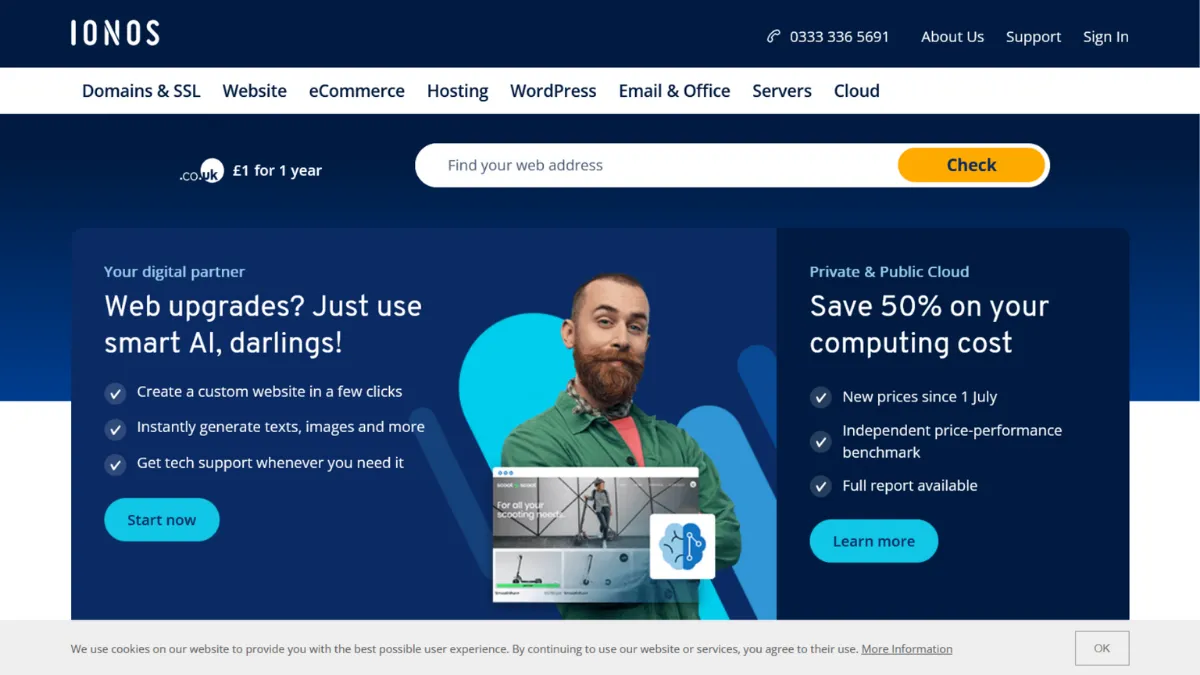
Budget web hosting has a transparency problem, and IONOS sits right at its centre. The German-European provider offers some of the most aggressively priced entry plans in the UK market, genuine enterprise-grade infrastructure, and a surprisingly capable AI-assisted site builder. Used with clear eyes on the renewal pricing, it is one of the better-value hosting platforms available to small businesses and solo founders. Used without that awareness, it produces the kind of billing shock that dominates its negative reviews. The tool earns its place in this guide, but it rewards the prepared buyer far more than the impulsive one.
IONOS operates across shared hosting, managed WordPress, VPS, dedicated servers, and its own MyWebsite site builder product. The mechanism that drives its value is infrastructure scale: as a subsidiary of United Internet AG with data centres across the UK, Germany, France, and Spain, it can offer redundancy and uptime commitments that smaller providers cannot match at comparable price points. What most buyers get wrong is treating the introductory rate as the real cost. The headline figures, often £1 per month, reflect a short promotional period. Renewal rates can be several times higher, and the gap between the two is the single most important number to check before committing. The 30-day money-back guarantee exists, but it does not replace reading the renewal figure at checkout.
Realistic expectations depend heavily on which IONOS product you are evaluating. On shared hosting, performance benchmarks consistently show strong page load times relative to price, and the 99.9% uptime guarantee holds up in third-party testing. The managed WordPress tiers deliver reliable one-click setup and automated updates. The MyWebsite builder, however, performs closer to a guided beginner tool than a flexible design platform. If you need a live site quickly with minimal customisation, it works. If you want the design control of Webflow or the template depth of Squarespace, you will hit its ceiling within the first session.
IONOS is the right choice for budget-conscious small businesses that need reliable hosting and can commit to a 12-month term after checking the renewal rate, freelancers setting up a professional web presence without complex design requirements, and developers who want managed WordPress or VPS infrastructure at a competitive price point without being locked into multi-year contracts.
The most substantive limitation is support consistency. IONOS includes a personal consultant on its plans and offers 24/7 phone and chat access, which sounds strong on paper. User feedback across independent review platforms tells a more mixed story: response quality varies, cancellation reportedly requires a phone call rather than a simple online process, and some users describe difficulty stopping charges after cancellation. This is the dimension where the gap between the marketing and the lived experience is widest.
The sections below cover how IONOS works mechanically, its key features across hosting and site builder products, who it suits, and how its pricing holds up against alternatives including Hostinger and WIX.
What Is IONOS?
IONOS is a web hosting and digital presence platform founded in 1988 under the name 1&1 Internet, later rebranded and now operating as part of United Internet AG. It serves millions of customers across Europe and North America, offering a range of products from entry-level shared hosting and a proprietary website builder through to managed WordPress, VPS, cloud, and dedicated server solutions. The problem it solves is straightforward: getting a business website or web application live without requiring server administration expertise. Where IONOS differentiates from a generic shared hosting alternative is in its combination of European data centre infrastructure, short 12-month contract terms at a time when many competitors demand 36-month commitments for competitive rates, and an in-house control panel that consolidates domains, email, and hosting in one place. The platform now includes AI-assisted tools in its site builder tiers, covering text generation, image generation, and SEO copy. What it does not do is replicate the plugin ecosystem or design flexibility of a self-hosted WordPress installation. Understanding that distinction is the key to knowing whether IONOS fits your workflow.
How IONOS Works
Setting up with IONOS begins at plan selection, and the choice between the MyWebsite builder product and traditional web hosting matters more than most first-time buyers realise. The builder product is a hosted, proprietary platform: your site lives on IONOS infrastructure, edited through a drag-and-drop interface, and you do not get access to underlying files or a standard CMS backend. Traditional web hosting gives you server space to deploy WordPress, a custom application, or any CMS you choose, managed through IONOS's proprietary control panel rather than the industry-standard cPanel.
On the hosting side, deployment works via a one-click app installer that covers WordPress, WooCommerce, and a range of other applications. WordPress installations receive automated core updates on managed tiers, and NVMe SSD storage is standard across the range, which contributes to the performance figures that distinguish IONOS from older shared hosting providers still running conventional hard drives. Domains and email accounts are managed from the same control panel, and SSL certificates are included on all plans.
The MyWebsite builder generates an initial site structure using AI based on a short prompt about your business type. From there, you edit within a block-based interface. Higher tiers unlock additional block types, the AI image and SEO text tools, and an online booking module. Payment processing for the eCommerce tiers connects to Stripe, PayPal, and other major gateways without IONOS charging a transaction fee on top.
The counterintuitive insight most buyers miss: the builder and the hosting product are not interchangeable. Switching from the builder to WordPress hosting mid-project means rebuilding your site, not migrating it. If you expect your needs to grow beyond a simple brochure or booking site, starting on a WordPress hosting plan from day one costs less in the long run than upgrading from the builder later.
IONOS Key Features
IONOS offers distinct feature sets depending on whether you are on the site builder or the hosting product. The following covers the capabilities most relevant to a founder choosing between them.
Managed WordPress Hosting. IONOS offers both standard and managed WordPress plans, with the managed tiers handling core updates, security scanning, and performance optimisation automatically. The WordPress Cockpit provides a simplified management interface above the standard WordPress admin, which reduces onboarding time for users new to the platform. One-click staging environments are available on higher tiers, letting you test changes before pushing to a live site.
AI Site Builder Tools. The MyWebsite builder includes an AI text generator, an AI SEO text generator, and an AI image generator on mid and upper tiers. The text tools produce serviceable copy from a business description input and are useful for getting a first draft live quickly. The SEO text generator targets on-page copy rather than full keyword strategy, so pair it with a dedicated tool like Semrush if ranking is a priority.
Infrastructure and Performance. NVMe SSD storage, a content delivery network, and DDoS mitigation are included across hosting plans. The georedundant data centre setup across multiple European locations means that failover is handled at the infrastructure level rather than requiring a configuration on your part. The 99.9% uptime guarantee is standard for the category, but IONOS's network architecture supports it with more physical redundancy than many lower-cost providers.
Domain and Email Bundling. All plans include a free domain for the first year and at least one email account. Higher hosting tiers increase the email account allowance, though entry-level plans cap this at a single account, which is a real constraint for small teams needing multiple addresses from day one.
Scalability Across Hosting Types. A founder can start on shared hosting and move to VPS or a dedicated server without changing providers. IONOS's control panel maintains continuity across plan types, and its dedicated server range covers GPU-focused and storage-focused configurations alongside standard compute options. This path matters less for the site builder product, which does not offer an equivalent migration route to self-managed infrastructure. That constraint is worth acknowledging before you commit to the builder tier.
IONOS Pros and Cons
IONOS performs well in several areas and has real weaknesses worth understanding before you sign up.
- Competitive introductory pricing. Entry plans are among the lowest available in the UK market. For a founder who needs a site live on a tight initial budget and understands the renewal trajectory, this represents a meaningful short-term advantage over providers with uniform pricing.
- Short contract terms. Twelve-month contracts at competitive rates are unusual in this category. Most providers offering comparable pricing require a 36-month commitment. The flexibility to reassess annually reduces lock-in risk.
- Strong infrastructure for the price. NVMe storage, CDN inclusion, and georedundant hosting across European data centres deliver performance that outpaces what the entry pricing might suggest. Independent uptime monitoring broadly supports the 99.9% guarantee.
- Personal consultant included. IONOS assigns a dedicated support contact on its plans, which is a differentiator at this price point. Most shared hosting providers at similar rates offer only ticket-based or chat support without a named contact.
- Scalable server range. The breadth of hosting types, from shared through VPS to dedicated GPU servers, means a business can grow within the IONOS ecosystem without switching providers or rebuilding its DNS and domain setup.
There are genuine trade-offs to weigh alongside those strengths.
- Renewal rate increases. The gap between introductory and renewal pricing is substantial, often two to four times the entry figure. Buyers who do not check the renewal rate at checkout face a material cost increase after the first term. This is the single most reported complaint across independent review platforms.
- Support quality is inconsistent. The personal consultant offering is real, but user feedback describes significant variation in response quality and resolution speed. Cancellation reportedly requires a phone call rather than an online process, which adds friction at a critical moment.
- Site builder has a low design ceiling. The MyWebsite builder is adequate for a straightforward business site but limited compared to dedicated site builder platforms. Users who need fine-grained layout control or a blog that goes beyond basic pages will find it constraining.
- Entry-level email limits. A single email account on lower-tier plans is a practical barrier for any business with more than one person who needs a branded address. Upgrading specifically to gain more email accounts adds cost before you gain other hosting benefits.
- No free site migration. Moving an existing site to IONOS is your responsibility. Providers at similar price points increasingly include migration assistance; IONOS does not, which adds setup time and potential complexity for anyone switching from another host.
How to Get the Most Out of IONOS
Before you sign up, open the pricing page, locate the renewal rate, and confirm it fits your budget for year two onwards. The introductory figure is irrelevant to your long-term cost planning. If the renewal rate works, IONOS offers strong value. If it does not, the short contract term at least limits your exposure.
Choose your product type carefully at the start. If you want a simple brochure site or booking page and have no plans to add a blog, custom plugins, or complex functionality, the MyWebsite builder is faster to set up and requires no technical knowledge. If you expect to grow the site, add a store, or want access to the full WordPress plugin ecosystem, start on a WordPress hosting plan. The builder cannot be migrated to WordPress hosting; you would rebuild from scratch.
On WordPress hosting, use the WordPress Cockpit to complete the initial setup and then connect Google Analytics for traffic data and a plugin such as Rank Math for on-page SEO. IONOS's managed tiers handle core updates automatically, but plugin updates still require attention. Build a monthly plugin review into your workflow to avoid security drift.
Learning how to get the most out of IONOS for a small business website means treating the hosting and the content strategy as separate workstreams. The hosting handles availability and speed; the content work requires external tools. Use the AI SEO text generator to produce a working first draft, then edit for accuracy and specificity before publishing. AI-generated copy that goes live unedited tends to read generically and underperforms on search.
If you are on a VPS or dedicated tier, IONOS's API allows programmatic DNS management and basic infrastructure automation. Connect this to your deployment workflow early rather than retrofitting it later. Measure success by uptime, page load time from your target geography, and organic search position for your core terms, not by hosting metrics alone.
Who Should Use IONOS?
IONOS suits three types of buyers well. A small business owner setting up a first professional web presence who wants a branded domain, email, and a live site without hiring a developer will find the MyWebsite builder covers the basics and launches quickly. A freelance developer or agency managing client hosting who wants reliable WordPress infrastructure at a competitive rate, with the option to scale to VPS without changing providers, gets genuine value from the hosting tiers. A founder on a constrained launch budget who needs hosting live within hours and understands the renewal pricing will find the 12-month contract structure less punitive than the multi-year lock-ins common elsewhere in the category.
IONOS is not the right choice if you need a high-design site builder with advanced layout control, where WIX or Squarespace will serve you better. It also does not suit teams that rely heavily on email collaboration from multiple addresses at entry-level budget, given the single-account limit on lower plans. If your primary need is a no-code platform with a large third-party app marketplace, the IONOS builder's more limited plugin range will frustrate you within weeks.
IONOS Pricing
IONOS does not offer a free tier or trial period. A 30-day money-back guarantee applies across its plans, which provides a limited testing window. The pricing structure on both the MyWebsite builder and the web hosting range follows the same pattern: a promotional introductory rate for the first 12-month term, followed by a standard renewal rate that is materially higher. On the builder product, the promotional entry point in the UK market is around £1 per month excluding VAT, but the standard renewal rate is substantially higher. UK buyers should also note that VAT at 20% is added to all published ex-VAT figures at checkout, so the real cost is higher than the headline number in most advertising.
On the shared hosting range, entry plans cover a single website with limited storage and one email account. Higher tiers add more storage, additional email accounts, and performance features such as CDN and enhanced server resources. WordPress hosting plans are priced in a similar band to shared hosting, with managed tiers sitting at the upper end. VPS plans start at rates competitive with the category and scale to more powerful configurations. Dedicated servers are available from a higher base price with setup fees on some configurations.
The realistic cost for a small business using IONOS long-term is the renewal rate, not the promotional figure. Always check the renewal rate displayed during checkout before committing. Compared with the alternatives below, IONOS's renewal pricing is competitive rather than standout, which is a different value proposition than the introductory marketing suggests.
IONOS vs Alternatives
Hostinger is the most direct competitor at the budget end of the market. It offers similar introductory pricing, comparable performance on shared hosting, and a broader template library in its site builder. IONOS edges ahead on infrastructure redundancy and the dedicated server range; Hostinger's support response times are more consistently rated by users. If support reliability matters more than server scalability, Hostinger warrants a closer look.
WIX competes directly with the IONOS MyWebsite builder product. WIX offers significantly more design flexibility, a large app market, and a more capable free tier for testing. IONOS wins on hosting infrastructure and pricing for businesses that need email and domain bundled from day one. For pure site-building capability, WIX is the stronger platform.
Squarespace targets a higher design standard than IONOS and prices accordingly. Its templates are more polished, its eCommerce tooling is more complete, and its pricing is more transparent with no promotional-to-renewal cliff. IONOS beats Squarespace on raw hosting flexibility and the ability to run a self-managed WordPress installation. Choose Squarespace if design quality and a predictable monthly cost matter most; choose IONOS if you want a wider server product range.
GoDaddy covers similar ground: hosting, domains, a site builder, and WordPress management in one place. GoDaddy has a larger international support operation and a more established domain marketplace. IONOS's European data centre footprint gives it an edge for UK and EU-based businesses that care about data residency. Neither is the obvious winner; your geography and the product type you need should drive the choice.
IONOS Review: Final Verdict
IONOS earns an overall score of 4.01 out of 5, a rating that reflects its genuine infrastructure quality and value at entry pricing, offset by weaker scores on support consistency and cost efficiency once renewal rates are factored in. Support scores 3.6 across our dimensions, and that reflects a real gap between the personal consultant promise and the experience many users report at cancellation or when issues escalate. Cost efficiency scores 3.7, which is honest: the introductory pricing is excellent, but the renewal structure means the long-term value is closer to average for the category.
The bottom line is this: IONOS is a capable, infrastructure-strong hosting provider that suits buyers who read the renewal pricing before signing up. Go in with that awareness, and it is one of the better-value platforms in the UK market. Go in chasing the headline rate, and you will be disappointed by year two.
How We Rated It:
More Tool Reviews





Subscribe to Stay in the loop
Get the latest AI and technology news, honest tool reviews, and practical guides delivered straight to your inbox.
Success! Check your Inbox!

Tezons Newsletter
The latest technology news, in-depth tool reviews, and practical guides - curated and delivered to your inbox.
Latest News




Have a question?
Have any questions?
Didn’t find what you were looking for? We’re just a message away.