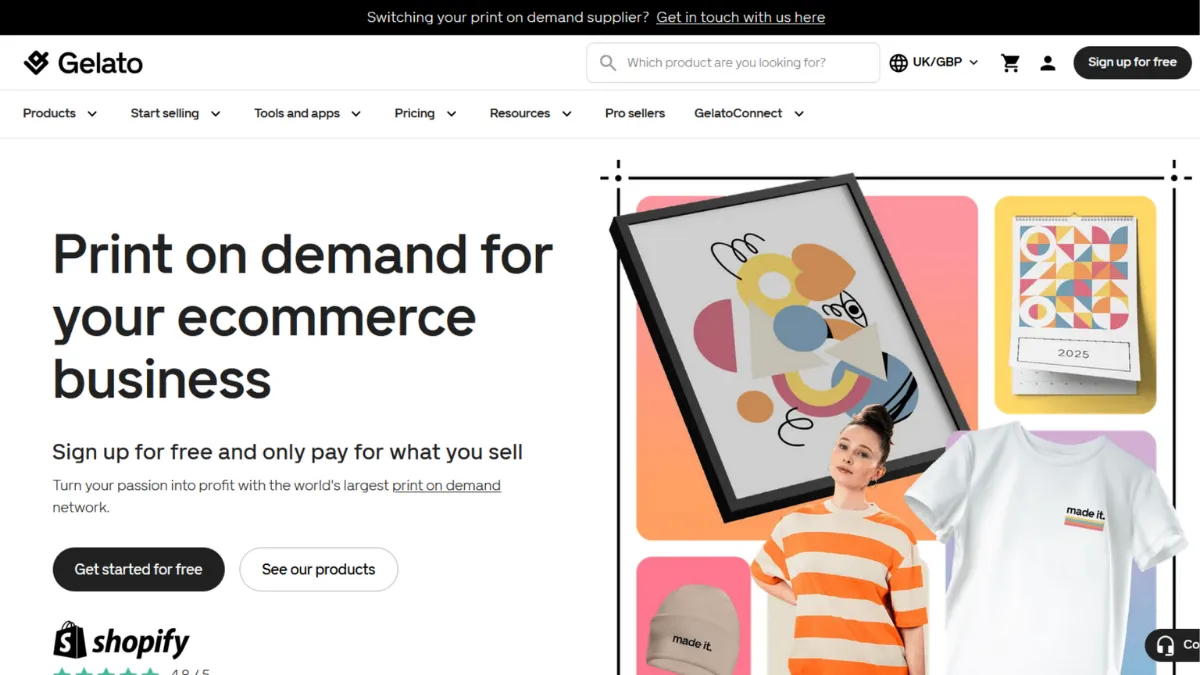
Print on demand sounds simple until your customers start complaining about two-week shipping waits on orders that crossed three borders. Gelato solves that problem at the infrastructure level: rather than routing every order through a single warehouse, it connects your store to a global network of local print partners, so a customer in Berlin gets their poster printed in Germany and a buyer in Toronto gets theirs made in Canada. That single architectural decision makes Gelato meaningfully different from most POD platforms, and it is the reason founders who sell internationally keep choosing it over alternatives that offer wider catalogues but slower delivery.
The mechanism behind Gelato is a routing algorithm that selects the nearest available production facility when an order is placed. You upload a design once, connect your store to Shopify, Etsy, WooCommerce, or another supported platform, and Gelato handles fulfilment automatically. Production lead times typically run two to three working days across most regions, and because items are printed locally, customs delays and long-haul shipping costs rarely apply. The platform's sustainability angle follows directly from this model: fewer air miles per order means a lower carbon footprint, which has become a genuine selling point with buyers who factor environmental impact into purchasing decisions. What most new sellers get wrong is treating the global network as a guarantee of identical output everywhere. Print quality varies between partner facilities, and results can differ slightly by region, so placing sample orders before you commit to a product line is not optional.
Realistic expectations matter here. Gelato's catalogue runs to several hundred product types, covering apparel, wall art, photo books, mugs, phone cases, home decor, and stationery. That is a solid range, but it is meaningfully narrower than some competitors. Wall art and flat print products are where Gelato performs best, with sharp reproduction and strong quality consistency. Apparel results are generally good but quality variance across facilities is more noticeable on garments than on flat prints. Sellers who build businesses around a focused product range, particularly posters, prints, and home decor, will find the platform exceptionally well suited to their needs. Sellers who want to offer 900-plus SKUs across every category may run into catalogue limits before they hit scale.
Gelato is the right fit for solo founders and small teams running product-focused e-commerce stores with an international customer base. Creators who sell original artwork as wall prints, photographers selling photo products, and Etsy sellers who want competitive European delivery times without managing their own fulfilment will get the most out of it. It also suits anyone who wants to validate a print product business without committing to upfront stock.
The catalogue limitation is a real constraint. With roughly 300-plus product options versus the 900-plus available on platforms like Printify, you will hit gaps if your business model depends on a wide SKU count. Apparel options in particular skew towards standard cuts, and niche formats like all-over prints are underrepresented. Some sellers also report that pricing on individual items runs slightly higher than with multi-supplier networks, a trade-off for the local fulfilment model.
The sections below cover the platform's core features, how to get results from day one, and how it compares to the main alternatives so you can make a clear decision before you invest time building a store around it.
What Is Gelato?
Gelato is a print on demand platform and global production network that lets you create and sell custom products without holding any inventory. Founded in 2007, it operates through more than 140 local print partners across 32 countries, making it one of the largest distributed print networks available to independent sellers. The problem it solves is straightforward: traditional POD services centralise production in one or two locations, which creates slow international shipping and high delivery costs. Gelato decentralises production so that orders are fulfilled as close to the end customer as possible. Unlike using a generic dropshipping supplier, Gelato integrates directly with major e-commerce platforms and handles the entire fulfilment workflow automatically, from order receipt through to dispatch. The platform is free to use at its base tier, with paid subscription plans that unlock product discounts and additional tools for sellers at scale. The question worth examining is how that production routing actually works in practice, and what determines the quality of output you can expect from the network.
How Gelato Works
When a customer places an order in your connected store, Gelato's system receives the order details and routes it to the print partner closest to the delivery address. You never select a production facility manually. The algorithm handles that decision based on geography, product availability, and partner capability. Your job is to upload print-ready design files, configure your products inside Gelato's design editor, and set your retail prices before publishing.
File quality is the biggest variable in output consistency. Gelato's design editor flags low-resolution uploads with a quality warning, which helps catch problems before an order goes to print. Working at 300 DPI at the correct dimensions for your chosen product will produce the best results. The platform supports standard image formats and provides mockup generation so you can preview products before listing them. For sellers who want to offer customer-personalised products, the Personalization Studio tool allows buyers to customise items directly in your storefront, with completed orders routed automatically to production without any manual intervention on your end.
Integration setup is typically straightforward for the major platforms. Connecting Shopify or Etsy takes minutes. Less common platforms may require more technical work or custom API integration, which is worth factoring in if your store runs on a niche e-commerce system. Once connected, order syncing and fulfilment tracking happen automatically. The counterintuitive reality that catches most new sellers is that Gelato's global network does not mean uniform quality everywhere. Because you are working with multiple independent production facilities, the print quality for the same product can vary slightly between a facility in Poland and one in Australia. Placing sample orders in your primary markets before going live is the most effective way to quality-check regional output. That practical step directly informs how you should structure your product listings and which markets to target first.
Gelato Key Features
Global Production Network. Gelato routes every order to the nearest available print facility from its network of 140-plus partners in 32 countries. This is the platform's most commercially significant capability. For sellers targeting Europe and North America, average production lead times of two to three working days are consistently achievable, and shipping costs are lower than platforms routing from a single warehouse. The practical implication is that your store can credibly compete on delivery times in markets where a centralised competitor would take a week or more.
Personalization Studio. This tool allows customers to customise products directly in your Shopify or Etsy storefront. The customisation options you configure are presented to the buyer at purchase, and completed personalised orders are sent to production automatically. No manual handling on your end. For sellers building a custom gifts or personalised merchandise business, this capability removes the operational bottleneck that would otherwise require manual file processing for every order. Note that access to Personalization Studio is tied to paid subscription tiers, so verify current access conditions on Gelato's site before building a business model around it.
Magic Mockups and Mockup Studio. Gelato provides AI-powered mockup generation tools that create product listing images without requiring external photography or design software. Magic Mockups generates lifestyle-style product images from your design files, while Mockup Studio produces clean product renders for listings and advertising. For sellers who lack photography budgets, this capability meaningfully reduces the cost and time required to produce professional-looking store listings. The quality is sufficient for most e-commerce contexts, though sellers targeting premium positioning may want to supplement with custom photography.
Price Navigator. This tool lets you preview product and shipping costs across different countries and currencies before setting your retail prices, and compare your proposed pricing against market averages. For sellers expanding into new markets, it removes the guesswork from margin planning. The ability to bulk-edit prices by product and variant, with a historical pricing log, gives you control over profitability without manual spreadsheet work. The trade-off worth knowing is that base product costs on Gelato can run slightly higher than on multi-supplier networks, so margin planning needs to account for this from the start.
Platform Integrations. Gelato connects natively to Shopify, Etsy, WooCommerce, Wix, and a small number of other e-commerce platforms. The Shopify integration is the most robust, with deep syncing and the Velocity Switch AI migration tool for sellers moving from another POD platform. Beyond e-commerce storefronts, third-party workflow integrations are limited compared to some competitors. If your business relies on connecting POD fulfilment to wider automation tools via Zapier or a similar platform, check current integration availability before committing.
Gelato Pros and Cons
Gelato's strengths are concentrated where they matter most for international sellers.
- Local fulfilment speeds up delivery. Routing production to the facility nearest your customer produces genuinely fast delivery across Europe and North America. For sellers with international audiences, this is a structural advantage over centralised POD services.
- Strong quality on flat print products. Wall art, posters, photo books, and flat prints consistently receive positive quality feedback. If your catalogue centres on these product types, Gelato is among the best available options for print reproduction quality.
- Free tier is genuinely usable. The free plan includes access to the production network, e-commerce integrations, and the design editor. You can validate a product idea and make real sales without paying a subscription fee, which is rarer than it sounds among comparable platforms.
- Sustainability positioning is commercially useful. Local production reduces per-order carbon emissions, and Gelato communicates this clearly. For brands whose customers care about environmental impact, this is a differentiator you can use in your marketing.
- Velocity Switch migration tool reduces switching friction. For sellers moving from Printify or Printful, the AI-powered migration tool maps existing product listings to Gelato's catalogue automatically. This lowers the barrier to testing the platform without rebuilding your store from scratch.
The platform has genuine limitations that affect specific seller types more than others.
- Smaller product catalogue than major alternatives. With around 300-plus products versus the 900-plus available on some competitors, you will hit catalogue gaps if your business model requires extensive SKU variety. Apparel options are particularly limited in niche formats.
- Quality variance between facilities on garments. Flat prints are consistent. Apparel results vary more noticeably between production facilities, and some sellers report that embroidery results do not always match previews. Sample orders before going live are essential for apparel products.
- Personalization Studio access requires a paid plan. Moving a feature relied on by active sellers to a paid tier caused disruption for some businesses when the change was introduced. Verify the current access structure before building a workflow that depends on it.
- Customer support response times are inconsistent. Reviews indicate that resolution speed and quality varies. Complex disputes, particularly around product quality claims, have taken multiple contacts to resolve for some sellers. This is worth factoring in if your store processes high order volumes.
- Third-party automation integrations are limited. Beyond the core e-commerce platform connections, Gelato's integration ecosystem is narrower than competitors. Sellers who rely on wider automation workflows may find the options insufficient.
How to Get the Most Out of Gelato
Before connecting your store, set up a Gelato account and order physical samples of every product you intend to sell, in every key market you plan to serve. This step is not optional. Because production is distributed across facilities, the same product can look slightly different depending on where it is manufactured. Knowing what your customers will receive before they order protects your brand and your refund rate.
For your first connected store, keep the product range focused. Launching with ten well-tested products produces better results than publishing fifty untested listings. Use Price Navigator before you set your retail prices rather than after. Understanding your actual margins across different shipping destinations before launch prevents the situation where you discover unprofitable SKUs only after you have started selling them.
Sellers who want to know how to start a print on demand business with Gelato efficiently should prioritise wall art and photo products for their initial catalogue. These categories perform most consistently across the network and are where Gelato's quality reputation is strongest. Once you have validated your pricing and margins in these categories, expanding into apparel makes sense, with the caveat that apparel sample testing is more important than for flat products.
If you are on the free plan and generating consistent monthly orders, run the maths on Gelato+ before assuming it is unnecessary. The product discounts available to paid subscribers can pay for the subscription cost within a relatively small number of monthly orders, depending on your average product cost. The break-even calculation is straightforward: divide the monthly plan cost by your average saving per order and you have the order volume at which the subscription becomes self-funding.
Track delivery times by region from the moment you launch. Gelato's key advantage is speed, and monitoring actual delivery performance in your main markets tells you whether the network is delivering on that promise for your specific product mix. If you find a market where delivery times are not competitive, that data informs whether to expand there or focus elsewhere.
Who Should Use Gelato?
Gelato works best for three specific types of seller.
The first is an independent artist or photographer who wants to sell wall art, prints, or photo products to a global audience without managing fulfilment. The combination of high flat-print quality, fast European and North American delivery, and a free entry tier makes it straightforward to test whether there is demand for your work before spending anything.
The second is an e-commerce founder building a focused product store around a clear niche: personalised gifts, branded merchandise, or a themed home decor range. If your catalogue centres on a defined set of product types rather than breadth, Gelato's quality and delivery speed are genuine competitive advantages over wider-catalogue alternatives.
The third is an existing store owner who sells internationally and finds shipping times and costs from a centralised POD service limiting growth in European markets. Gelato's local production model can materially improve delivery performance in those regions without requiring you to manage separate suppliers.
This platform is not suited to sellers who need extensive apparel variety, including all-over prints, a wide range of cuts and styles, or highly specific garment specifications. If product catalogue breadth is your primary requirement, a multi-supplier marketplace will serve you better. Sellers who run high-volume stores and need reliable, fast customer support resolution for quality disputes should also assess the support tier available at their plan level before committing.
Gelato Pricing
Gelato operates on a free base tier with paid subscription plans for sellers who want product discounts and access to premium tools. The free plan includes access to the full production network, e-commerce platform integrations, and the design editor. It is genuinely functional for low-volume sellers and for testing the platform before upgrading.
Paid plans are available at monthly or annual rates, with the entry paid tier in the range of around $24 per month and a higher tier at around $99 to $129 per month, though Gelato has adjusted pricing periodically. At the entry paid tier, product discounts and access to tools like Magic Mockups and Price Navigator are included. The higher tier adds further discounts, shipping benefits, and broader access to premium features. An enterprise or Platinum tier exists for larger operations. Always check Gelato's pricing page directly for current rates, as plan structures and prices change.
The free plan is enough if you are testing, validating a product idea, or selling fewer than around 10 to 15 orders per month. Above that volume, the product discounts available on a paid plan typically cover the subscription cost within a moderate number of orders, making the upgrade economically straightforward. Compared to alternatives, Gelato's paid tiers are priced competitively relative to the local fulfilment advantage they deliver, though Printful offers a comparably structured paid plan with a wider product range if catalogue depth is a priority.
Gelato vs Alternatives
The three platforms most commonly compared to Gelato are Printify, Printful, and AutoDS for sellers running dropshipping operations alongside print products.
Printify offers a much wider product catalogue, with 900-plus items and the ability to select from multiple print partners per product. This gives you more control over pricing and niche product availability. Choose Printify when SKU breadth matters more than delivery speed, or when you need product types Gelato does not carry. Gelato wins when international fulfilment speed and print quality consistency on flat products are your priorities.
Printful operates a more curated network with tighter quality control across its own fulfilment centres. The brand-ready positioning and consistent output make it a strong choice for sellers who prioritise quality uniformity over speed. Gelato's local production network generally produces faster delivery and lower shipping costs in Europe, while Printful's more controlled environment can produce more consistent garment results. The choice depends on whether speed or quality consistency matters more to your customers.
AutoDS operates as a broader dropshipping automation platform rather than a dedicated POD service. It handles product sourcing, listing management, and order fulfilment across many supplier types. If you are running a general dropshipping store rather than a design-led print business, AutoDS addresses a different problem. For dedicated print product businesses, Gelato's purpose-built POD workflow is more appropriate.
For sellers building content-driven traffic around their print store, pairing Gelato with an SEO tool like Semrush to identify product and niche keyword opportunities can meaningfully improve organic discovery for your listings.
Gelato Review: Final Verdict
Gelato earns an overall score of 4.24 out of 5, reflecting a platform that delivers a clear structural advantage in international print fulfilment backed by genuinely strong flat-print quality, set against a narrower product catalogue and support consistency that does not always match the quality of the core product. The 4.5 on performance reflects the local production model working as advertised for delivery speed across its primary markets. The 3.8 on integrations reflects a narrower third-party ecosystem than sellers who rely on wider automation workflows will want.
The bottom line: if you sell wall art, photo products, or a focused print catalogue to international customers and want fast delivery without managing your own fulfilment, Gelato is the strongest available option in its category. Build your catalogue around its strengths, place sample orders before you go live, and upgrade to a paid plan when your monthly order volume makes the maths obvious.
How We Rated It:
More Tool Reviews







Subscribe to Stay in the loop
Get the latest AI and technology news, honest tool reviews, and practical guides delivered straight to your inbox.
Success! Check your Inbox!

Tezons Newsletter
The latest technology news, in-depth tool reviews, and practical guides - curated and delivered to your inbox.
Latest News




Have a question?
Have any questions?
Didn’t find what you were looking for? We’re just a message away.