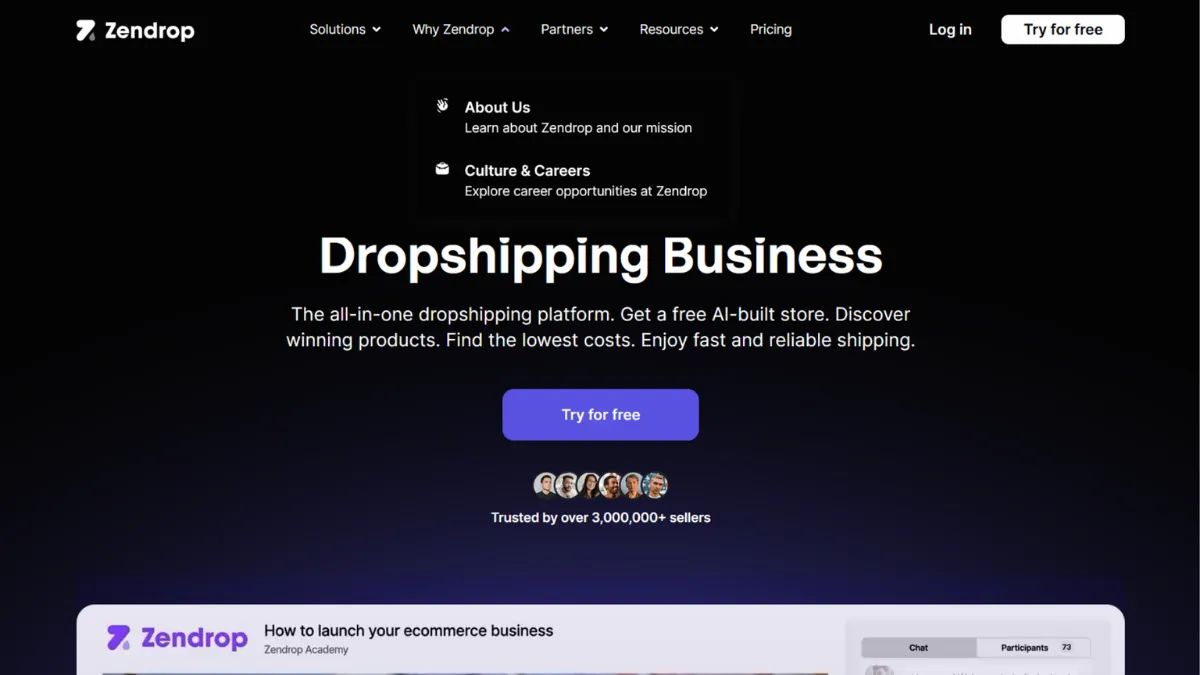
Dropshipping breaks most new sellers on logistics, not marketing. The supplier you choose at the start determines whether customers get their orders in five days or five weeks, and that difference defines your refund rate, your ad economics, and whether the business survives past its first product test. Zendrop was built to solve the supplier reliability problem specifically, offering a managed fulfilment network with US warehouse capacity, automated order processing, and branding options that most AliExpress-style platforms do not touch. For Shopify sellers who have burned money on slow overseas shipping or unreliable suppliers, it addresses the right problem in a way that generic sourcing directories cannot.
The mechanism behind Zendrop is supplier consolidation with automation layered on top. Rather than connecting you to thousands of independent sellers as AliExpress does, Zendrop works with a vetted supplier network and routes orders through its own fulfilment infrastructure. When a customer places an order in your store, Zendrop receives it automatically, picks and packs from either a US or China warehouse depending on stock location, and sends tracking information directly to your customer. The automation handles the repetitive fulfilment loop so you can focus on paid traffic and product selection. What most users get wrong is assuming the free plan is a viable starting point for a real store. Automated fulfilment, US product access, and custom branding are all locked behind paid tiers, which means the free plan functions as a product browser more than an operational tool.
Expect US orders to arrive within five to eight business days for products stocked in US warehouses. China-sourced products carry longer lead times, broadly comparable to other platforms shipping from overseas. Custom branding, including private label packaging and thank-you cards, requires meeting minimum order quantities, so sellers in early testing phases will not see those benefits until volume picks up. Product costs on Zendrop run higher than sourcing direct from AliExpress because the platform adds margin for its managed services. The calculation only works in your favour once you account for the time saved on fulfilment management and the reduction in customer complaints from faster, trackable shipping.
Zendrop suits Shopify sellers who have validated a product and need reliable, repeatable fulfilment rather than the cheapest possible unit cost. It works well for store owners building towards a branded experience, particularly those targeting US customers where five-to-eight day delivery sets a viable expectation. Sellers scaling past their first hundred orders per month will see the Pro tier pay for itself in support quality and automation efficiency.
The product catalogue, while covering over a million items, does not give you direct supplier selection. Zendrop sources through its own network, which improves consistency but removes the ability to shop competing suppliers for the lowest unit price on a specific product. Sellers who need granular supplier control or who source heavily from niche categories may find the catalogue limiting compared to open platforms.
The sections below cover how the platform works mechanically, its key features, pricing structure, and how it stacks up against the main alternatives.
What Is Zendrop?
Zendrop is a dropshipping fulfilment platform built for ecommerce sellers who want to connect their online store with a managed supplier network without handling inventory. The platform operates as a middleman between your store and its supplier base, automating the order-to-shipment process so you receive orders through your storefront while Zendrop handles everything downstream. What separates it from a generic product directory is the degree of infrastructure control: Zendrop manages its own US and China warehouse operations, which gives it more leverage over shipping consistency than platforms that simply list third-party suppliers and leave fulfilment entirely to them. The platform integrates natively with Shopify and supports connections to WooCommerce and other platforms. It has accumulated tens of thousands of verified reviews across Trustpilot and the Shopify App Store, making it one of the more established managed dropshipping options in the market. The natural question is how that infrastructure actually processes an order from click to doorstep.
How Zendrop Works
Setup begins with connecting your ecommerce store, a process that takes minutes for Shopify via the app integration. Once connected, you browse Zendrop's catalogue, edit product titles, descriptions, and pricing rules to match your store's positioning, then publish directly to your storefront. Zendrop's auto-order-syncing means that when a customer checks out, the order appears in your Zendrop dashboard automatically and moves into fulfilment without manual input. You fund orders through your Zendrop account balance, and the platform handles payment to the supplier, packing, and despatch.
Output quality depends on a few controllable variables. Choosing US-stocked products shortens delivery windows significantly. Activating automated fulfilment on a paid plan removes the manual approval step from every order. Configuring pricing rules at catalogue import rather than adjusting individual products later saves considerable time at scale. The platform also offers a product sourcing request feature, where you can submit a specific product you want to sell and Zendrop will attempt to source it from its network within a short turnaround.
The counterintuitive insight most sellers miss is that Zendrop's supplier-agnostic model cuts both ways. Because you cannot select between competing suppliers for the same product, you gain consistency but lose price negotiation leverage. A seller importing from AliExpress can compare five suppliers for the same gadget and pick the cheapest or fastest. On Zendrop, the platform sets the product cost. This matters more at higher order volumes where per-unit cost differences compound, and it is the main reason why the platform suits brand-building sellers more than pure margin optimisers. That trade-off shapes which features you should actually use, which the next section covers in detail.
Zendrop Key Features
Automated Order Fulfilment. Once enabled on a paid plan, Zendrop processes every order from your connected store without manual approval. Orders move from checkout to fulfilment automatically, and tracking numbers sync back to your store and to the customer. For sellers managing more than a few dozen orders per week, removing that daily fulfilment queue is the single highest-value feature on the platform. The practical ceiling is not the automation itself but your product cost margins, since each order is charged at Zendrop's supplier rate plus any applicable plan fees.
US and China Warehouse Fulfilment. Zendrop operates warehouses in the United States alongside its China fulfilment network. US-stocked products reach domestic customers in roughly five to eight business days, a material improvement over standard China-to-US shipping timelines. Access to US products requires a paid plan. Sellers targeting US customers with any kind of repeat purchase model should treat US warehouse access as non-negotiable, since delivery speed directly affects review scores and return rates.
Custom Branding and Private Labelling. Paid plan subscribers can add custom packaging, branded inserts, and thank-you cards to their orders. Private labelling, where the product itself carries your brand mark rather than a generic label, is available but requires minimum order quantities. Custom branding is the feature that moves Zendrop from a commodity sourcing tool into something that supports genuine brand building. Sellers who use it report stronger customer retention versus unbranded shipments, though minimum quantities mean it is not practical during early product testing.
Product Sourcing on Request. If you cannot find a specific product in the Zendrop catalogue, you can submit a sourcing request and the team will attempt to locate it from their supplier network. This covers scenarios where you have identified a winning product elsewhere, such as on Google Trends or via competitor research, but it does not yet appear in the Zendrop catalogue. Turnaround is typically fast. The limitation is that sourced products still feed through Zendrop's managed pricing, so direct price negotiation with the manufacturer is not part of the arrangement.
Zendrop Academy and Live Coaching. The Plus plan includes access to Zendrop Academy, a structured education resource covering dropshipping strategy, store setup, and scaling, alongside live weekly coaching calls. For sellers who are new to ecommerce or rebuilding after a failed first attempt, structured guidance from practitioners reduces the time spent on avoidable mistakes. The content is operationally focused rather than theoretical, which raises its practical value. The coaching access alone justifies the Plus tier upgrade for sellers who are still learning the fundamentals of paid traffic and product selection alongside platform mechanics. That said, the gap between free and paid plan functionality is the most common complaint among new users, which the next section addresses directly.
Zendrop Pros and Cons
Zendrop performs well across several practical dimensions, but the free-to-paid gap creates a real friction point worth addressing before you commit.
- Automated fulfilment removes daily manual work. Once configured, orders move from store to supplier without you touching them. At volume, this frees meaningful time to focus on advertising and product research rather than processing queues.
- US warehouse access improves customer satisfaction measurably. Domestic delivery windows of five to eight days set a realistic expectation for US customers and reduce the complaint volume that longer overseas shipping generates. Sellers switching from AliExpress-direct report noticeable drops in refund requests.
- Custom branding is available at accessible thresholds. Unlike many fulfilment platforms that reserve branding options for high-volume enterprise accounts, Zendrop makes custom packaging and thank-you cards available at its standard paid tier.
- Support quality is consistently rated above average. With 24/7 live chat and a Trustpilot rating above 4.5 from a large review base, the support function performs better than many comparable platforms, where support is slower or document-only.
- The product sourcing request feature covers catalogue gaps. Being able to submit a specific product and have Zendrop source it extends the effective catalogue well beyond what is listed, which matters when you are chasing a trending product that has not yet appeared on the platform.
The platform has real weaknesses that affect specific seller types more than others.
- The free plan has limited operational value. Automated fulfilment, US products, and custom branding are all gated behind paid tiers. The free plan works for exploring the catalogue, but running a real store on it is impractical past the first few orders.
- Product unit costs run higher than sourcing direct. Zendrop's managed model adds a cost layer compared to AliExpress direct. Sellers optimising margins on high-volume, low-price products will feel this most, and the maths may not favour the platform over cheaper alternatives at scale.
- No supplier-level selection within the platform. You cannot browse and compare competing suppliers for the same product as you can on open marketplaces. This reduces pricing flexibility and limits your ability to negotiate directly.
- Custom branding requires minimum order quantities. Early-stage sellers testing whether a product converts will not be able to use branded packaging until they hit the required volumes, which delays the brand-building benefit for new operators.
- The catalogue is narrower than open platforms. Over a million products covers most common niches, but sellers in highly specific categories may find fewer options than they would sourcing independently through AliExpress or a specialist supplier directory.
How to Get the Most Out of Zendrop
Before importing a single product, connect your Shopify store and configure your pricing rules at the catalogue level. Setting a blanket markup rule saves you from editing each product individually after import. Then filter the catalogue by US-stocked products if you are selling to US customers. That filter alone separates the shipping-competitive products from those that will generate complaints at checkout.
In your first week, use the product sourcing request feature proactively rather than waiting until you exhaust the catalogue. If you already have a product validated elsewhere, submit the sourcing request early so Zendrop can locate it while you build the rest of your store. Enable automated fulfilment on day one of your paid plan. There is no practical reason to manually approve orders once you have confirmed your supplier and pricing are correct.
Building results over time means treating Zendrop as part of a broader stack rather than a standalone solution. Connect your store analytics, whether Google Analytics or a built-in Shopify dashboard, so you can tie fulfilment performance (shipping times, refund rates) back to your advertising ROI. Sellers who track fulfilment metrics alongside ad spend make faster decisions about which products to scale and which to retire.
The mistake most Zendrop users make is staying on the Pro plan indefinitely when their store would benefit from the Plus tier's coaching and trending product access. If you are still searching for your winning product, the structured education in Zendrop Academy and the live coaching calls reduce that research time substantially. How to start a dropshipping business with a realistic path to profit is a question the coaching programme addresses directly, covering traffic strategy and product validation alongside platform mechanics.
Measure success by fulfilment rate, average delivery time, and refund rate, not just order volume. A store processing two hundred orders per month with a three percent refund rate performs better than one doing five hundred orders with a twelve percent refund rate, and Zendrop's US warehouse access is the most direct lever for pushing that refund number down.
Who Should Use Zendrop?
This is for you if you are a Shopify seller who has moved past the product research phase and needs reliable, repeatable fulfilment for a US-focused audience. You are building a brand, not just a product arbitrage operation, and you want the packaging and customer experience to reflect that. You have either experienced the pain of slow AliExpress shipping or you are entering the market knowing you want to avoid it from the start.
It also suits ecommerce operators who are managing multiple Shopify stores and want a single fulfilment platform rather than separate supplier relationships for each. The ability to run several stores under one Zendrop subscription reduces operational overhead meaningfully at that scale.
Sellers who use Canva or similar tools to build a consistent brand identity will find Zendrop's custom packaging options a natural complement, since branded unboxing is a practical extension of the visual identity work they are already doing.
Zendrop is not the right fit if you are a margin-first operator sourcing high volumes of low-cost products where every cent of unit cost matters. At that model, the platform's managed pricing will erode your margins compared to direct supplier sourcing. It also does not suit sellers who need granular supplier selection, print-on-demand as a primary product category (the POD catalogue is small), or multi-channel selling across Amazon and eBay in addition to Shopify, where a platform with broader marketplace integrations would serve better.
Zendrop Pricing
Zendrop offers a free plan that provides access to the product catalogue and basic features, but limits order fulfilment to 25 orders per month and excludes automated fulfilment, US products, and custom branding. For most active stores, this ceiling is reached quickly. The free plan is best treated as a trial environment rather than an operational base.
The Pro plan, priced at approximately $49 per month (or around $399 annually), unlocks automated fulfilment, US product access, custom branding, and unlimited orders. This is the minimum viable tier for running a store with any meaningful order volume. Annual billing reduces the effective monthly cost and is the better option once you have confirmed the platform works for your product.
The Plus plan, at approximately $79 per month (or around $549 annually), adds Zendrop Academy, live coaching calls, trending product access, AI-generated ad tools, and private product listings. The upgrade makes sense if you are still identifying your winning product or if you want the education and coaching support alongside fulfilment. Always check the current rates on Zendrop's pricing page, as promotional pricing and plan changes occur.
Compared to alternatives, Zendrop's cost sits in the mid-range. The managed fulfilment model means you pay a platform fee plus per-product margins rather than a pure platform fee on top of direct supplier costs. For sellers where fulfilment reliability and support quality translate to lower refund rates, the total cost of the platform competes well against cheaper tools that carry higher operational risk.
Zendrop vs Alternatives
The most direct comparison is with AutoDS, a dropshipping automation platform that integrates with more sales channels, including Amazon and eBay alongside Shopify. AutoDS offers more advanced AI features for product research and price monitoring, but it does not provide custom branding options and sources primarily from AliExpress and Alibaba, which carries longer shipping variability. Choose AutoDS if you sell across multiple marketplaces or need deep pricing automation. Zendrop wins on branding, US shipping speed, and support quality.
Printify competes only in the print-on-demand segment. Its POD catalogue and product customisation depth far exceed Zendrop's print-on-demand offering. If your store is primarily or entirely built on custom printed products, Printify is the more capable tool. Zendrop serves sellers who need standard dropshipping product fulfilment with occasional POD capacity, not the reverse.
Printful occupies a similar space to Printify for print-on-demand, with a strong focus on branding and product quality. For sellers whose product range is entirely custom merchandise, Printful's fulfilment quality is a better match than Zendrop. For sellers mixing standard dropshipping products with branded packaging, Zendrop covers more of the operational picture in one platform.
Spocket is a closer competitor to Zendrop, also focusing on US and EU supplier networks with faster shipping than AliExpress. Spocket tends to have higher product costs but offers supplier transparency that Zendrop does not. Zendrop's edge is automation depth, support quality, and the education resources included at the Plus tier.
Zendrop Review: Final Verdict
Zendrop scores 4.26 out of 5 overall, a result that reflects a strong operational platform with one clear gap: cost efficiency relative to margin-first dropshippers who source direct. Its highest dimension scores sit in ease of use and support, both of which reflect the platform's core value proposition: removing operational friction for sellers who want to focus on marketing and product selection rather than supplier management. The weakest score is integrations, which sits at 3.5 and reflects the platform's Shopify-primary design, with more limited native support for other sales channels and marketing tools compared to broader automation platforms.
The bottom line: Zendrop is the right tool for Shopify sellers building a branded dropshipping business with US customers at its centre. If your goal is the lowest possible unit cost or multi-channel marketplace selling, look elsewhere.
How We Rated It:
More Tool Reviews




Subscribe to Stay in the loop
Get the latest AI and technology news, honest tool reviews, and practical guides delivered straight to your inbox.
Success! Check your Inbox!

Tezons Newsletter
The latest technology news, in-depth tool reviews, and practical guides - curated and delivered to your inbox.
Latest News




Have a question?
Have any questions?
Didn’t find what you were looking for? We’re just a message away.