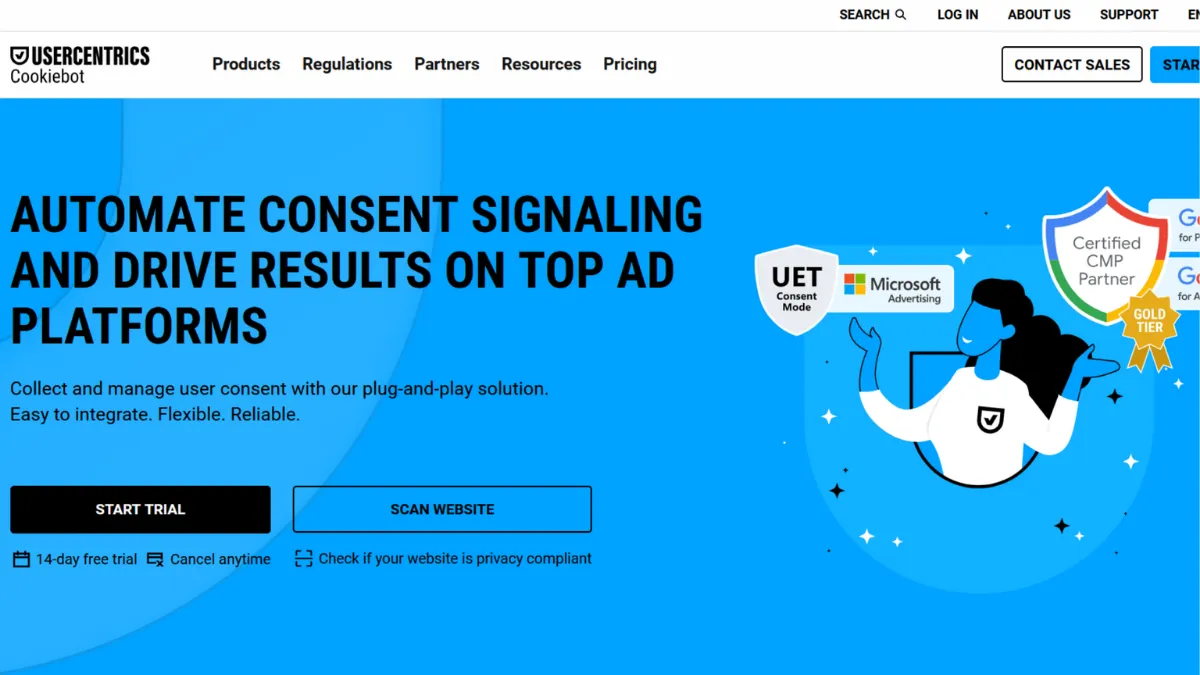
Regulatory fines for cookie consent failures have landed on businesses of every size, and the pattern is consistent: companies that treat consent management as a one-time setup rather than an ongoing system are the ones caught out. Cookiebot, now operated by Usercentrics, is a consent management platform (CMP) built around automated detection and continuous compliance. It earns its place as one of the most widely trusted tools in its category, used by over two million websites globally, but choosing it without understanding its pricing mechanics and scale limitations is a mistake that costs real money.
The platform works by embedding a script on your site that automatically crawls every page each month, identifies all cookies and trackers in use, and sorts them into four categories: necessary, preferences, statistics, and marketing. Non-essential cookies are blocked until a visitor actively consents. The consent banner then records each decision in an auditable log, stored for 12 months, ready for regulatory review. What most users get wrong is assuming the free tier will scale with their site. It covers one domain up to 50 subpages, which is enough for a minimal landing page or early-stage blog but not for any site with a product catalogue, blog archive, or geo-specific URL variants. Growth pushes you into paid tiers faster than expected, and the pricing model auto-upgrades when your page count exceeds the current tier during monthly scans.
Realistic expectations matter here. Cookiebot makes your banner appear and your consent records credible. It does not make your wider data practices compliant on its own. Compliance responsibility remains with you, the site owner. The platform handles the consent layer, the geo-targeting to serve different banner versions by jurisdiction, and the signal passing to Google Tag Manager and your analytics stack. For most small to mid-sized sites, that covers the bulk of what regulators look for. For sites running complex programmatic advertising, the IAB Transparency and Consent Framework (TCF) 2.2 support matters, and Cookiebot has Gold-tier certification from Google for Consent Mode v2.
This tool suits founders running content-heavy sites, WooCommerce or Shopify stores operating in the EU or UK, agencies managing multiple client domains, and any business that needs an auditable consent record without building one from scratch. If you already use Google Tag Manager, setup is faster because consent events flow through GTM automatically. If you operate a single small site and want the simplest possible solution at minimal cost, there are lighter-weight alternatives worth considering first.
The genuine limitation is pricing architecture. Costs scale per domain, not per account, with no bundled multi-domain discount. An agency managing ten client sites pays ten separate subscription fees. Pricing tiers also upgrade automatically when your site grows, which can produce unexpected invoice changes if you are not monitoring your subpage count. Some users have reported confusion after automatic tier jumps mid-billing cycle.
The sections below cover how the scanning mechanism works, which features matter most, how to configure it properly from day one, and how it compares to the main alternatives.
What Is Cookiebot?
Cookiebot is a cloud-based consent management platform that helps websites comply with GDPR, CCPA, LGPD, and more than 40 other privacy regulations worldwide. The problem it solves is straightforward: without a properly configured CMP, your site almost certainly drops cookies before visitors have agreed to anything, which is a legal violation under GDPR for any site targeting EU users. Generic cookie banners that say nothing more than 'this site uses cookies' do not meet the required standard; lawful consent must be informed, specific, and freely given. Cookiebot automates the scanning and blocking layer so that your site only activates non-essential trackers after valid consent is collected. Unlike a basic Termly setup or a manually maintained cookie policy, Cookiebot continuously re-scans your site, meaning new cookies added by third-party scripts get detected and categorised without you having to intervene. The platform is operated by Usercentrics, a Munich-based company that merged with the original Danish Cookiebot team, and its infrastructure sits within the EU, which satisfies the GDPR data transfer requirements that affect some competitors. How it actually executes the detection and blocking on each visitor's browser is worth understanding before you configure it.
How Cookiebot Works
When you add the Cookiebot script to your site's header, it runs before any other scripts load. This pre-consent blocking approach means that on a visitor's first arrival, no non-essential cookies fire until the visitor interacts with the banner. The scanner crawls your domain monthly from external servers, simulating a browser session across every URL it can reach and logging every cookie and tracker encountered. Results are categorised by type and added to a live cookie declaration on your site, which regulators and curious visitors can review.
The banner that visitors see is served from Cookiebot's CDN and rendered in the visitor's detected language from a library of 47-plus supported languages. Geo-targeting controls which version of the banner loads by jurisdiction: EU visitors see the explicit opt-in model required by GDPR, while California visitors see the opt-out version aligned with CCPA. This happens automatically without you managing separate banner instances for each region.
Consent signals are passed to Google Tag Manager via dataLayer events, which means your GTM tags only fire for the categories a visitor has accepted. If a user accepts statistics cookies but rejects marketing, your analytics runs and your advertising tags do not. This is the correct behaviour under GDPR and is what Google's Consent Mode v2 mandates for advertisers running campaigns targeting EU users. Cookiebot's Gold-tier certification for Consent Mode v2 means it passes the full set of required consent signals without additional configuration.
The counterintuitive detail most users miss: the monthly scan does not catch every cookie in real time. If a developer adds a new third-party script between scans, that cookie may fire without being categorised or blocked until the next crawl runs. High-velocity development teams should manually trigger re-scans after significant updates rather than waiting for the monthly cycle. This also raises a practical question: which specific features give you the tools to manage that process efficiently?
Cookiebot Key Features
Automated Cookie Scanning and Categorisation. The platform crawls your entire domain monthly and classifies every cookie and tracker it finds into the four GDPR-aligned categories. The categorisation draws on a large proprietary cookie database, so common third-party cookies from Google, Meta, and major ad networks are identified and labelled automatically. For unusual or custom cookies, you can manually assign categories from the dashboard. This removes the manual audit work that would otherwise require a developer to review network requests on every page.
Pre-Consent Blocking. Non-essential scripts are blocked at load time before a visitor takes any action. This is the technically correct implementation under GDPR; it is also the most common point where cheaper or DIY solutions fall short. Cookiebot achieves this by wrapping third-party script tags so they only activate once the relevant consent category is accepted. For sites using Google Tag Manager, consent events trigger tag firing rules automatically, which means your marketing and analytics stack responds to consent decisions without custom code.
Consent Audit Logs. Every visitor consent decision is recorded with a timestamp, IP-based geo reference, and the specific choices made. These logs are stored for 12 months and can be exported for regulatory review or legal proceedings. Under GDPR, the burden of proof lies with the data controller, meaning you must demonstrate that consent was collected correctly. A complete audit trail is the only defence that holds up in a supervisory authority review.
Geo-Targeting and Multi-Language Banners. The platform detects visitor location and serves the appropriate consent model for that jurisdiction. Over 47 languages are supported with auto-translation, and banner text can be customised per language. For businesses selling internationally, this removes the need to build separate compliance configurations for each market. The visual customisation options cover layout, colour, font alignment, and logo placement, giving you enough control to keep the banner on-brand without a developer.
Google Consent Mode v2 and IAB TCF 2.2 Support. For any site running Google Ads or relying on Google Analytics for conversion data, Consent Mode v2 integration is now required, not optional. Cookiebot's Gold certification means it passes all required signals, including ad_storage, analytics_storage, ad_personalization, and ad_user_data. For publishers running programmatic advertising, TCF 2.2 support ensures consent data is shared consistently across the ad supply chain. The absence of these integrations in a competitor tool is a material compliance gap, not a minor feature difference. That feature depth brings a trade-off in setup complexity that the pros and cons section covers directly.
Cookiebot Pros and Cons
Where Cookiebot earns its reputation:
- Automated re-scanning keeps compliance current. Monthly crawls detect newly added cookies without manual intervention. For sites that regularly update plugins, themes, or third-party scripts, this is the feature that prevents compliance drift.
- Gold-tier Google Consent Mode v2 certification. This is the highest certification level Google awards. It matters directly to any site running Google Ads campaigns in the EU, where consent signals now affect campaign measurement and bidding.
- Audit-ready consent logs. Twelve months of timestamped, exportable consent records satisfy the accountability requirements under GDPR without any additional tooling.
- Geo-targeting is genuinely automatic. The platform serves different consent models by jurisdiction without requiring separate configurations. Few competitors match this out of the box at the same price point.
- EU-based infrastructure. Data processing occurs within EU jurisdiction, which simplifies the data transfer analysis required under GDPR Chapter V. This is an overlooked advantage for legal teams assessing CMP risk.
Where Cookiebot creates friction:
- Per-domain pricing with no multi-site discount. Every domain is billed separately at its own tier. Agencies and multi-brand businesses face costs that compound quickly, and no bundled pricing is available at standard tiers.
- Automatic tier upgrades can surprise you. If a monthly scan detects more subpages than your current plan covers, your plan upgrades and your invoice increases without a warning prompt. Monitor your subpage count, particularly on sites with dynamic URL generation.
- Support is documentation-first. The ticketing system and help docs are thorough, but live chat or phone support is not available at standard tier pricing. If you encounter a configuration issue under a compliance deadline, resolution time can be frustrating.
- The free tier outgrows most real sites quickly. Fifty subpages covers a minimal site only. Any business with a blog, product range, or regional URL structure will exceed this limit, and the step up to a paid plan is a meaningful cost increase.
- Scanning gaps in high-velocity development. Monthly scans mean new cookies added between cycles can fire uncategorised. Teams deploying frequently need to manually trigger scans after each significant update, which adds process overhead.
How to Get the Most Out of Cookiebot
Before you activate the banner, audit your site's URL structure and estimate your true subpage count. Include blog pagination, filter pages, geo-variants, and any URLs generated dynamically by your CMS or e-commerce platform. Choosing a plan based on your visible navigation underestimates the total, and automatic upgrades will correct that estimate at billing time. A more accurate count upfront saves the surprise.
During initial setup, connect Cookiebot to Google Tag Manager before going live. Map your GTM tags to Cookiebot's consent categories so that your analytics and advertising tags only fire for users who have accepted the relevant category. Skipping this step means your tags fire regardless of consent decisions, which defeats the purpose of the platform and creates the exact liability you are paying to avoid.
After the first scan completes, review the categorised cookie list manually. The automated categorisation is accurate for common third-party scripts, but custom or internal cookies may be miscategorised or listed as unknown. Incorrect categorisation, particularly marking a marketing cookie as necessary, is a compliance risk that automated scanning cannot eliminate entirely.
To understand how to improve GDPR cookie consent rates, the key lever most site owners ignore is banner design. Cookiebot's default configuration satisfies legal requirements, but it does not optimise for consent. Placing the banner in a less intrusive position, simplifying the accept/reject options, and matching the banner's visual style to your site's design all affect the rate at which visitors accept analytics and marketing cookies. Higher acceptance rates mean more usable data from your analytics setup, which feeds into every downstream decision you make about content and conversion. Test banner positions and copy using Cookiebot's A/B testing feature on premium plans.
Schedule a manual re-scan after every significant plugin update, theme change, or third-party script addition. Do not wait for the monthly automatic cycle. Build this into your deployment checklist as a non-optional step. Set up consent rate monitoring in the Cookiebot dashboard and review it monthly alongside your Google Analytics performance data. A drop in acceptance rates often signals a banner change or a new cookie category that visitors are rejecting, and catching it early limits compliance exposure.
Who Should Use Cookiebot?
This tool suits three specific types of operators. The first is a founder running an e-commerce site in the EU or UK, particularly on Shopify or WooCommerce, who needs an audit-ready consent record and Google Consent Mode v2 compliance for their ad campaigns. Without proper consent signals, campaign measurement breaks in ways that are difficult to diagnose and expensive in wasted ad spend. The second is a marketing agency managing compliance across multiple client domains, where automated scanning removes the need to manually audit each site separately. The third is a content publisher relying on programmatic advertising revenue, where IAB TCF 2.2 support is not optional: ad networks require standardised consent signals and will block demand-side spend without them.
This is not the right tool if you run a single, simple static site with no paid advertising and no EU audience. A free or low-cost alternative covers your legal obligation at a fraction of the cost and setup effort. It is also a poor fit for agencies managing large numbers of client domains where per-domain billing makes the total cost significantly higher than flat-rate multi-site competitors. If your compliance needs are basic and your budget is tight, start elsewhere.
Cookiebot Pricing
Cookiebot offers a free plan for a single domain covering up to 50 subpages, which includes automated cookie detection, a basic consent banner, and monthly scans. It is functional but limited, and most real business sites exceed the subpage cap quickly. A 14-day free trial of premium features is available without a credit card, which is genuinely useful for testing the full banner customisation and geo-targeting before committing.
Paid tiers are structured by subpage count per domain, with all premium plans sharing the same feature set. Entry-level paid pricing starts at around the equivalent of 15 to 30 euros per domain per month depending on site size, with larger plans scaling up from there. The Extra Large plan, for sites above 7,000 subpages, sits at approximately 90 euros per domain per month. These figures have shifted upward in recent billing cycles, so verify current rates on Cookiebot's pricing page before committing.
The cost efficiency calculation changes dramatically depending on how many domains you manage. Single-domain operators at the small or medium tier get solid value relative to the compliance exposure they are avoiding. Multi-domain operators face compounding per-domain costs with no bundled discount, which makes alternatives with flat multi-site pricing worth a direct comparison. Compared to doing nothing and risking a regulatory fine, any paid tier is cost-effective. Compared to lighter-weight alternatives, the value depends on whether you need the advanced features that simpler tools do not offer.
Cookiebot vs Alternatives
CookieYes is the most direct competitor and consistently rated as more approachable for small, single-site operators. It offers a simpler setup experience, more accessible live support, and flat-rate pricing on higher tiers that works better for businesses managing multiple properties. Cookiebot wins on compliance depth: the Gold-tier Google Consent Mode v2 certification, IAB TCF 2.2 support, and EU infrastructure give it an edge for regulated industries and programmatic advertisers. Choose CookieYes if simplicity and support responsiveness matter more than compliance feature depth.
Termly targets small businesses and sole traders who want a bundled privacy solution covering cookie consent, privacy policy generation, and terms of service in one place. It is more affordable at entry level and faster to configure for non-technical users. Cookiebot outperforms it on automated scanning accuracy and consent signal integration with the Google ecosystem. Choose Termly if your site is simple, your audience is primarily outside the EU, and you want a single tool covering multiple compliance documents.
Usercentrics, Cookiebot's parent platform, serves enterprise clients with server-side consent management, advanced analytics, and dedicated compliance support. It is a materially different product at a materially different price point. If your site handles high traffic volumes, operates across complex tag architectures, or requires legal team involvement in CMP configuration, Usercentrics is the appropriate comparison rather than Cookiebot. For the majority of SMB operators, Cookiebot's feature set is sufficient and the cost step to Usercentrics is not justified.
CookieScript and similar budget alternatives exist at lower per-domain price points but lack the scanning depth, certification credentials, and audit log quality that make Cookiebot defensible in a regulatory review. The cost saving is real; so is the compliance gap.
Cookiebot Review: Final Verdict
Cookiebot earns an overall score of 4.21 out of 5, reflecting a strong compliance-focused platform with a meaningful weakness in cost structure for multi-domain operators. Its accuracy and reliability score of 4.6 is its standout dimension: the scanning engine, pre-consent blocking, and audit log quality are among the best in the category for the price. The cost efficiency score of 3.8 reflects the per-domain pricing model, which creates genuine value for single-site operators but becomes expensive at scale without any bundled discount.
The bottom line: if your business operates in the EU, runs Google Ads campaigns, or publishes content through programmatic ad networks, Cookiebot is a credible and well-supported choice. If you manage more than three or four domains, run the maths against flat-rate multi-site alternatives before committing.
How We Rated It:
More Tool Reviews





Subscribe to Stay in the loop
Get the latest AI and technology news, honest tool reviews, and practical guides delivered straight to your inbox.
Success! Check your Inbox!

Tezons Newsletter
The latest technology news, in-depth tool reviews, and practical guides - curated and delivered to your inbox.
Latest News




Have a question?
Have any questions?
Didn’t find what you were looking for? We’re just a message away.