How to choose AI tools for your business


The right AI tool for your business is the one that solves your highest-cost problem, not the one with the most press coverage. This guide gives you a framework for working out where to start, which categories are worth your attention, and how to build a stack in stages without ending up with six subscriptions nobody uses consistently.
Work out where your time actually goes before picking anything
Most bad AI tool decisions start in the same place: someone reads a round-up, signs up for three free trials, and picks whichever tool felt most impressive during the demo. Two months later, the tools are barely used and the underlying problem is unchanged.
Before you look at any tool, spend one week logging where your time goes. Group tasks into categories: content production, email and outreach, customer management, reporting, and internal admin. Note how long each takes and how much of it requires genuine judgement versus follows a predictable pattern. That list is your brief. Any tool you evaluate should address something on it directly.
The tasks that cost the most time and require the least creative judgement are your first candidates for AI support. For most businesses, that points to one of three areas:
- Written output - drafts, replies, briefs, social copy, anything that starts with a blank page
- Data movement - copying information between tools, updating records, filing things in the right place
- Repetitive decisions - routing support tickets, sending follow-up emails, assigning tasks based on fixed rules
Start with the category that costs you the most. Not the most exciting one, and not the one your competitors appear to be investing in.
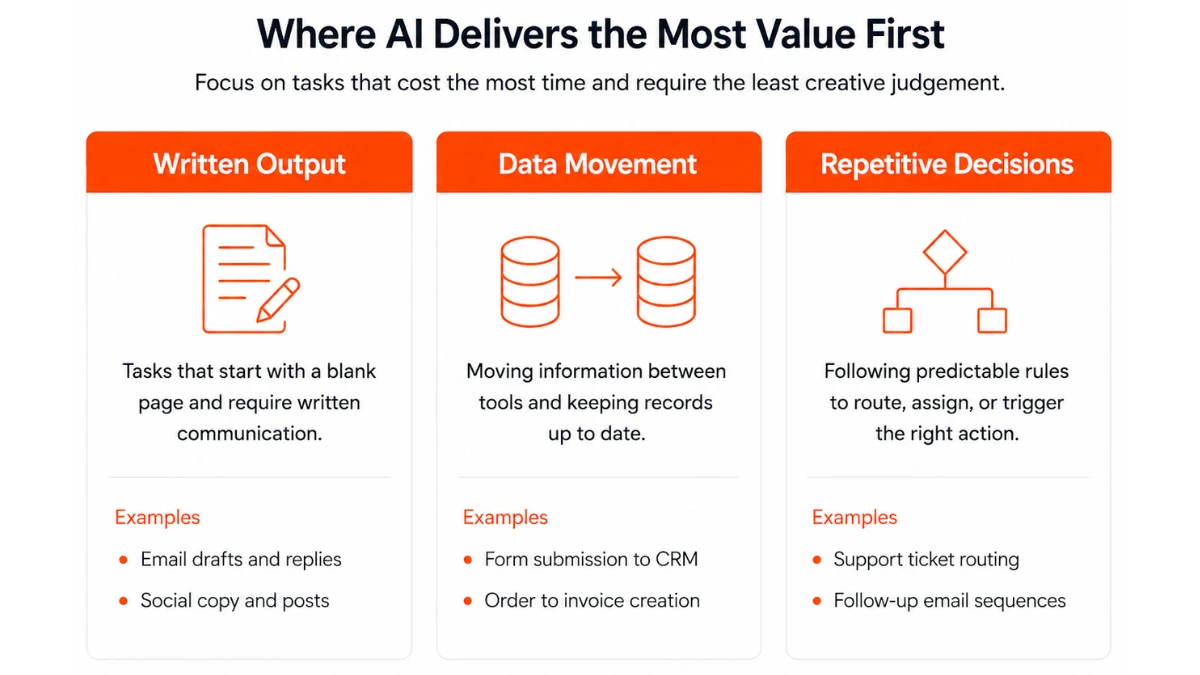
The four categories worth addressing first
Once you know your priority area, the tool landscape becomes much easier to navigate. Here is what each category covers and what to watch for.
Content and marketing
ChatGPT is the most widely used starting point for written content, and for most teams it earns its place. It drafts emails, social posts, briefs, and blog outlines at speed, and the gap between a well-prompted output and a finished piece is narrow enough that a non-writer can close it. The limitation worth knowing: it produces fluent, generic prose by default. If your content needs a specific voice or relies on verifiable facts, you need to supply both in the prompt, the tool will not fill in either on its own.
For SEO and inbound, Semrush gives you keyword tracking, site auditing, and content gap analysis in one place. It tells you what to write and whether what you have already published is working. The cheaper tiers limit the number of projects you can run simultaneously, which matters if you manage more than one site or run campaigns across multiple regions.
Sales and CRM
HubSpot's free CRM is the most practical starting point for any business that does not already have a sales pipeline tool. It tracks contacts, automates follow-up sequences, and connects to your email without requiring a paid plan. The free tier is more capable than most people realise, the limits only become restrictive once your team grows past around 5 people or your active pipeline exceeds a few hundred contacts.
The thing most CRM articles do not mention: the tool only improves your sales process if your sales process is already documented. A CRM applied to an undocumented process tracks disorder at speed. Before you connect HubSpot to anything, write down the steps your team actually follows from first contact to close.
Operations and automation
Zapier connects your existing tools so data moves between them without manual copying. A lead submits a form and appears in your CRM. A support ticket gets assigned based on keywords. An order triggers an invoice. None of these are glamorous, but together they remove a significant amount of low-value work from your team's day.
The limitation that catches people out: Zapier works best on simple, linear workflows. If your automation needs conditional branches, if the contact is in this segment do X, otherwise do Y - Make handles that logic more cleanly. Make's interface is less approachable, but for anything with more than two steps and a decision point, it gives you more control over what happens at each stage.
Analytics
Google Analytics remains the default starting point and, for most businesses, the only analytics tool you need at the early stages. It is free, connects to every major platform, and shows you where traffic comes from and what it does on your site. The common mistake is setting it up and never building a single report. Before you connect anything to GA4, write down three questions you want it to answer each month and build your dashboards around those questions only.
How to build your stack in stages
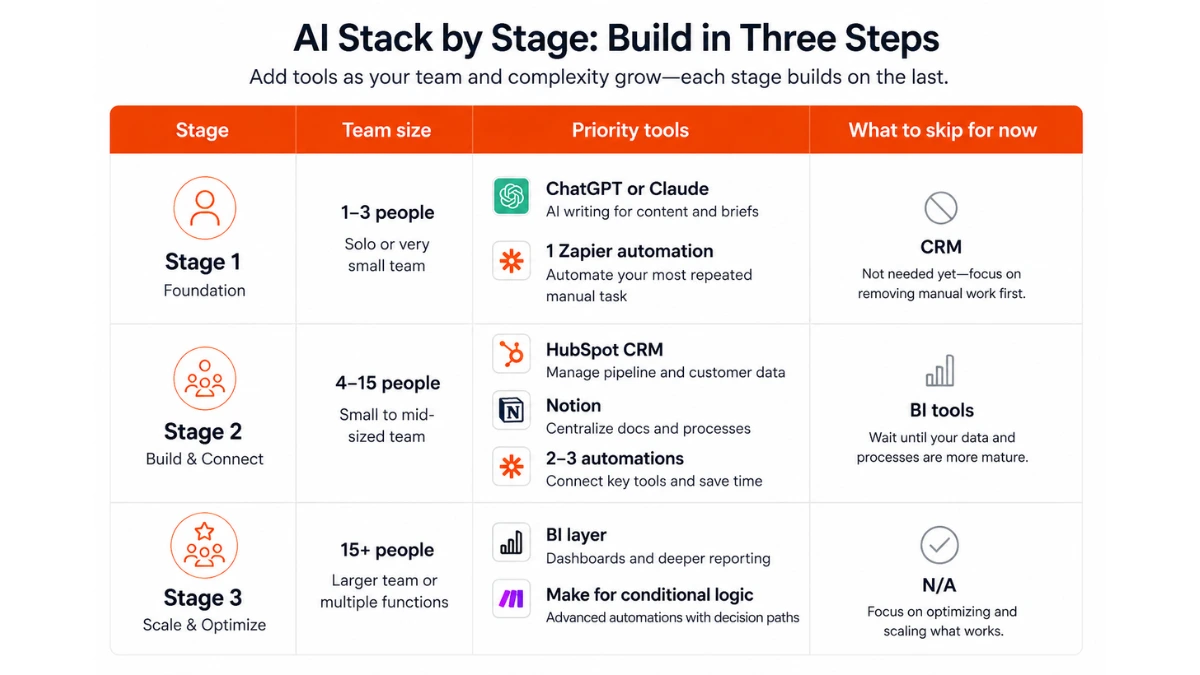
The businesses that get the most from AI tools do not implement everything at once. They build in three stages, each grounded in what the previous stage proved was working.
Stage 1 - solo or very small team (1 to 3 people)
At this size, the priority is removing administrative drag without adding complexity. Two tools cover most of the ground:
- A general-purpose AI writing tool for content, email, and briefs. ChatGPT or Claude both work here. Pick one and learn it properly before evaluating others.
- A single automation connecting your most repeated manual task. If you move data from a form to a spreadsheet every day, automate that one thing with Zapier. The first automation you set up teaches you more about where automation is useful than any amount of reading about it.
At this stage, a CRM is often premature unless you are actively managing more than 20 contacts in a pipeline. A well-maintained spreadsheet is faster to set up and easier to hand off.
Stage 2 - small team (4 to 15 people)
Once more than one person is producing work and managing relationships, the gaps that emerge are coordination and consistency. The tools that close those gaps:
- CRM: HubSpot free tier. Set it up with your documented sales process before importing any contacts.
- Project and knowledge management: Notion handles both in one place. Use it to store your processes, track projects, and centralise information your team currently holds across email threads and local folders. The limitation is that Notion's database features require meaningful setup time, the default blank workspace gives you little to work with out of the box.
- Automation: Expand from your Stage 1 automation to cover 2 or 3 more workflows. The highest-value targets at this stage are typically: new contact to CRM, support ticket routing, and weekly reporting pulled automatically from your analytics.
Stage 3 - growing team (15 or more people, or significant volume)
At this stage, the gaps are usually in visibility and hand-off. Managers spend time chasing updates that should be automatic. Data sits in different tools and no one has a single view of performance.
The additions that make the most difference here are a BI layer pulling data from your CRM, analytics, and operations tools into one view, and more sophisticated automation that handles conditional logic. This is where mapping your workflows before automating them pays off significantly. Automating a broken process at scale makes the breakage worse, not better.
Where free plans genuinely cover your needs
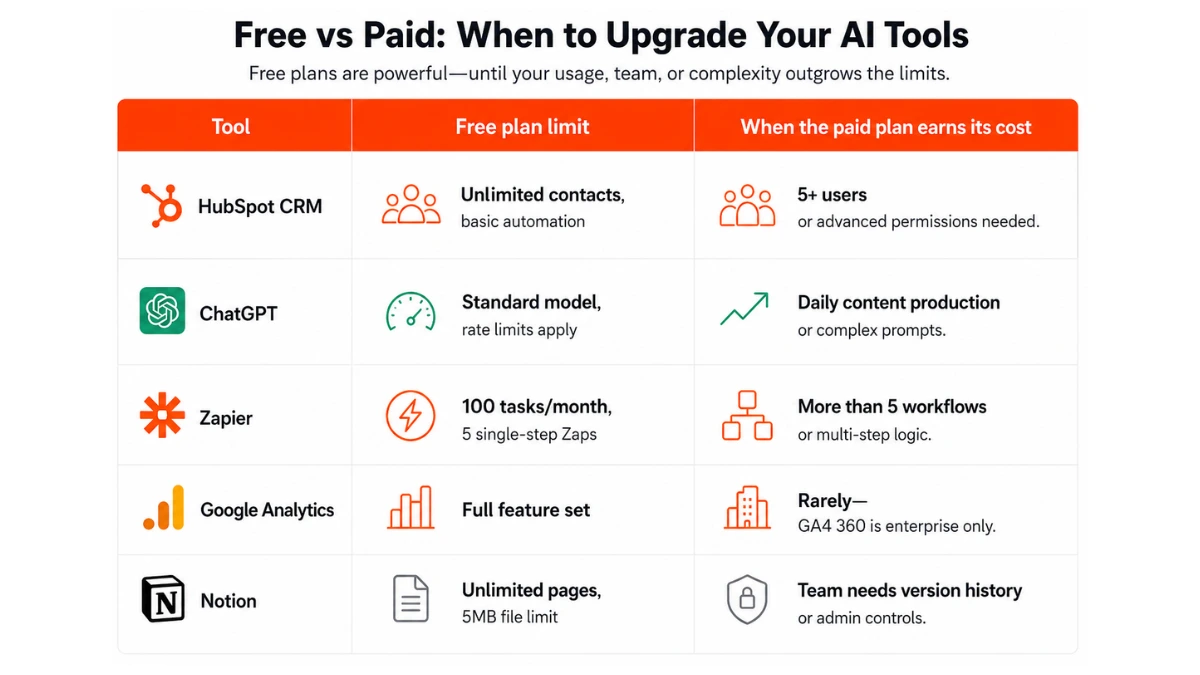
The free tier argument is stronger than most paid-plan marketing suggests. Several of the most capable tools in each category offer free plans that can run a real workflow without any cost, provided you understand where the limits sit.
- HubSpot CRM: Free plan covers contact management, deal tracking, email integration, and basic automation. Limits become meaningful at higher contact volumes and when you need multi-user permissions beyond basic access.
- ChatGPT: The free tier covers most content and drafting use cases for a small team. The paid plan earns its cost if you are producing content daily or running complex multi-step prompts.
- Zapier: Free plan covers 100 tasks per month and 5 single-step automations. Enough to confirm whether automation solves your specific problem before paying anything.
- Google Analytics: Entirely free. The GA4 360 upgrade is an enterprise product — the standard free version is sufficient for the vast majority of businesses.
- Notion: Free for individuals and small teams with unlimited pages. The paid plan adds unlimited file uploads, version history, and admin controls.
Where paid plans consistently earn their cost is in integration depth and automation volume. Upgrade when the free tier's limits are actively slowing you down, not before.
One pricing detail that often gets missed: tools that charge per user scale quickly. A tool that costs £15 per person per month is £150 per month for a team of 10. Check the pricing model before you commit, not just the entry price.
Four questions to ask before adding any new tool
Every tool you add creates a new surface to maintain, a new login to manage, and something your team needs to learn. That cost is real even when the tool is free. Before adding anything new, run through these questions:
- Does it connect to what you already use? A tool that does not integrate with your existing CRM, email, or project management system creates a parallel workflow rather than improving the one you have.
- Will the people who need to use it actually use it? The most capable tool in a category is worthless if adoption is patchy. If your team found the last tool you introduced confusing, that is a signal about how much onboarding time you need to build in.
- Can you measure whether it is working? Define a specific metric before you start. Time saved per week. Number of follow-ups sent. Response rate on email sequences. Without a baseline, you cannot tell whether the tool changed anything.
- What does the process look like without it? Document the current process before you change it. That record becomes the basis for onboarding new team members and for reverting cleanly if the tool does not work out.
Trial periods are worth treating as evaluations, not demos. Run the tool on a real task for 2 to 3 weeks, measure against your baseline, then decide. Most businesses run a free trial, decide it looks good, and move to a paid plan without ever testing whether it changed their output.
The adoption mistake that ends most AI tool rollouts
Announcing a tool to your team is not an adoption plan.
The pattern that works: one person owns the tool. They document the process it replaces and the new process it creates. They run a short session with the team, not a product walk-through, but a demonstration of the specific task the tool improves. They set a 30-day check-in to review whether adoption is holding.
That structure takes less time than dealing with a subscription nobody uses. The tools that quietly die are almost always the ones where no one was made responsible for making them work.
Team collaboration tools are the infrastructure that determines how well any AI tool spreads across your organisation. When your project management, documentation, and communication are centralised, connecting AI tools to those systems is straightforward. When each person works from their own setup, the benefits stay individual rather than becoming organisational.
Data quality determines whether your AI tools perform
AI tools that pull from or feed into your CRM, analytics, or project management systems only work well if the underlying data is accurate. Duplicate contacts in your CRM, inconsistent naming in your project tracker, untagged traffic sources in GA4 - these do not get fixed by an AI tool. They get amplified.
Before you add any AI layer to your operations, check three things: your CRM for duplicate or incomplete records, your analytics for correctly tagged traffic sources, and your automation tools to confirm data is landing in the right fields. That audit takes a few hours and prevents a category of problem that is extremely tedious to diagnose once it is embedded in your workflow.
The businesses that see the clearest return from AI tools share one characteristic: they started with clean data and documented processes, then added automation on top. Notion will not fix a team that does not know where to save things. HubSpot will not close more deals if no one has defined what a qualified lead looks like. Sort those two things before you add any further tooling.
More AI & Tech Blogs





Latest AI & Tech Blogs


Subscribe to Stay in the loop
Get the latest AI and technology news, honest tool reviews, and practical guides delivered straight to your inbox.
Success! Check your Inbox!

Tezons Newsletter
The latest technology news, in-depth tool reviews, and practical guides - curated and delivered to your inbox.
Latest News




Have a question?
Have any questions?
Didn’t find what you were looking for? We’re just a message away.