Ministers back law change for pavement delivery robots
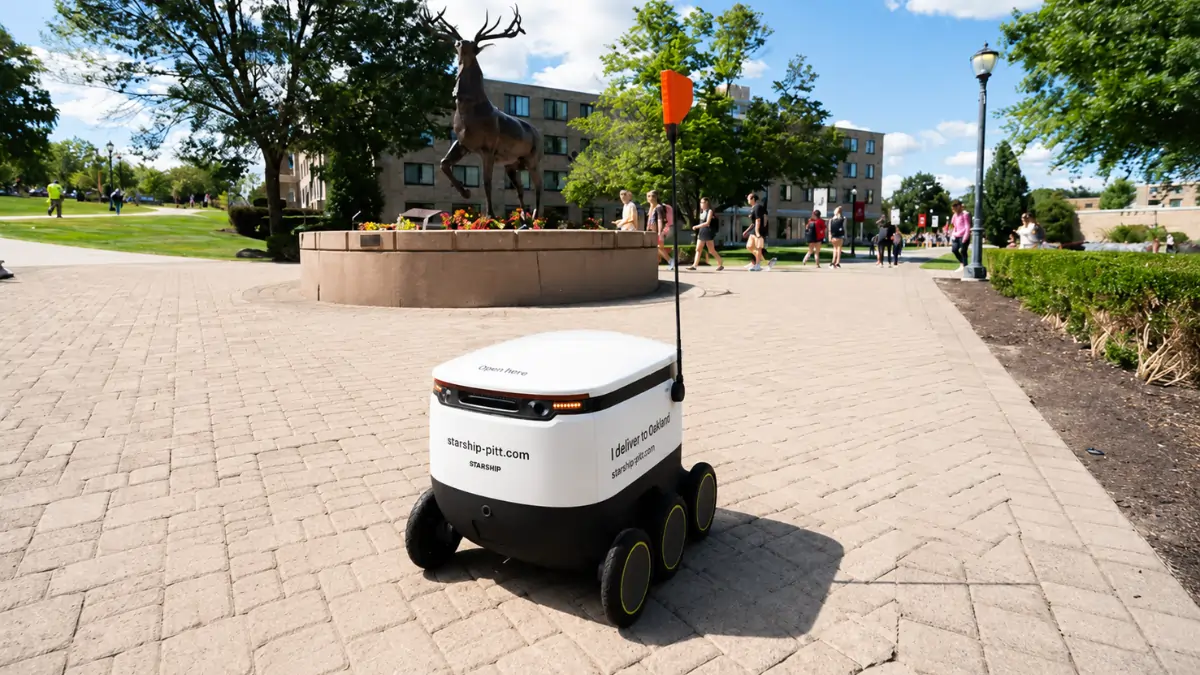

Ministers are likely to support changing the law to let autonomous delivery robots operate on pavements across England, the Department for Transport has signalled.
The move would place the low-speed machines in the same regulatory category as e-scooters and other micromobility vehicles, following a public consultation. It would resolve a legal grey area created by the 1835 Highways Act, which bans carriages from footways. Safety campaigners have criticised the plan, warning it could make crowded pavements more hazardous for older people, blind and partially sighted pedestrians, and wheelchair users.
Low-speed delivery robots already operate in a handful of English towns and cities, mostly carrying groceries and takeaway food. The Department for Transport says its priority is safety, but the regulatory basis for the existing trials remains unclear under current law. The box-shaped, six-wheeled machines are built by Starship Technologies, a company founded by two former Skype co-founders and based in San Francisco. They are already a familiar sight in several English locations:
- Cambridge
- Bristol
- Milton Keynes
- Sheffield
- Leeds
- Barnsley
Starship wants to put more than 10,000 robots onto English pavements and has offered to build a UK manufacturing site if the government clears the legal path. The company has said it already leads robot delivery across European cities and is seeking fresh funding to expand further in the UK.
Quick-commerce and grocery delivery firms have watched the sector closely, since pavement robots offer a lower-cost alternative to van or bike couriers for short local trips. A change in the law would give retailers a clearer legal basis to expand robot delivery services beyond the current pilot schemes.
Starship's robots navigate pavements using onboard cameras, GPS and obstacle-detection sensors, operating autonomously for most of a delivery but with a remote human operator able to take control if a robot cannot resolve a hazard on its own. That level of autonomy is what has drawn scrutiny from campaigners, who argue the machines cannot always distinguish between a minor obstacle and a person who needs more space or time to move.

The approach echoes how the government handled e-scooters, which ran in a similar legal grey area for several years before councils were given powers to run regulated rental trials. Ministers now appear set to fold delivery robots into the same micromobility framework rather than draft bespoke rules for the machines. For councils already hosting robot trials, a change in the law would replace an ad hoc arrangement with a clearer legal footing, though it would not by itself settle questions over where robots can operate or how many a single street can accommodate.
Local authorities that eventually ran e-scooter trials were required to register operators, set maximum speeds and specify designated parking zones. Campaigners want any robot framework to include comparable safeguards, such as caps on how many machines can operate on a single street and clear liability rules if a robot injures a pedestrian.
Living Streets warns of pavement crowding
The pedestrian safety charity Living Streets has written to the transport secretary, Heidi Alexander, calling for caution before any change to the law goes ahead. The charity says the legal status of the existing robot trials is unclear, and has launched a campaign called Pavement Overload to highlight footway congestion linked to robot deliveries.
Living Streets said delivery robots create a hazard whenever they meet a pedestrian and there is not enough room on the pavement for both to pass safely. The charity set out specific risks in its letter to the transport secretary:
- Wheelchair users may find no dropped kerb nearby to leave the footway and avoid a robot
- Blind pedestrians using guide dogs face navigation hazards the dogs are not trained to detect
- Existing obstructions such as parked vehicles and wheelie bins already restrict pavement access for disabled people
As part of its campaign, Living Streets released video footage showing robots colliding with pedestrians or forcing them to step aside to let the machines pass.
Living Streets chief executive Catherine Woodhead said it was concerning that robots already operate on pavements without clear legal authority, and argued the Department for Transport should resist calls to legalise the practice. She said pavements exist for people, and that robot operations put pedestrians with mobility issues at risk. Woodhead also pointed to Sheffield, where a Starship hub was installed at a scout hut without the council or local residents being consulted first.
Living Streets wants any new rules to include limits on robot numbers on a given street and a clearer route for residents to raise concerns before a robot hub is installed nearby. The charity is demanding that any consultation on pavement robots treat safety and accessibility as baseline requirements rather than later additions.
Living Streets argues that pavement space secured through decades of accessibility campaigning is now at risk from a new category of obstacle. The charity says robots occupy space that disabled campaigners spent years securing through kerb design, tactile paving and other accessibility standards, and that a change in the law should not undo that progress.
A Department for Transport spokesperson said the government welcomes technological innovation but wants the safety of pedestrians and vulnerable road users put first. The spokesperson confirmed the law will be updated for delivery robots once parliamentary time allows and the public consultation concludes.
More AI & Tech News




.webp)


Subscribe to Stay in the loop
Get the latest AI and technology news, honest tool reviews, and practical guides delivered straight to your inbox.
Success! Check your Inbox!

Tezons Newsletter
The latest technology news, in-depth tool reviews, and practical guides - curated and delivered to your inbox.
Latest News




Have any questions?
Didn’t find what you were looking for? We’re just a message away.