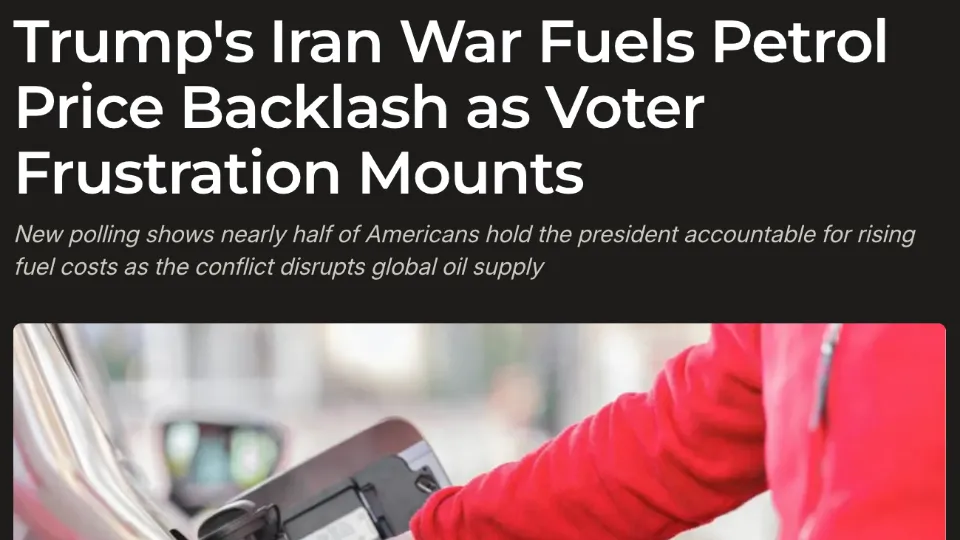
Trump's Iran War Fuels Petrol Price Backlash as Voter Frustration Mounts


- Petrol prices in the US reached $3.60 per gallon after rising more than 20 per cent since Trump ordered military action against Iran
- 48 per cent of Americans blame Trump and his administration for rising fuel costs, according to a Morning Consult poll
- The US energy department forecasts petrol prices will not return to pre-conflict levels before the end of 2027
Growing discontent over fuel prices is emerging as a significant political liability for Donald Trump, with fresh polling indicating that close to half of Americans directly attribute the recent surge at petrol stations to the president and his administration's decision to launch military operations against Iran.
A poll conducted this week by Morning Consult found that 80 per cent of US voters have observed a notable increase in petrol prices over recent weeks. Of those, 48 per cent place the blame squarely on Trump and his administration. By comparison, just 16 per cent held oil and gas companies responsible, 13 per cent pointed to market dynamics and the OPEC producer group, and 11 per cent cited the legacy of policies enacted under former president Joe Biden.
Petrol prices in the United States reached $3.60 per gallon on Thursday, according to motoring organisation AAA. The figure represents a rise of more than 20 per cent since the president ordered military action against Iran, and marks the highest level recorded across either of Trump's two terms in office.
Prices at the pump have climbed for 12 consecutive days, and analysts do not anticipate the trend reversing while crude oil markets remain unsettled. The primary driver is Iran's near-closure of the Strait of Hormuz, a critical maritime passage through which approximately a fifth of the world's oil supply flows. So long as that chokepoint remains disrupted, upward pressure on crude is expected to persist.
West Texas Intermediate, the benchmark US crude price, has risen by more than a third since the United States and Israel first struck Tehran late last month. The contract settled at $87.25 per barrel on Wednesday, a single-day gain of 4.6 per cent.
The visibility of petrol prices, displayed prominently along roadsides and motorway forecourts across the country, makes them a particularly potent economic signal for ordinary voters. "Americans fill up 50 times a year. That is 50 chances to regret their last vote," said Kevin Book, head of research at ClearView Energy Partners.
The Morning Consult poll also found that 47 per cent of Americans oppose the military campaign in Iran. Among that group, 63 per cent expressed concern about rising petrol costs.
Efforts by the administration to contain the price surge have so far yielded limited results. Proposals to provide insurance cover for oil tankers navigating the strait, or to deploy US Navy vessels as escorts, have not calmed markets. An international agreement announced on Wednesday to release record volumes of strategically held oil reserves, combined with comments from Trump suggesting a modest drawdown of American stockpiles, has similarly failed to arrest the rise.
On Wednesday, energy secretary Chris Wright confirmed that the United States would release 172 million barrels from its Strategic Petroleum Reserve as part of the coordinated international effort.
At petrol stations across the country, consumers are voicing their frustration. In Nashville's Green Hills neighbourhood, where petrol was priced at $3.40 per gallon at a Shell forecourt, shopper Alexa Reese said she was struggling to make sense of the situation. "I don't understand why we are in Iran," she said, adding that she had also noticed the impact on the cost of air travel.
A separate poll conducted by Ipsos in recent days found that approximately two thirds of Americans expect petrol prices to continue rising over the coming year, with around half anticipating that the conflict will have a negative effect on their personal finances.
Not all voters apportion blame to the White House. Jesse Brown, a retired resident in Nashville, argued that energy companies rather than politicians bore primary responsibility. "Biden didn't have control of the gas prices and neither does Trump," he said. "Price gouging used to be illegal. I am not sure what happened to that."
Trump, who travelled to Kentucky on Wednesday to promote his economic record, told supporters his administration was working to keep oil flowing and that prices would fall once the military mission was complete. "Oil prices are already coming back down," he said, "but we are not leaving until that job is finished."
The White House has characterised the current disruption as temporary. Spokeswoman Taylor Rogers stated that once military objectives are achieved and what she described as the Iranian threat is neutralised, fuel prices would fall sharply, potentially below pre-conflict levels, delivering long-term benefits to American households.
Trump has echoed that framing, describing the elevated prices as "a very small price to pay" for national and global security in a recent social media post.
However, official projections suggest the pressure on consumers may be prolonged. A forecast published this week by the US energy department indicated that petrol prices are unlikely to return to pre-conflict levels before the end of 2027.
Analysts at Capital Economics have estimated that if crude oil remains near its current level, consumer price inflation could climb to 2.9 per cent in March, up from a year-on-year rate of 2.4 per cent recorded in February.
For context, US petrol prices reached a historic peak of more than $5 per gallon in the summer of 2022, following Russia's full-scale invasion of Ukraine during Biden's presidency. They had since fallen to around $2.80 per gallon by the time Biden left office. Despite the current rise, American fuel prices remain roughly half those seen in many European countries.
Industry Impact and Market Implications
The ongoing disruption to oil supply routes through the Strait of Hormuz carries significant consequences across several sectors. For energy companies, elevated crude prices typically support revenues in upstream production divisions, though the uncertainty weighs on downstream refining margins and logistics planning. Airlines, freight operators, and consumer-facing businesses with fuel-intensive operations face increased cost pressures that are difficult to pass on quickly without risking further demand erosion.
For investors, the conflict introduces a prolonged inflationary variable into an economic environment that had been showing gradual signs of stabilisation. The Capital Economics projection of a 2.9 per cent inflation reading in March, if realised, complicates the Federal Reserve's rate path and may delay expectations of monetary easing.
The strategic petroleum reserve release, while significant in scale, has historically provided only a temporary buffer against structurally elevated crude markets. Analysts and market participants are likely to watch Middle East developments closely for any sign of diplomatic movement that could reopen the strait and relieve supply pressure.
Politically, the price environment creates a defined risk to consumer confidence, which remains a key driver of US domestic spending. With the energy department forecasting no return to pre-conflict price levels until late 2027, businesses dependent on discretionary consumer spending may need to adjust revenue expectations over the medium term.
LATEST NEWS
Satellites and AI used to track UK hedgehogs in bid to slow decline
Elon Musk keeps losing in court. He shows no sign of stopping
Paramount hires first consumer AI chief as Ellison bets on tech
MORE FROM NEWS

.webp)


RELATED






Subscribe for updates
Get the insights, tools, and strategies modern businesses actually use to grow. From breaking news to curated tools and practical marketing tactics, everything you need to move faster and smarter without the guesswork.
Success! Check your Inbox!

Tezons Newsletter
Get curated tools, key business news, and practical insights to help you grow smarter and move faster with confidence.
Latest News


Have a question?
Still have questions?
Didn’t find what you were looking for? We’re just a message away.