Millions of airline flights at risk as UK jet fuel crisis deepens
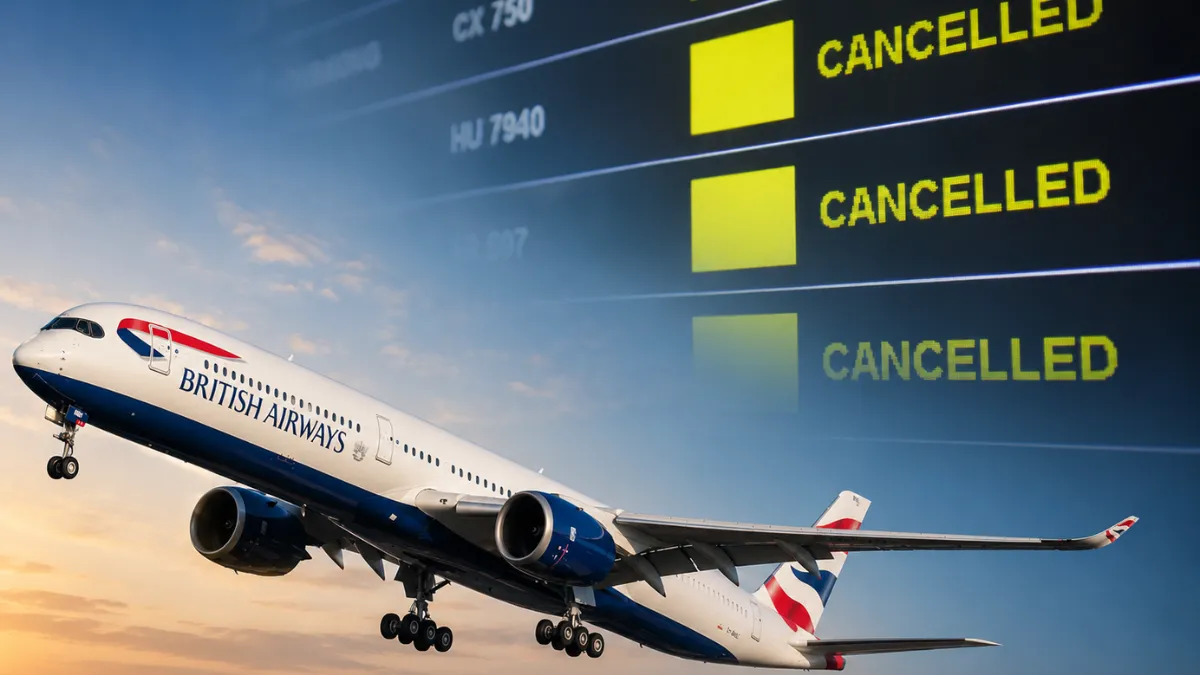

- At least 13,000 airline flights have been cancelled worldwide this month, removing around 2 million seats from global schedules as the Strait of Hormuz closure restricts jet fuel supply
- The UK is identified as particularly vulnerable, having sourced up to 50% of its jet fuel from the Persian Gulf before the conflict, with Goldman Sachs warning that British fuel inventories could fall to critically low levels
- Even if the Strait of Hormuz reopens quickly, analysts estimate it would take up to six months to restore pre-conflict fuel production levels, suggesting disruption could extend well beyond the summer season
At least 13,000 airline flights have been cancelled worldwide this month, cutting around 2 million seats from global schedules as the closure of the Strait of Hormuz continues to squeeze jet fuel supply. Britain faces particular exposure: analysts warn the country could be among the hardest hit in Europe, given its heavy reliance on Gulf imports, limited domestic refining capacity, and relatively low fuel reserves.
Which airlines have cancelled flights so far?
Germany's Lufthansa has already reduced schedules to conserve fuel. EasyJet and British Airways have both signalled that ticket prices will rise as fuel costs increase sharply. Between 10 April and 21 April, the total number of globally available seats in May fell from 132 million to 130 million, a reduction driven primarily by carriers pulling less profitable routes and cutting frequencies where supply exceeds demand.
Bryan Terry, managing director of Alton Aviation Consulting, said additional announcements from carriers that have not yet acted should be expected: "Every airline will be paring schedules, dropping the most unprofitable routes and reducing frequencies on busy routes where capacity exceeds demand." He added that airlines typically adjust schedules four to eight weeks after a supply shock, meaning decisions on June and July services will be confirmed within days.
Aviation analytics firm Cirium has warned that the longer the Iran conflict continues, the more flight cuts should be expected in June. Separately, French bank Société Générale estimates that if only half of lost fuel supply is replaced from alternative sources, fuel levels in Europe could breach critical thresholds by the end of May, raising the possibility of airport-specific shortages. Read more about warnings issued to the EU airline industry as the crisis developed. For the latest coverage of global events, visit the World section.
How vulnerable is the UK jet fuel supply?
The UK's exposure to aviation fuel shortages is higher than most European countries for several compounding reasons. Before the Iran conflict began, Britain sourced as much as 50% of its jet fuel from the Persian Gulf, a supply route now closed. At the same time, the UK is Europe's largest aviation market by capacity, meaning demand is proportionally greater than its ability to produce fuel domestically.
Middle East jet fuel shipments to Northern Europe fell by between 90% and 100% during March and April. To compensate, carriers and suppliers turned to North America, where shipments to Northern Europe rose by nearly 800% in the same period. Despite this, analysts and investment banks have warned the shift is insufficient. Goldman Sachs said in a briefing note that inventories in some countries, particularly the UK, could fall to critically low levels, increasing the likelihood of rationing. Allianz Trade, the finance and insurance group, identified the UK alongside Germany, France, and Italy as economies running persistent aviation kerosene deficits, all heavily reliant on external supply.
The Government has asked the UK's four major refineries to maximise jet fuel production. Alternative supply lines are also being developed: the Dangote refinery in Nigeria has received bumper orders, with deliveries already reaching the UK via Milford Haven. An industry spokesperson said UK airlines are not currently experiencing a shortage, and the Government emphasised that aviation fuel is typically purchased in advance, with airports keeping bunkered stock to support resilience.
Could fuel rationing happen?
One insurer has assessed the likelihood of an outright supply shortfall in Europe by the end of May as significant. Airlines and regulators have not ruled out shortages extending into June and the peak summer months. One industry source predicted that rationing would lead to ticket cost increases of approximately 10% to 15%, with less popular routes axed to protect services on high-demand corridors, though at reduced frequencies.
Will summer holidays to Spain and Portugal be affected?
Millions of British travellers fly to Europe during the summer months, with Spain and Portugal among the most popular destinations alongside Italy, France, and Turkey. The Government's stated strategy is to give airlines enough time to set realistic timetables, avoiding last-minute disruptions to booked holidays. A spokesperson said: "We continue to work with fuel suppliers, airports, airlines and international counterparts to keep flights operating."
Michael O'Leary, chief executive of Ryanair, said the carrier has secured fuel supplies through the end of June, but claimed rival airlines were searching for flights to cancel in coming weeks to contain losses. Prime Minister Sir Keir Starmer also appeared to manage expectations publicly, suggesting Britons may need to reconsider their summer travel plans if the Gulf conflict persists.
Crucially, even a swift diplomatic or military resolution to the Hormuz closure would not immediately restore normal fuel supply. Allianz Trade estimates that three months after the strait reopens, only around 70% of lost production would be recovered, rising to approximately 90% after six months. The result is that elevated prices and potential disruption could persist well beyond the summer travel period.
What the flight cancellations mean for UK travellers this summer
Britain's structural dependence on imported aviation fuel, combined with its position as Europe's largest aviation market, places it at disproportionate risk compared with countries that produce more kerosene domestically. If rationing is introduced, the consequences for travellers are likely to be uneven: high-demand routes may survive at reduced frequency, whilst less popular services face outright cancellation. Travellers with bookings to secondary European destinations face the greatest uncertainty. Booking flexibility and travel insurance now carry more practical value than they have for years.
LATEST NEWS
Satellites and AI used to track UK hedgehogs in bid to slow decline
Elon Musk keeps losing in court. He shows no sign of stopping
Paramount hires first consumer AI chief as Ellison bets on tech
MORE FROM NEWS

.webp)


RELATED




Subscribe for updates
Get the insights, tools, and strategies modern businesses actually use to grow. From breaking news to curated tools and practical marketing tactics, everything you need to move faster and smarter without the guesswork.
Success! Check your Inbox!

Tezons Newsletter
Get curated tools, key business news, and practical insights to help you grow smarter and move faster with confidence.
Latest News




Have a question?
Still have questions?
Didn’t find what you were looking for? We’re just a message away.