Warehouse Automation Surges as Logistics Giants Deploy Thousands of Robots
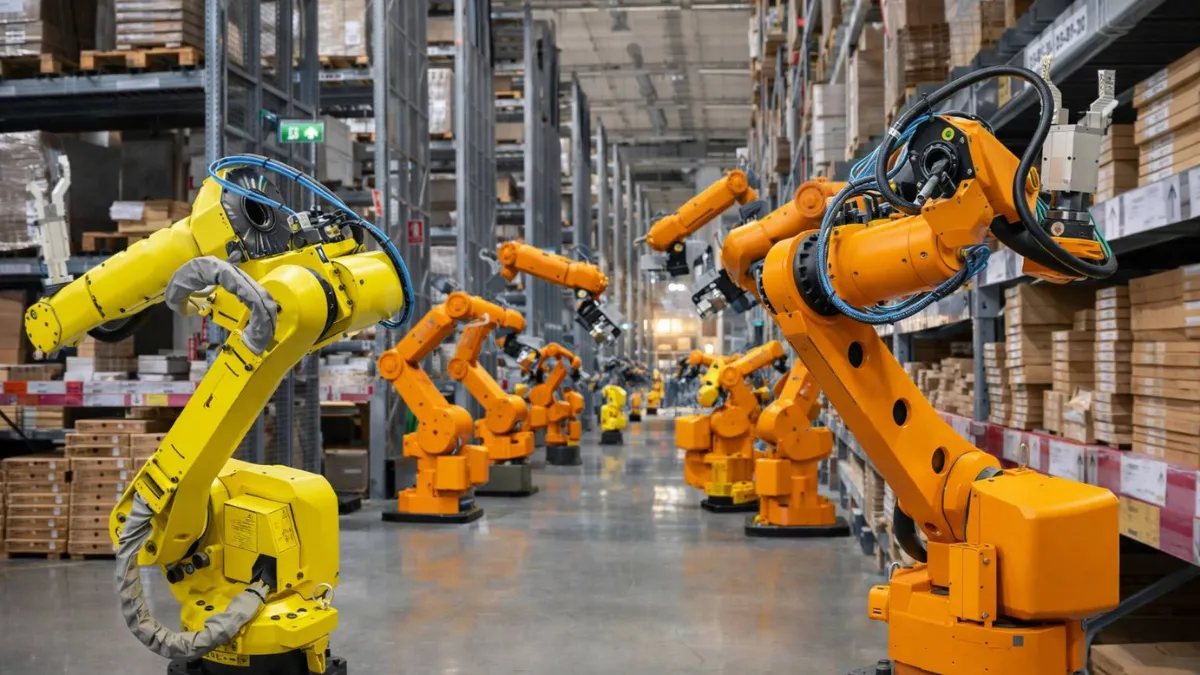

Global logistics companies are rapidly expanding their use of autonomous robots and artificial intelligence across distribution centres, fundamentally reshaping how goods move through supply chains.
DHL Group has scaled its automation programme from 240 projects in 2020 to more than 10,000 today, with robotic systems now operating in 95% of its warehouses worldwide. The technology has delivered measurable gains: autonomous container-unloading units process up to 650 cases hourly, whilst item-picking robots have lifted productivity by 30% at certain facilities.
Tim Tetzlaff, who leads digital transformation at DHL globally, explained that the shift addresses twin pressures of labour scarcity and space constraints in key distribution locations. Workers previously walked distances equivalent to a half marathon daily whilst sorting and moving inventory, tasks now significantly reduced by mobile robotics.
The automation wave extends across the sector. United Parcel Service operates 127 automated buildings following deployment in 57 additional sites during the final quarter of last year, with 24 more planned for this year. The company expects 68% of its American volume to flow through automated facilities by year end, up from 66.5% currently, according to chief executive Carol Tomé.
FedEx has pursued similar investment through its Network 2.0 strategy, installing robotic arms at its Memphis hub and partnering with robotics firm Dexterity for container loading. The company projects the global warehouse automation market will surpass $51 billion by 2030. Chief executive Raj Subramaniam reported that roughly 24% of eligible daily volume now passes through 355 optimised facilities.
The technological transition has coincided with workforce reductions at some carriers. UPS has cut more than 75,000 positions over the past year whilst closing 93 buildings in 2025, with at least 24 more closures planned for the first half of this year. The company attributes the changes to a shift away from labour-intensive legacy sites toward consolidated automated centres, according to executive vice president Nando Cesarone.
A UPS spokesperson stated that automation focuses on repetitive tasks, allowing the company to redeploy human workers to roles requiring greater skill. FedEx has not disclosed specific job reduction figures, though Subramaniam confirmed Network 2.0 has generated structural cost savings.
Labour representatives are monitoring the balance between technological advancement and worker welfare. The Teamsters union, which represents employees at major logistics firms, emphasised that automation must support rather than undermine the workforce. Spokesperson Lena Melentijevic said workers remain the backbone of company success and the union will advocate for their interests as technology evolves.
DHL maintains that its automation complements rather than replaces human labour. Despite deploying 8,000 collaborative robots globally, the company hired 40,000 people during the same period, according to Tetzlaff. The firm views robotics as providing flexible capacity to handle demand fluctuations, having expanded its robotic fleet by 30% during the recent holiday season.
Item picking represents DHL's largest robotic deployment, with over 2,500 units using trained mechanical arms to select products for packaging. Tetzlaff noted that complex dexterous tasks remain firmly in human hands, with robots handling scalable repetitive work whilst employees manage tasks requiring judgement and adaptability.
Industry experts suggest fully autonomous warehouses remain distant. Benjamin Reich, who leads logistics and fulfilment at Accenture, observed that clients continue prioritising human workers whilst redirecting hiring toward technical roles to manage increasingly automated operations. The transformation reflects a shift in required skill sets rather than wholesale job elimination.
Ronny Horvath, transportation and logistics lead at Accenture, identified broader workforce challenges including shortages of personnel with both manual and organisational capabilities. Competition for warehouse staff based on compensation, benefits and working conditions has intensified, making automation a tool to address gaps rather than simply reduce headcount.
Research from Accenture indicates 51% of factories worldwide anticipate fully automated warehouses by 2040, whilst 70% of logistics executives rank autonomous supply chains as a top investment priority. Horvath noted most companies are building automation infrastructure from the ground up, a process requiring substantial time before benefits fully materialise.
The industry consensus suggests automation delivers its greatest value through enhanced efficiency and supply chain optimisation rather than labour replacement. Companies report improved ability to meet demand surges, streamline processes and maintain service levels as warehousing requirements grow increasingly complex.
Industry Impact and Market Implications
The accelerated deployment of warehouse automation signals a structural shift in the logistics sector that will reshape competitive dynamics and cost structures over the coming decade.
For established carriers, automation represents both a defensive necessity and an offensive capability. Companies unable to match the efficiency gains achieved through robotics risk losing market share to competitors who can offer faster turnaround times and lower per-unit costs. The technology creates a capital intensity barrier that may consolidate the industry, favouring larger operators with resources to invest in sophisticated systems whilst smaller regional players face pressure to specialise or merge.
The automation surge also redefines the competitive relationship between logistics firms and major retailers operating their own fulfilment networks. As companies like Amazon continue expanding proprietary warehouse infrastructure, traditional carriers must demonstrate comparable technological sophistication to retain business. The $51 billion market projection through 2030 suggests significant vendor opportunities for robotics manufacturers, software developers and systems integrators.
From a labour perspective, the transition creates winners and losers within the workforce. Demand for technicians, data analysts and automation specialists will rise, potentially commanding premium wages, whilst opportunities for workers in conventional sorting and picking roles contract. This shift has implications for regional economies heavily dependent on warehouse employment, particularly in distribution hubs where facilities are consolidating.
The investment cycle also carries risks. Companies committing billions to automation infrastructure face execution challenges around integration, maintenance costs and technological obsolescence. The timeline to full autonomy remains uncertain, and interim periods may see firms operating hybrid systems that prove more complex and costly than either fully manual or fully automated approaches.
Market observers should monitor capacity utilisation rates at automated facilities, return on investment timelines, and whether efficiency gains translate to pricing power or simply get competed away through industry overcapacity. The balance between job creation in technical roles and elimination in manual positions will influence both regulatory scrutiny and public perception of the sector's evolution.
More AI & Tech News




.webp)


Subscribe to Stay in the loop
Get the latest AI and technology news, honest tool reviews, and practical guides delivered straight to your inbox.
Success! Check your Inbox!

Tezons Newsletter
The latest technology news, in-depth tool reviews, and practical guides - curated and delivered to your inbox.
Latest News




Have any questions?
Didn’t find what you were looking for? We’re just a message away.