Anthropic Commits to Ad-Free AI Chatbot as Industry Debates Monetisation Strategies
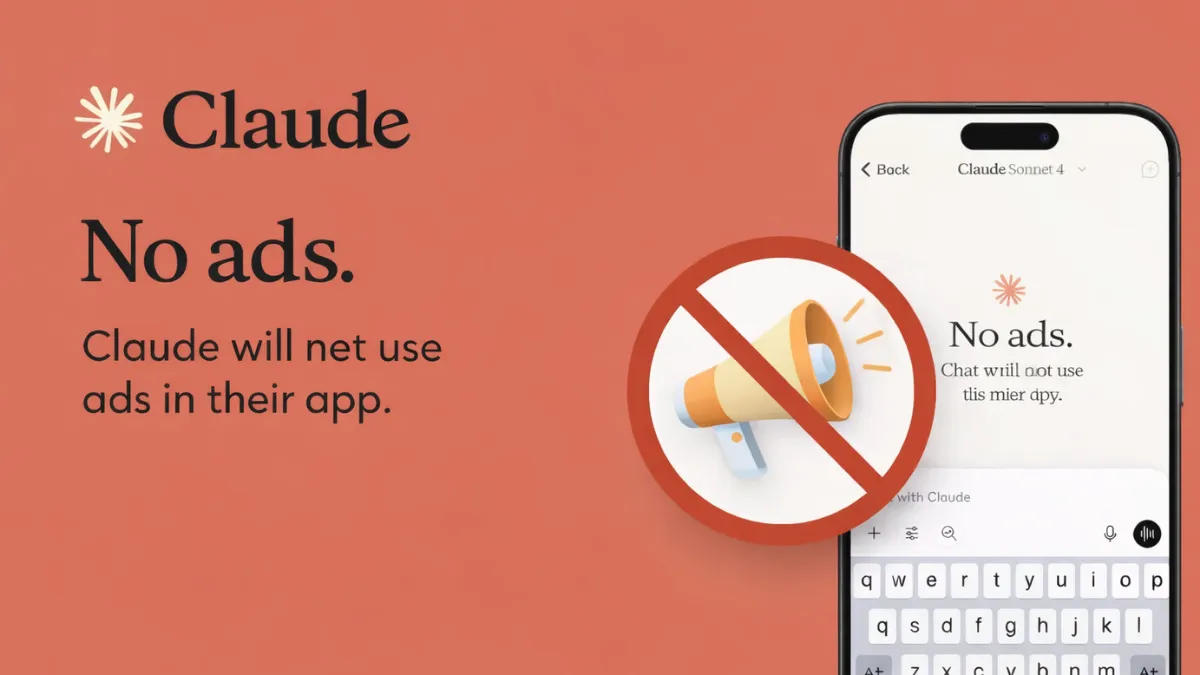

Anthropic has confirmed it will not introduce advertisements to its Claude artificial intelligence platform, distancing itself from monetisation approaches being adopted elsewhere in the sector.
The San Francisco-based company disclosed its position in a statement released on Wednesday, emphasising that conversations with Claude would remain free from commercial messaging, sponsored content, and third-party promotional material. The firm stated that advertising would feel out of place given the personal nature of interactions users have with the chatbot.
Founded in 2021 by a group of researchers who previously worked at a competing AI laboratory, Anthropic has built its business around the Claude model family and related tools. The company's coding assistant, Claude Code, has seen significant uptake among developers in recent months.
Anthropic's revenue model centres on enterprise agreements and individual paid memberships. Funds generated through these channels are directed back into platform development and capability improvements, according to the company's public statement. Leadership acknowledged that alternative approaches to monetisation exist across the industry and that other organisations may legitimately pursue different strategies.
The announcement arrives shortly after a major rival in the generative AI space revealed plans to trial advertising within its own chatbot service. That company indicated it would begin showing clearly marked promotional content to certain user groups in the United States, with ads positioned beneath chatbot responses and designed not to affect the quality or nature of answers provided.
The decision to test advertising comes as the same organisation has committed substantial capital to infrastructure expansion, with agreements valued in excess of $1.4 trillion announced during 2025. Advertising revenue has historically supported the financial operations of several leading technology platforms, particularly those operating search engines and social networks.
Anthropic has chosen to make its ad-free positioning a central element of its public messaging. The company launched its first major broadcast marketing effort on Wednesday, scheduled to run during one of the most-watched sporting events in the United States. The campaign includes both pre-event and in-game slots totalling 90 seconds of airtime, with creative content highlighting the absence of advertising within Claude.
By declining to pursue ad-supported revenue, Anthropic forgoes a stream of income that has proven lucrative for other technology companies. The firm has nonetheless made clear it views this as a deliberate strategic choice rather than a temporary position.
The divergence in approach underscores broader questions facing the AI industry about how to sustainably fund the development and operation of large language models. Training and running these systems requires significant computational resources, leading companies to explore various combinations of subscription fees, enterprise licensing, usage-based pricing, and now advertising.
Consumer expectations around AI assistants remain in flux, with users demonstrating varied tolerance for commercial content depending on context and platform. How these preferences evolve may influence monetisation decisions across the sector in the months ahead.
Industry impact and market implications
The contrasting monetisation strategies emerging among leading AI companies signal an industry still establishing sustainable economic models. Anthropic's rejection of advertising reflects a bet that users will value an uninterrupted, commercially neutral experience enough to support premium pricing structures. This approach mirrors positioning historically seen in productivity software and professional tools, where subscriptions fund ongoing development without reliance on third-party revenue.
The alternative path, integrating advertisements into free or low-cost AI services, follows patterns established by consumer internet platforms over the past two decades. If executed carefully, advertising could subsidise broader access to AI capabilities whilst generating returns that support infrastructure investment at scale. However, the approach carries risks. Users accustomed to ad-free interactions with AI assistants may resist commercial messaging, particularly if they perceive it as compromising response quality or introducing bias.
For enterprise customers, the presence or absence of advertising may factor into procurement decisions, especially in regulated industries where data sensitivity and content neutrality matter. Organisations deploying AI tools for internal workflows, customer service, or decision support may favour platforms with transparent, non-advertising business models to reduce concerns about external influence on outputs.
From a competitive perspective, differentiation on advertising policy could segment the market. Companies targeting premium users, developers, and enterprises may find advantage in ad-free positioning, whilst those prioritising user base growth and accessibility might accept advertising as a trade-off. The financial viability of each approach will ultimately depend on cost structures, user retention, and willingness to pay across different segments.
The infrastructure commitments referenced in the original reporting context suggest capital intensity remains a defining characteristic of the AI sector. Whether subscription revenue alone can support the scale of investment required, or whether advertising becomes a necessary component for certain business models, remains an open question that the industry will likely answer through experimentation over the coming years.
More AI & Tech News



.webp)


Subscribe to Stay in the loop
Get the latest AI and technology news, honest tool reviews, and practical guides delivered straight to your inbox.
Success! Check your Inbox!

Tezons Newsletter
The latest technology news, in-depth tool reviews, and practical guides - curated and delivered to your inbox.
Latest News


Have any questions?
Didn’t find what you were looking for? We’re just a message away.